Key takeaways
- Blade length: Match the manufacturer’s stated length exactly; even a small difference can prevent proper tensioning or overload the adjustment range.
- Width: A wider blade generally tracks more steadily during tall resaw cuts, while a narrower blade is easier to steer around curves.
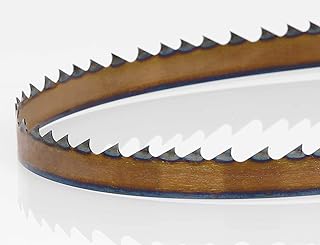
- Tooth pitch: Coarse teeth, commonly 2–4 TPI, clear sawdust efficiently from thick stock. Finer teeth suit thinner boards and cleaner contour work.
- Tooth design: Hook-tooth profiles can feed hardwood effectively, while hardened or carbide teeth are useful when long life and consistent cutting matter.
- Material and setup: Carbon steel is economical for routine work; carbide costs more but can stay sharp longer. Correct tension, alignment, and a clean fence remain essential.
What's inside
Resawing looks simple until a blade wanders, burns the timber, or turns an expensive board into uneven veneers. The right blade depends on more than length: tooth pitch, kerf, steel type, tension, and your saw’s actual capacity all affect whether a cut feels controlled or frustrating.
This guide compares practical options for home workshops and furniture projects, from compact 10-inch saw blades to long carbide-tipped blades for larger machines. We focus on tooth geometry, likely use cases, and the details worth checking before you click through to Amazon. Always confirm your saw’s required blade length and maximum blade width first.
As an Amazon Associate we earn from qualifying purchases.



How to Choose a Band Saw Blade For Resawing (2026)
- Blade length: Match the manufacturer’s stated length exactly; even a small difference can prevent proper tensioning or overload the adjustment range.
- Width: A wider blade generally tracks more steadily during tall resaw cuts, while a narrower blade is easier to steer around curves.
- Tooth pitch: Coarse teeth, commonly 2–4 TPI, clear sawdust efficiently from thick stock. Finer teeth suit thinner boards and cleaner contour work.
- Tooth design: Hook-tooth profiles can feed hardwood effectively, while hardened or carbide teeth are useful when long life and consistent cutting matter.
- Material and setup: Carbon steel is economical for routine work; carbide costs more but can stay sharp longer. Correct tension, alignment, and a clean fence remain essential.
The Best Band Saw Blade For Resawing (2026)s Reviewed
AYAO 70-1/2-Inch 4 TPI Blade
The AYAO 70-1/2-inch blade is a sensible fit for compatible Craftsman and Rikon 10-inch saws, including the listed 921400, 10-305, and 10-3061 models. Its 1/2-inch width and 4 TPI hardened teeth create a useful balance for small-shop resawing, especially when you want a dedicated blade rather than constantly changing one blade between tasks.
Timber Wolf 93-1/2-Inch 3/4-Inch Resaw Blade
The Timber Wolf 3423VPC uses silicone steel and a low-tension design, making it an appealing choice for compatible 14-inch saws that do not respond well to excessive tension. Its 3/4-inch width supports straighter tall cuts, so it is worth considering for furniture parts, book-matched panels, and repeated stock preparation.
Dark Stone 111-Inch Carbide-Tipped Blade
Dark Stone’s 111-inch DS23427 pairs a 3/4-inch width with 2 TPI hook teeth and carbide tips. That coarse, durable configuration is aimed at substantial hardwood resawing, where efficient chip clearance and long tooth life are more important than making a particularly fine-edged cut.
Dark Stone 131-1/2-Inch Carbide-Tipped Blade
The DS23406 extends the same general concept to saws requiring a 131-1/2-inch blade. Its 3/4-inch width, 2 TPI spacing, 0.032-inch gauge, and carbide-tipped hook teeth make it a strong candidate for larger machines and demanding hardwood work, provided the blade length and wheel capacity match your saw precisely.
93-1/2-Inch SK5 Carbon Steel Blade Assortment
This four-pack is the most flexible choice for a workshop that handles more than resawing. It includes two 1/2-inch 6 TPI blades, a 1/4-inch 6 TPI blade, and a 1/8-inch 14 TPI blade, giving you options for moderate resawing, curves, and finer cuts on compatible 14-inch band saws.
Frequently Asked Questions
What TPI is best for resawing?
A coarse blade in the 2–4 TPI range is usually the practical starting point for thick wood. The larger gullets carry sawdust out of the kerf and reduce clogging, while a 6 TPI blade can be preferable for thinner boards or a cleaner finish.
Is a wider blade better for resawing?
Usually, yes. A wider blade resists twisting and can track more confidently through tall stock. However, it must be supported by your saw’s guides and tension system; fitting the widest possible blade is not automatically the best choice.
Are carbide-tipped blades worth the extra cost?
They can be, particularly for frequent hardwood resawing or production-style work. Carbide teeth generally offer longer service life, but they are less forgiving of impacts, dirty timber, and poor setup. Occasional users may find carbon steel a better value.
Why does my resaw cut drift?
Drift can come from a dull or unsuitable blade, incorrect tension, misaligned guides, a fence that is not set to the blade’s natural tracking direction, or feeding the wood too aggressively. Check setup before blaming the blade alone.
Final Thoughts
For compact compatible saws, the AYAO 70-1/2-inch blade is a practical starting point. The Timber Wolf is a compelling low-tension option for many 14-inch machines, while the Dark Stone 111-inch and 131-1/2-inch carbide blades deserve attention for serious hardwood resawing. Choose by exact machine compatibility first, then prioritize width, tooth pitch, and the amount of cutting you expect to do.