Key takeaways
- Height: Measure from the floor to the underside of your counter, then allow roughly 9 to 12 inches between the seat and countertop for comfortable legroom. Counter-height stools usually suit 34- to 36-inch surfaces.
- Footprint: Check the full width and depth, not just the visual profile. In a narrow kitchen, armless stools or models that tuck fully beneath the island preserve walking clearance.
- Mobility: Swivel seats make getting in and out easier without pulling the stool across the floor. Adjustable designs are useful when one seating area serves several people or surfaces.
- Support: A shaped backrest, footrest, and modest cushioning can make everyday meals more comfortable. For occasional seating, a simpler frame may be easier to move and store.
- Materials: Choose upholstery that suits your cleaning habits. Faux leather wipes down quickly, while linen-look fabric adds softness but benefits from prompt attention to spills and crumbs.
What's inside
Choosing bar stools for a compact kitchen or apartment dining area is rarely as simple as picking a finish you like. The wrong seat can crowd a walkway, clash with an island’s proportions, or leave too little room to sit comfortably. Height, footprint, back support, and ease of cleaning all matter more when every inch has to work.
This guide compares practical bar-stool options for 2026, with a small-space organization perspective. The selection includes swivel and stationary designs, upholstered and faux-leather seats, compact frames, and adjustable models so you can match the stool to your counter, routines, and available floor space.
As an Amazon Associate we earn from qualifying purchases.




How to Choose a/an Bar Stools (2026)
- Height: Measure from the floor to the underside of your counter, then allow roughly 9 to 12 inches between the seat and countertop for comfortable legroom. Counter-height stools usually suit 34- to 36-inch surfaces.
- Footprint: Check the full width and depth, not just the visual profile. In a narrow kitchen, armless stools or models that tuck fully beneath the island preserve walking clearance.
- Mobility: Swivel seats make getting in and out easier without pulling the stool across the floor. Adjustable designs are useful when one seating area serves several people or surfaces.
- Support: A shaped backrest, footrest, and modest cushioning can make everyday meals more comfortable. For occasional seating, a simpler frame may be easier to move and store.
- Materials: Choose upholstery that suits your cleaning habits. Faux leather wipes down quickly, while linen-look fabric adds softness but benefits from prompt attention to spills and crumbs.
The Best Bar Stools (2026)s Reviewed
Modern Barrel Counter Stools, Set of 2
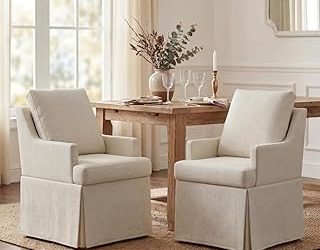
These 26-inch stools combine a supportive backrest and arms with a compact barrel silhouette, making them a comfortable choice for an island that doubles as a breakfast table. Beige linen fabric softens a small room visually, while the stated 450-pound capacity offers reassuring everyday durability.
Sand-Colored Swivel Counter Stools, Set of 2
A 360-degree swivel and contoured backrest make this pair especially practical in a busy kitchen, where users need to turn toward the counter without dragging the stool. The sand-colored upholstery and solid wood legs bring warmth without making the seating area feel visually heavy.
LUE BONA 26-Inch Swivel Bar Stools, Set of 3
This three-stool set is a smart fit for longer islands or households that need an extra seat without mixing styles. Linen-look upholstery, black metal frames, and included lumbar pillows create a more finished seating arrangement, though the three-piece footprint should be measured carefully in a tight room.
Raynesys 24-Inch Curved Bonded Leather Stools, Set of 2
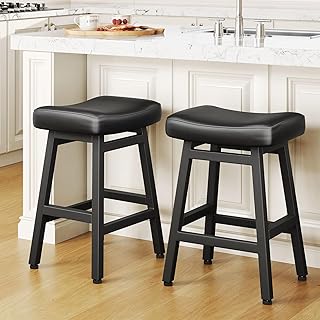
At 24 inches, these stools suit lower counters and can be a useful solution when standard counter-height seating feels too tall. The curved black bonded-leather seats and heavy-duty metal legs create a streamlined, easy-to-coordinate look that works particularly well in contemporary kitchens.
Nalupatio Adjustable Faux-Leather Swivel Stools, Set of 2
These adjustable stools are valuable when flexibility matters more than a fixed silhouette. Their black faux-leather upholstery is easy to wipe clean, while the backrest and swivel mechanism add comfort; keep in mind that hydraulic bases generally need more clearance than four-legged stools.
Frequently Asked Questions
How much space should be between bar stools?
Plan for about 24 to 30 inches from the center of one stool to the center of the next. Use the wider end of that range for stools with arms or broad seats, and the narrower end only when the stools are compact and the counter is used casually.
What is the difference between counter-height and bar-height stools?
Counter-height stools typically have seats around 24 to 27 inches high and pair with counters measuring about 34 to 36 inches. Bar-height stools are taller, commonly around 28 to 33 inches, and are intended for raised bar surfaces around 40 to 42 inches high.
Are swivel bar stools a good choice for small kitchens?
They can be, especially when the seat rotates smoothly and users do not need to pull the stool far away from the island. However, check the base diameter and turning clearance; a bulky pedestal can occupy more floor space than a slim four-leg frame.
Should bar stools have backs?
A backrest is preferable for frequent meals, homework, or longer conversations because it provides more support. Backless stools are easier to tuck away and can keep a compact kitchen looking open, but they are usually better for short sitting periods.
Final Thoughts
For cushioned everyday seating, the Modern Barrel Counter Stools and Sand-Colored Swivel Counter Stools are strong all-around choices. The LUE BONA set makes sense for a longer island that needs three coordinated seats, while the Raynesys stools stand out when a lower, streamlined profile is the priority.