Key takeaways
- Measure the parked footprint, not the running one: A benchtop saw with a stand claims roughly two square feet of permanent floor, and it cannot share that space with anything else. A handheld portable claims a hook. Decide which cost your home can absorb before you compare motors.
- Match cut capacity to your actual projects: A 5-inch capacity handles thick table legs, reclaimed beams, and pipe. A 3-3/8-inch model is lighter and easier to control one-handed, which matters more than you’d think when you’re cutting on a balcony rail or a kitchen counter.
- Weigh corded against cordless honestly: Cordless tools like the DEWALT 20V MAX line eliminate extension cords in tight rooms, but you need a battery ecosystem. Corded units such as the VEVOR Portable Band Saw give you unlimited runtime for less money if an outlet is already nearby.
- Prioritize curves or straight cuts, not both: Benchtop saws with a table excel at scrollwork, cabriole legs, and pattern cutting. Handheld saws are built for straight, deep cuts through stock too big to lift. Beginners who buy the wrong category rarely use the tool twice.
- Check how it stores and how it cleans up: Integrated hang hooks, removable bases, and carrying wheels are not marketing filler in a small space. Neither is a saw that throws chips instead of fine dust, since you likely lack a dust collector and a dedicated room to be messy in.
What's inside
Anyone building furniture in a 600-square-foot apartment knows the real constraint isn’t skill or budget, it’s floor area. A band saw is the tool that unlocks curved aprons, tapered legs, and clean resaws, yet most buying advice assumes you have a garage bay to spare. When your shop is a balcony, a hallway closet, or a folding bench that lives behind the couch, a 200-pound cabinet saw isn’t a stretch goal. It’s a non-starter.
The good news is that the beginner band saw category has quietly split in two. Handheld portable models now cut deep enough for real furniture stock and hang on a wall hook when you’re done, while compact benchtop machines deliver genuine curve-cutting control on a footprint smaller than a nightstand. This guide compares both paths, explains which specs actually matter when square footage is your scarcest resource, and reviews the models worth your first purchase in 2026.
As an Amazon Associate we earn from qualifying purchases.


How to Choose a Beginner Band Saw (2026)
- Measure the parked footprint, not the running one: A benchtop saw with a stand claims roughly two square feet of permanent floor, and it cannot share that space with anything else. A handheld portable claims a hook. Decide which cost your home can absorb before you compare motors.
- Match cut capacity to your actual projects: A 5-inch capacity handles thick table legs, reclaimed beams, and pipe. A 3-3/8-inch model is lighter and easier to control one-handed, which matters more than you’d think when you’re cutting on a balcony rail or a kitchen counter.
- Weigh corded against cordless honestly: Cordless tools like the DEWALT 20V MAX line eliminate extension cords in tight rooms, but you need a battery ecosystem. Corded units such as the VEVOR Portable Band Saw give you unlimited runtime for less money if an outlet is already nearby.
- Prioritize curves or straight cuts, not both: Benchtop saws with a table excel at scrollwork, cabriole legs, and pattern cutting. Handheld saws are built for straight, deep cuts through stock too big to lift. Beginners who buy the wrong category rarely use the tool twice.
- Check how it stores and how it cleans up: Integrated hang hooks, removable bases, and carrying wheels are not marketing filler in a small space. Neither is a saw that throws chips instead of fine dust, since you likely lack a dust collector and a dedicated room to be messy in.
The Best Beginner Band Saws (2026) Reviewed
DEWALT DCS378B 20V MAX XR Bandsaw
The brushless motor and 3-3/8-inch capacity make this the most manageable cordless option for someone cutting hardwood stock in a room they also sleep in. It’s the pick I recommend when control and light weight matter more than maximum depth, and it stows on a shelf beside your drill.
DEWALT DCS374B 20V MAX Band Saw
Same cordless convenience, but with 5 inches of capacity for salvaged beams, thick legs, and metal pipe. The integrated hang hooks are the detail that earns it a place in a small shop, since the saw lives vertically on a pegboard instead of eating bench space.
WEN BA3962 10-Inch Band Saw with Stand
If your projects lean toward curved rails, shaped chair backs, and repeatable templates, a table is not optional and this is the least intimidating way to get one. The two-speed 3.5-amp motor handles wood confidently, and the stand keeps the footprint close to a bar stool’s.
DOVAMAN Portable Band Saw
A well-rounded corded handheld with a 10-amp motor, 5-inch deep cut, and a 0-45 degree adjustable base for angled work. Two blades in the box means you can learn on one and keep a fresh spare, which spares beginners a frustrating first weekend.
MAXXT Band Saw with Aluminum Base
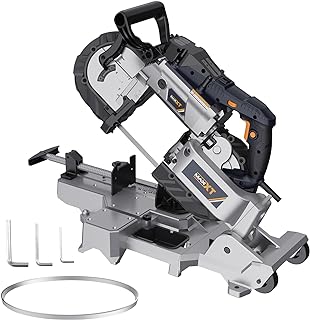
The lightweight aluminum base and carrying wheels make this the easiest 5-inch saw to move between a hallway, a balcony, and a shared basement. Variable speed lets you slow down for metal and open up for wood without swapping blades constantly.
Frequently Asked Questions
Can a portable band saw cut furniture parts?
Yes, for straight cuts. Portable models excel at breaking down thick stock, trimming legs to length, and cutting metal hardware or tubing. For curves and shaped edges, you need a saw with a table.
How much space does a 10-inch benchtop saw really need?
Plan on about two square feet for the base plus roughly three feet of clearance in front and to the left for infeed and outfeed. In a tight room, position it near a doorway so the doorway becomes your outfeed.
Is a cordless band saw powerful enough for beginners?
For furniture-scale stock, comfortably so. A modern 20V brushless saw cuts hardwood and mild steel without complaint. Battery capacity, not motor power, is the practical limit on how long you can work.
What blade should a beginner start with?
Use a 14 to 18 TPI blade for metal and a wider, lower-tooth-count blade for wood. Keep two on hand and change them often, since a dull blade wanders and teaches bad habits.
Final Thoughts
For most small-space furniture builders, the DEWALT DCS374B is the strongest first band saw: deep capacity, no cord, and hooks that keep it off your bench. Choose the WEN BA3962 instead if curved work is central to your designs, or the MAXXT if you need a corded 5-inch saw that rolls out of the way when the room goes back to being a room.