Key takeaways
- CFM over blade count: Airflow is measured in cubic feet per minute, and it’s the only number that tells you whether a fan can actually circulate a room. Look for 5,000+ CFM for a standard bedroom and 7,000+ for open living areas or garages; blade count alone predicts nothing.
- Span versus ceiling height: A 60 or 72 inch fan needs roughly 8 feet of clearance to breathe properly. Under that, a flush-mount or low-profile downrod on a 52 inch span moves more usable air than an oversized fan choking against the ceiling plane.
- DC motors for shared rooms: DC motors draw a fraction of the power of AC equivalents and run near-silent at low speeds. In a studio where the fan sits eight feet from your pillow and your desk, that difference is the whole experience.
- Reversibility earns its keep in winter: Running clockwise on low pulls warm air down from the ceiling instead of blowing it past you. In small spaces with poor insulation, this alone can shave a few degrees off your heating load.
- Damp rating for anything semi-outdoor: Covered balconies, screened porches, and unconditioned garages all need at least a damp-rated housing. Indoor-only fans corrode at the motor housing and start clicking within a season.
What's inside
In a compact home, air movement is a structural problem disguised as a comfort problem. Square footage that has to work three jobs at once — office, dining room, guest bed — traps heat around bodies and equipment, and a fan that only stirs the space directly beneath it leaves the rest of the room stale. Add low ceilings, a single window, and furniture pushed against every wall, and the usual advice about “just adding a fan” stops being useful. What matters is throw: how far the column of air actually travels before it dissipates.
This guide focuses on ceiling fans chosen specifically for airflow volume rather than looks alone, with notes on how each one behaves in tight rooms, converted garages, covered balconies, and open-plan studios where one fixture has to carry the whole floor. I’ve flagged blade span, motor type, and noise floor for each pick, since those three factors determine whether a fan becomes background infrastructure or a nightly annoyance.
As an Amazon Associate we earn from qualifying purchases.


How to Choose a Ceiling Fan To Move Air (2026)
- CFM over blade count: Airflow is measured in cubic feet per minute, and it’s the only number that tells you whether a fan can actually circulate a room. Look for 5,000+ CFM for a standard bedroom and 7,000+ for open living areas or garages; blade count alone predicts nothing.
- Span versus ceiling height: A 60 or 72 inch fan needs roughly 8 feet of clearance to breathe properly. Under that, a flush-mount or low-profile downrod on a 52 inch span moves more usable air than an oversized fan choking against the ceiling plane.
- DC motors for shared rooms: DC motors draw a fraction of the power of AC equivalents and run near-silent at low speeds. In a studio where the fan sits eight feet from your pillow and your desk, that difference is the whole experience.
- Reversibility earns its keep in winter: Running clockwise on low pulls warm air down from the ceiling instead of blowing it past you. In small spaces with poor insulation, this alone can shave a few degrees off your heating load.
- Damp rating for anything semi-outdoor: Covered balconies, screened porches, and unconditioned garages all need at least a damp-rated housing. Indoor-only fans corrode at the motor housing and start clicking within a season.
The Best Ceiling Fan To Move Air (2026)s Reviewed
60 in Ceiling Fan, 7400+ CFM with Light and Remote
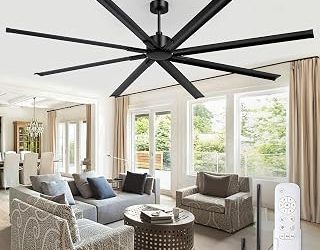
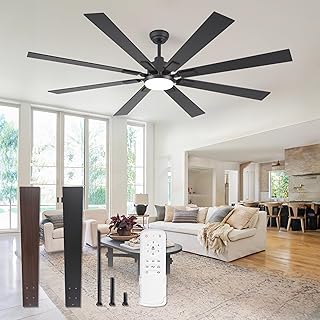
This is the strongest all-rounder here for a single-fixture room, pushing over 7,400 CFM across a 60 inch span while staying quiet enough for a bedroom at speeds one through three. The 3 CCT light and timer make it viable as the only ceiling fixture in a studio, which matters when you don’t have a second junction box to work with.
Minislak 72 Inch Ceiling Fan, 8 Aluminum Blades
Eight aluminum blades on an industrial DC motor make this the right answer for garages, workshops, and long open rooms where you need air pushed sideways as much as down. No light kit, so pair it with existing overheads — but the throw at 72 inches is genuinely different from what a 52 inch fan can do.
ZMISHIBO 72″ Ceiling Fan with Lights, Dual-Finish
A rare combination of true high-CFM output and a finished look, with a dual-finish housing that reads as intentional rather than utilitarian. The damp rating and 24W 3 CCT LED make it a strong pick for covered patios and balconies that double as living space.
OPONL 52 Inch Ceiling Fan with Light, 6CCT Dimmable
The most flexible lighting of the group, with six color temperatures and real dimming — useful when one fixture has to serve as task light, dinner light, and wind-down light. Reversible, quiet, and sized for bedrooms under 250 square feet.
52 Inch Modern Ceiling Fan, DC Reversible, 3CCT
A clean, low-visual-weight option for apartments where the ceiling is already crowded with sightlines. The DC motor keeps it near-silent on lower speeds, and the three-blade profile doesn’t visually shrink an eight-foot ceiling the way a bulkier fan does.
Frequently Asked Questions
What size fan do I need for a small room?
For rooms up to about 225 square feet, a 52 inch fan is the practical ceiling — larger spans start to feel oppressive and can create uneven drafts. Between 225 and 400 square feet, move up to 60 inches. Above that, or in any long, narrow room, 72 inches earns its size.
Is higher CFM always better?
No. A high-CFM fan running at its lowest speed in a small room is usually more comfortable and quieter than a weaker fan running flat out, but a 7,000+ CFM fan in a 100 square foot bedroom will mostly sit on speed one. Buy for the largest room you’ll use it in.
Can I use these on an 8-foot ceiling?
Yes, with a short downrod or flush mount, provided blades sit at least 7 feet off the floor. Check the included downrod length before buying — many large fans ship with rods sized for 9-foot ceilings.
Do DC motor fans actually save money?
They typically draw 50 to 70 percent less power than comparable AC fans at the same airflow. Over a full cooling season of nightly use, that’s a modest but real difference, and the quieter operation is the bigger day-to-day payoff.
Final Thoughts
For most small-space buyers running one fixture in a multi-purpose room, the 60 in 7400+ CFM fan hits the best balance of throw, quiet, and integrated lighting. If your space is long, tall, or unconditioned — a garage, a deep covered patio — the Minislak 72 Inch delivers the sideways reach that smaller spans can’t, while the ZMISHIBO 72″ gives you that same scale without sacrificing the finished look a living room deserves.