Key takeaways
- Use the rear seat whenever possible. Front airbags can seriously injure a restrained dog.
- Attach the restraint to a harness, not to a collar.
- Use the vehicle belt path exactly as directed; routing a belt around soft fabric can cause the seat to fold or slide.
- Do not connect two incompatible restraint systems together unless the manufacturer specifically permits it.
- Replace equipment after a collision, even if tears or broken stitching are not visible.
- Keep the dog’s head and paws inside the vehicle to reduce injury and distraction.
The best dog car seats are the ones that match your dog’s seated height and weight, fit the vehicle’s actual seat dimensions, and attach securely enough that the bed cannot slide, tip, or become a projectile in a sudden stop.
Start with the measurements that matter
Measure your dog while standing and sitting before comparing products. Record body length from chest to the base of the tail, seated height from the seat or floor to the top of the head, and weight. A dog who fits by weight but cannot sit without bending its neck is not a good fit.
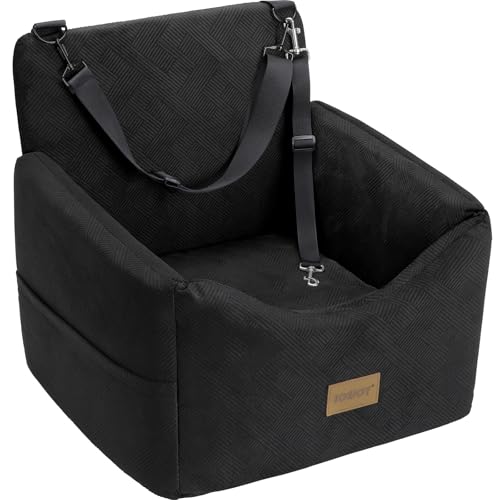
JOEJOY Dog Car Seats for Small Medium Dogs Under 35lbs, Dog Booster Seat with Detachable Washable Cover and Cushion, Memory Foam Pet Car Seat with Safety Belt and Storage Pockets (Black)
Included for 'Best Dog Car Seats: Size, Safety & Fit Guide' because the listing specifies Dog Booster Seat with Detachable Washable Cover and Cushion, details this guide uses to compare options.
View on Amazon
JOEJOY Elevated Dog Car Seat for Small/Medium Dogs up to 35 lbs, Memory Foam Booster Seat with Detachable Washable Cover, Travel-Safe Car Bed with Safety Belts & Storage Pockets, Grey
Included for 'Best Dog Car Seats: Size, Safety & Fit Guide' because the listing specifies Memory Foam Booster Seat with Detachable Washable Cover and Travel-Safe Car Bed with Safety Belts & Storage Pockets, details this guide uses to compare options.
View on Amazon
PETSFIT Dog Car Seat with Patented Safety System, 5" Elevated Cushion
Included for 'Best Dog Car Seats: Size, Safety & Fit Guide' because the listing specifies 5" Elevated Cushion, details this guide uses to compare options.
View on Amazon
BurgeonNest Dog Car Seat for Small Dogs & Cats Under 25 lbs,Black
Included for 'Best Dog Car Seats: Size, Safety & Fit Guide' because the listing specifies Black, details this guide uses to compare options.
View on AmazonMeasure the vehicle too. Check the usable width between door panels or armrests, the depth from the seatback to the front edge of the cushion, and the height available below the roof or headrest. Do not assume a “large” vehicle seat has a large usable area; sculpted cushions and center consoles can reduce the flat space substantially.
| Dog size | Typical dog weight | Useful interior seat dimensions | Best match |
|---|---|---|---|
| Toy or very small | Up to about 12 lb | 16–20 in wide × 12–16 in deep; 8–12 in interior height | Console, bucket-seat, or compact booster seat |
| Small | 12–25 lb | 20–26 in wide × 16–20 in deep; 10–15 in interior height | Box-style booster or carrier-style seat |
| Medium | 25–45 lb | 26–34 in wide × 20–24 in deep; 14–20 in interior height | Wide rear-seat bed or secured travel crate |
| Large | Over 45 lb | Often too large for a raised car seat | Vehicle-rated harness or appropriately anchored crate |
These are planning dimensions, not universal limits. Always use the manufacturer’s stated weight capacity and interior measurements. Allow at least 2 inches of width beyond your dog’s shoulder width and enough length for the dog to turn around. A booster that raises a dog too close to the roof can be less comfortable and less stable than a lower bed.
Best dog car seats by travel situation
For a toy or small dog that wants to see out
Choose a raised booster with a firm bottom, a broad vehicle attachment system, and an internal safety tether. The booster should sit level rather than tilt toward the dashboard. A 16–20-inch-wide model usually fits one small dog, while a 22–26-inch model may accommodate two only if the combined weight stays below the limit and both dogs can lie down.
Look for a tether that clips to a properly fitted harness rather than a collar. The tether should restrain movement without allowing the dog to climb out. A soft-sided booster is convenient for small dogs, but its walls must retain their shape when the dog leans against them.
For a medium dog or a dog that stretches out
A flat rear-seat bed or travel crate is usually a better choice than a tall booster. Raised seats concentrate weight higher above the cushion, which increases tipping and sliding when a dog shifts position. Measure the rear bench from door to door and leave room for seat belts, buckles, and the vehicle’s center hump.
For a 30–45-pound dog, look for a bed or carrier with at least 26–34 inches of usable width and a base that can be secured at two or more points. If the product is a carrier, compare its exterior dimensions with the vehicle’s door opening; a carrier that fits the cabin may not pass through the doorway when loaded.
For a large dog
Most raised “car seats” are not appropriate for large dogs. A crash-tested harness system or a rigid crate secured in the cargo area is generally the more practical category. The crate must be large enough for the dog to stand, turn, and lie naturally, but not so oversized that the dog can be thrown around inside it during a collision.
Never improvise with a cargo-area crate that is merely wedged against the seats. Check how it attaches to the vehicle, whether the tie-down points can handle the load, and whether the crate blocks emergency access or the driver’s rear visibility.
Safety: distinguish comfort restraint from crash protection
A seat that keeps a dog from roaming is not automatically a crash-protection system. Marketing terms such as “secure,” “safety,” or “automotive-grade” do not replace published testing information. Give priority to products with clear load limits, defined attachment instructions, and independent crash-testing documentation where available.
- Use the rear seat whenever possible. Front airbags can seriously injure a restrained dog.
- Attach the restraint to a harness, not to a collar.
- Use the vehicle belt path exactly as directed; routing a belt around soft fabric can cause the seat to fold or slide.
- Do not connect two incompatible restraint systems together unless the manufacturer specifically permits it.
- Replace equipment after a collision, even if tears or broken stitching are not visible.
- Keep the dog’s head and paws inside the vehicle to reduce injury and distraction.
For the strongest protection, compare products with published crash-test evidence from a recognized independent organization, such as the Center for Pet Safety, rather than relying only on a comfort-seat label.
Anchor systems: the key trade-off
| Attachment approach | Advantages | Limitations | Best for |
|---|---|---|---|
| One seat-belt pass-through | Fast to install; works with many vehicles | Can allow rotation or sideways movement if the base is narrow | Short trips and compact booster seats |
| Two vehicle belt paths | Better resistance to tipping and sliding | More time-consuming; may not work with every seat shape | Wide rear-seat beds and heavier dogs |
| LATCH-compatible attachment | Uses dedicated child-seat anchors and can reduce movement | Anchor spacing and permitted use vary by vehicle; not every pet product is approved for it | Products specifically designed and labeled for LATCH use |
| Internal tether | Stops climbing and roaming inside the seat | Not a substitute for securing the seat itself; an overly long tether creates more travel distance | Small dogs in boosters or carriers |
A secure installation should leave the seat with very little side-to-side movement. If you can pull the front edge several inches forward or lift one corner easily, reassess the belt route, attachment points, or product category.
Materials and durability: what wears out first
| Construction | Strengths | Trade-offs |
|---|---|---|
| Ripstop polyester or nylon shell | Lightweight, commonly water-resistant, easy to fold | Can abrade at seams and absorb odor if the liner is not removable |
| Quilted fabric and fleece lining | Comfortable for anxious dogs and useful in cold weather | Retains hair; may dry slowly after washing |
| High-denier nylon with reinforced stitching | Better resistance to scratching and repeated loading | Usually stiffer and more expensive |
| Foam-filled or molded base | Supports the dog and prevents sagging | Foam can compress over time; molded bases may be awkward to store |
| Metal or rigid frame | Maintains shape and resists collapse | Heavier, harder to install, and must have protected edges |
For frequent travel, prioritize a removable, machine-washable cover, waterproof seam protection, and replaceable padding. The first failures are often zipper teeth, tether clips, belt-routing loops, and stitching at the corners—not the central fabric panel. Check these areas monthly, especially if your dog scratches before settling.
A practical decision matrix
| Your situation | Recommended category | What to prioritize |
|---|---|---|
| Small car or narrow rear seat | Compact booster or carrier | Under 20–22 in wide, low center of gravity, short belt path |
| Kids also use the rear bench | Narrow booster or center-position carrier | Clear access to buckles and at least 2 in of clearance from child seats |
| Dog gets carsick | Low, washable bed with waterproof liner | Removable cover, absorbent top layer, easy cleaning |
| Dog is an escape artist | Enclosed carrier or reinforced seat with short tether | Secure zippers, strong mesh, harness attachment, no loose gaps |
| Long road trips | Flat bed or crate with room to reposition | Ventilation, firm support, water access during stops, durable fabric |
| Large or powerful dog | Crash-tested harness or secured crate | Published load limits and vehicle attachment instructions |
Installation and fit checklist
- Place the empty seat on the intended vehicle position and confirm it sits flat.
- Route the vehicle belt or approved anchor straps without twisting them.
- Apply firm pressure to remove slack, then test for movement at the front and sides.
- Put the dog in a properly fitted harness and adjust the internal tether so the dog can sit and lie down but cannot climb over the edge.
- Check that the dog’s head is not pressed against the roof and that no strap crosses the throat.
- Repeat the inspection after the first few journeys; soft materials can compress and create looseness.
As a general budget guide, basic small-dog boosters often cost about $40–$100, more structured carriers and rear-seat beds commonly fall around $80–$250, and independently tested harness or crate systems may cost $150–$500 or more. The right purchase is not the tallest, softest, or most expensive model; it is the one whose dimensions, anchors, and stated limits match both your dog and your vehicle.