Key takeaways
- Measure the swing, then the shelf: A 12-inch press needs roughly 20 inches of bench depth once the table overhangs. Check your storage spot before you check the spec sheet — a table that can’t be stowed on edge will end up living on your bench permanently.
- Fence quality over surface size: A 24-inch top with a flimsy fence gives you less accuracy than an 18-inch top with a rigid aluminum extrusion. Look for T-tracks and a fence that stays square when you cinch it down.
- Flip stops earn their keep: Repeatable stops mean you drill a row of shelf-pin holes without re-measuring. In a cramped shop where you can’t leave a jig set up, that repeatability is the whole point.
- Replaceable inserts save the top: Sacrificial center inserts protect your surface and prevent tearout on through-holes. A top without one becomes chewed-up scrap in a season of hard use.
- Think about dual-purpose height: If your press shares a bench with a sander or router, an adjustable-height base lets you set a comfortable working plane for each rather than compromising on one.
What's inside
The drill press itself is rarely the problem. The problem is the eight square feet of floor it wants, the cast-iron table barely wider than a coffee mug, and the fact that in a one-car garage or a spare-bedroom shop, every tool has to justify its footprint. Most people buying a drill press table aren’t chasing a bigger workshop — they’re trying to get real clamping surface, a usable fence, and repeatable stops out of a machine that lives on a shelf between projects.
This guide looks at drill press tables and compact benchtop presses through a small-space lens: how much surface area you gain per inch of bench you give up, whether a table can be lifted off and stowed vertically, and which built-in features let one station do the work of two. I’ve grouped bolt-on table upgrades alongside the benchtop presses worth pairing them with, plus one adjustable workbench that solves the height problem small shops usually ignore.
As an Amazon Associate we earn from qualifying purchases.



How to Choose a/an Drill Press Tables (2026)
- Measure the swing, then the shelf: A 12-inch press needs roughly 20 inches of bench depth once the table overhangs. Check your storage spot before you check the spec sheet — a table that can’t be stowed on edge will end up living on your bench permanently.
- Fence quality over surface size: A 24-inch top with a flimsy fence gives you less accuracy than an 18-inch top with a rigid aluminum extrusion. Look for T-tracks and a fence that stays square when you cinch it down.
- Flip stops earn their keep: Repeatable stops mean you drill a row of shelf-pin holes without re-measuring. In a cramped shop where you can’t leave a jig set up, that repeatability is the whole point.
- Replaceable inserts save the top: Sacrificial center inserts protect your surface and prevent tearout on through-holes. A top without one becomes chewed-up scrap in a season of hard use.
- Think about dual-purpose height: If your press shares a bench with a sander or router, an adjustable-height base lets you set a comfortable working plane for each rather than compromising on one.
The Best Drill Press Tables (2026)s Reviewed
O’SKOOL Drill Press Table (DAB022)
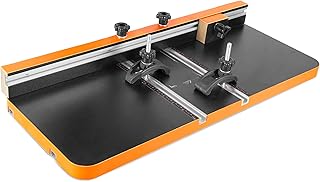
The 23-5/8″ x 15″ MDF top with aluminum fence, flip stop, and dual T-tracks is the most complete out-of-the-box upgrade here, and the replaceable insert means you’re not babying the surface. At one inch thick it’s stiff enough to clamp against without deflection, and it stores flat against a wall when the press goes back on the shelf.
WEN DPA2513 24-by-12-Inch Table
A shallower 12-inch depth makes this the better pick if your bench is narrow, and the adjustable fence plus stop block covers the two jobs most small-shop drilling actually needs. It’s the leanest footprint-to-capability ratio in this roundup.
JET JWDP-12 Benchtop Drill Press
Variable speed without belt-swapping is the feature you appreciate on the tenth hole, not the first, and JET’s 1/2 HP head runs smoother and quieter than most benchtop machines — which matters when your shop shares a wall with a bedroom. Pair it with the O’SKOOL table and you have a station that punches well above its size.
WORKPRO 48″ Adjustable Workbench
Five height settings and a 2,000-pound rubber wood top turn one bench into a drilling station, an assembly table, and a standing work surface, and the built-in outlets eliminate the extension cord snaking across your floor. This is the small-shop multiplier: fewer surfaces, more function.
VEVOR 12-Inch Benchtop Press (1 HP, 530–3140 RPM)
The widest speed range in this group plus a 0–45° tilting worktable makes it genuinely versatile for wood and metal, and the laser and LED light reduce the squinting that comes with drilling in a dim garage corner. The tilt table means you can skip building angle jigs you’d have nowhere to store anyway.
Frequently Asked Questions
Will an aftermarket table fit my existing drill press?
Most bolt-on tables are designed for 12-inch and larger presses and mount through the existing cast-iron table slots. Measure your table’s slot spacing before ordering, and confirm the press has enough quill travel to clear the added inch of thickness.
Does a thicker table reduce my drilling depth?
Yes — a one-inch top costs you roughly an inch of usable stroke. For most furniture work that’s irrelevant, but if you regularly bore deep mortises, verify your press’s spindle travel first.
MDF or plywood for the work surface?
MDF is flatter and more consistent, which is why quality tables use it. Keep it dry and seal any exposed edges; swelling is its only real weakness.
Can I store a drill press table separately from the press?
Absolutely, and in tight shops you should. Two knobs or bolts usually release the table, letting you hang it on a French cleat or slide it behind a cabinet between projects.
Final Thoughts
For most small-shop woodworkers, the O’SKOOL DAB022 is the best value upgrade — full fence, flip stop, and replaceable insert on a surface that stores easily. If bench depth is your constraint, the WEN DPA2513 delivers the same core capability in a shallower footprint, and pairing either with the JET JWDP-12 gives you a quiet, variable-speed station that earns its place on a crowded bench.