Key takeaways
- Rear clearance: Traditional rail designs need six to twelve inches behind the saw to slide fully. Glide-rail models like the Makita LS1219L pivot instead of sliding backward, so they can sit almost flush to a wall — the single biggest space saver in this category.
- Blade diameter vs. real capacity: A 10-inch saw is lighter, cheaper, and shorter front to back. If your work tops out at 2×8 crosscuts and 4-inch baseboard, the extra depth of a 12-inch saw buys you nothing but lost bench space.
- Weight and how you’ll move it: Anything past 60 pounds becomes a two-hand, planted-feet lift. If the saw goes on a shelf between projects, stay lighter or commit to a wheeled stand.
- Cut line visibility: Shadow-line LED systems cast the blade’s actual silhouette and don’t need calibration. Lasers are useful but drift, and in a dim garage corner a shadow line is easier to read.
- Dust collection reality: Enclosed spaces amplify dust problems. Check for a proper port that fits a shop vac hose — bag-only collection in a small room means you’ll be sweeping constantly.
What's inside
A dual bevel sliding miter saw is one of those tools that earns its keep the moment you stop cutting straight lines. Crown molding, angled shelf cleats, mitered box corners, picture frames with tight returns — all of it goes faster when the head tilts both directions and you’re not flipping stock end over end on a cramped bench. The problem for most home woodworkers isn’t whether they want one. It’s where the thing lives. These saws are wide, back-heavy, and demand clearance on both sides for material support, which is a genuine planning exercise in a one-car garage or a shared basement corner.
This guide looks at dual bevel sliding miter saws through that lens: footprint, rear clearance, weight you can realistically lift onto a stand, and whether the saw can be tucked against a wall when it’s not in use. I’ve flagged which models suit a dedicated bench, which ones work better on a folding stand you roll out and put away, and where cutting capacity is genuinely worth the extra depth. Specs below are current as of 2026.
As an Amazon Associate we earn from qualifying purchases.




How to Choose a Dual Bevel Sliding Miter Saw (2026)
- Rear clearance: Traditional rail designs need six to twelve inches behind the saw to slide fully. Glide-rail models like the Makita LS1219L pivot instead of sliding backward, so they can sit almost flush to a wall — the single biggest space saver in this category.
- Blade diameter vs. real capacity: A 10-inch saw is lighter, cheaper, and shorter front to back. If your work tops out at 2×8 crosscuts and 4-inch baseboard, the extra depth of a 12-inch saw buys you nothing but lost bench space.
- Weight and how you’ll move it: Anything past 60 pounds becomes a two-hand, planted-feet lift. If the saw goes on a shelf between projects, stay lighter or commit to a wheeled stand.
- Cut line visibility: Shadow-line LED systems cast the blade’s actual silhouette and don’t need calibration. Lasers are useful but drift, and in a dim garage corner a shadow line is easier to read.
- Dust collection reality: Enclosed spaces amplify dust problems. Check for a proper port that fits a shop vac hose — bag-only collection in a small room means you’ll be sweeping constantly.
The Best Dual Bevel Sliding Miter Saws (2026) Reviewed
Makita LS1219L 12″ Dual-Bevel Sliding Compound Miter Saw
The direct-drive motor and forward guide rail let this saw work with minimal rear clearance, which makes it the standout choice for tight shops where the bench backs onto a wall. Cut quality is excellent out of the box, and the dual laser marks both sides of the blade so you can cut to either edge of your line.
DEWALT DWS780 12-inch Double Bevel Sliding Compound Miter Saw
The XPS shadow light is the most practical cut-line system available and needs no adjustment over the saw’s life. It’s a heavy, deep saw that wants a permanent home or a solid rolling stand, but the dust extraction is genuinely effective and the detent plate holds settings reliably.
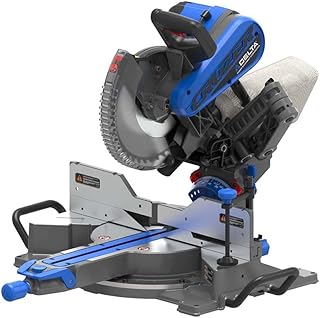
Delta 26-2310 10″ Dual Bevel Sliding Miter Saw
A 16-inch crosscut from a 10-inch blade is unusual reach, and the smaller blade keeps the overall package lighter and shallower than 12-inch competitors. For anyone building furniture rather than framing, this hits the capacity sweet spot without eating the whole bench.
DOVAMAN 10-Inch Dual Bevel Sliding Miter Saw
The two-speed motor (5000/3200 RPM) plus three included TCT blades makes this the most versatile pick if you cut aluminum extrusion or plastics alongside hardwood. The LED shadow line is a welcome inclusion at this price, and the 3.5 x 13.4-inch capacity handles standard furniture stock comfortably.
DOVAMAN 12-Inch Dual-Bevel Compound Sliding Miter Saw
Ambidextrous controls matter more than they sound when your saw is wedged into a corner and you can only approach from one side. A 4.2 x 13-inch capacity and nine positive stops cover most furniture joinery, making this a sensible entry point into 12-inch cutting.
Frequently Asked Questions
How much space do I actually need for a sliding miter saw?
Plan for the saw’s footprint plus roughly three feet of support on each side for long stock — a folding stand with extension arms solves this without permanent bench space. Rear clearance depends entirely on the rail design.
Is dual bevel worth the extra cost over single bevel?
For crown molding and any project with mirrored angled cuts, yes. Not flipping heavy or awkward stock reduces errors and saves setup time on every cut.
Should I choose 10-inch or 12-inch for furniture work?
Ten inches handles the vast majority of furniture stock while staying lighter and shallower. Go 12-inch only if you regularly cut wide boards or tall baseboard on the bevel.
Can I run one of these on a standard household circuit?
Yes — all 15-amp saws here run on a 120V circuit, but avoid sharing that circuit with a dust collector or shop vac to prevent nuisance trips.
Final Thoughts
For small shops, the Makita LS1219L is the clear winner on footprint alone — the near-zero rear clearance requirement changes what’s possible against a wall. If cut-line accuracy and dust control matter most and you have room for a permanent station, the DEWALT DWS780 remains the benchmark. Budget-conscious furniture builders should look hard at the Delta 26-2310, which delivers wide-board capacity in a notably more compact package.