Key takeaways
- New work vs. old work: New work boxes attach directly to exposed framing before drywall goes up. Old work boxes install through a cut hole in a finished ceiling using an expanding brace, no attic crawl required. Confirm which you need before adding to cart, because the two are not interchangeable.
- Weight rating: Check the stamped rating against your fan’s shipping weight, not its listed weight. Fans with integrated lights, heavy blade sets, or downrods run heavier than the spec sheet suggests. A 50-pound rating handles the vast majority of residential fans; heavier statement fixtures need a support bar rated to 70 pounds.
- Box depth and cubic capacity: Shallow half-inch pans work for simple fixtures, but a fan with a remote receiver, dimmer module, or three-way wiring needs volume. Cramming conductors into an undersized box creates heat and makes the canopy fight you. Adjustable-depth boxes solve this by letting you set the face flush with varied drywall thicknesses.
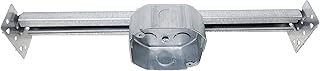
- Joist spacing compatibility: Older homes rarely follow modern 16-inch centers. Any brace-style box you buy should telescope across a 16 to 24 inch span so it bites solid lumber on both ends rather than relying on drywall.
- Location rating: Porches, sunrooms, and covered patios need a weatherproof box listed for damp or wet locations. PVC construction resists corrosion where a galvanized steel pan would eventually rust and stain your ceiling.
What's inside
In a compact home, the ceiling is prime real estate. It’s the one surface a fan, a pendant, or a low-profile flush mount can occupy without stealing a single square foot of floor. But that opportunity comes with a catch most people discover mid-project: the round box already sitting in the ceiling was almost certainly installed for a lightweight fixture, not a spinning 45-pound appliance. Standard lighting boxes are nailed to a single joist and rated for static loads only. A fan introduces vibration, torque, and years of cyclical stress, which is precisely why the National Electrical Code requires a fan-rated box or an approved support system.
This guide covers the six boxes worth your attention in 2026, sorted by the situation you’re actually in: cutting into a finished ceiling with no attic access, framing from scratch, or dealing with a covered porch where moisture and code both apply. We’ll walk through the selection criteria that matter, then break down each option so you can order once and mount with confidence.
As an Amazon Associate we earn from qualifying purchases.


How to Choose a/an Electrical Box For Ceiling Fan (2026)
- New work vs. old work: New work boxes attach directly to exposed framing before drywall goes up. Old work boxes install through a cut hole in a finished ceiling using an expanding brace, no attic crawl required. Confirm which you need before adding to cart, because the two are not interchangeable.
- Weight rating: Check the stamped rating against your fan’s shipping weight, not its listed weight. Fans with integrated lights, heavy blade sets, or downrods run heavier than the spec sheet suggests. A 50-pound rating handles the vast majority of residential fans; heavier statement fixtures need a support bar rated to 70 pounds.
- Box depth and cubic capacity: Shallow half-inch pans work for simple fixtures, but a fan with a remote receiver, dimmer module, or three-way wiring needs volume. Cramming conductors into an undersized box creates heat and makes the canopy fight you. Adjustable-depth boxes solve this by letting you set the face flush with varied drywall thicknesses.
- Joist spacing compatibility: Older homes rarely follow modern 16-inch centers. Any brace-style box you buy should telescope across a 16 to 24 inch span so it bites solid lumber on both ends rather than relying on drywall.
- Location rating: Porches, sunrooms, and covered patios need a weatherproof box listed for damp or wet locations. PVC construction resists corrosion where a galvanized steel pan would eventually rust and stain your ceiling.
The Best Electrical Box For Ceiling Fan (2026)s Reviewed
Southwire MSBFAN Adjustable Fan Box
This is the one I recommend most often for new construction and gut remodels, largely because the depth adjustment lets you dial the box face flush after drywall thickness surprises you. The dual rating — 50 pounds for fans, 75 for light fixtures — covers nearly every residential scenario without a second thought.
RACO RETRO-BRACE 936
The problem-solver for finished ceilings. Feed the brace through a 4-inch hole, ratchet it until the teeth bite the joists, and you’ve got a 70-pound-capable mount without opening the ceiling or crawling insulation. The 1.5-inch depth also gives you room for remote receivers that shallower retrofits can’t accommodate.
Hubbell-Bell PRCF57550GY Outdoor Box
For screened porches and covered patios, this weatherproof PVC box is the straightforward answer, and the 45-degree mounting option is genuinely useful on sloped or vaulted porch ceilings. Three included reducer bushings mean you’re not making a second hardware run for the conduit fitting you forgot.
RACO 8293 Round Ceiling Pan
A well-made shallow pan for tight ceiling cavities, with five knockouts giving you flexibility on cable entry. Understand what it is: a fixture pan, best paired with an independent support brace when a fan is involved rather than trusted to carry the load alone.
4″ Round Shallow Boxes, 2-Pack
Good economics if you’re wiring several rooms at once and want spares on the shelf. The half-inch depth suits simple flush mounts and wall sconces in tight framing; step up to a rated brace box for anything that spins.
Frequently Asked Questions
Can I hang a ceiling fan from my existing light box?
Only if it’s stamped as fan-rated. If there’s no marking, assume it isn’t. A standard lighting box relies on nails into one joist and will loosen under vibration.
Do I need attic access to install one of these?
No. Old work brace boxes like the RETRO-BRACE were designed specifically for ceilings you can only reach from below.
What about a sloped or vaulted ceiling?
You’ll need a box that accommodates an angled mount plus a sloped-ceiling adapter for the fan’s downrod. Verify the maximum pitch your fan supports.
Is a support bar or a brace box better?
A support bar with an integrated box gives the strongest anchor and highest weight capacity. Brace boxes trade a little capacity for far easier retrofit installation.
Final Thoughts
For most projects, the Southwire MSBFAN handles new work cleanly with its adjustable depth, while the RACO RETRO-BRACE 936 is the pick when you’re retrofitting a finished ceiling without attic access. If your fan is destined for a covered porch, the Hubbell-Bell PRCF57550GY is the weatherproof option that keeps you code-compliant and corrosion-free.