Key takeaways
- Working height vs. rated length: Subtract roughly four feet from the ladder’s stated length for realistic working height, and remember an extension ladder must be set at a 75-degree angle. For a typical two-story gutter at 18–20 feet, look at 16-foot fiberglass or 17.5–20-foot multi-position models.
- Collapsed dimensions: Measure your storage spot before you shop. Telescoping ladders retract to roughly 30–36 inches and stand upright in a closet corner; multi-position A-frames fold flatter but stay long. Both beat a fixed extension ladder that needs 12+ feet of clear wall.
- Weight you can actually carry: Telescoping aluminum models run 25–40 pounds and move easily through doorways. Fiberglass is heavier but non-conductive — worth the trade if you work near the meter or drop lines.
- Stabilizer design: Triangle stabilizer bars widen the base and stop side-to-side sway on uneven lawns. Some detach for storage, which matters if you’re squeezing the ladder into a tight vertical space.
- Locking mechanism quality: Look for one-touch or individual rung locks with clear engagement indicators, plus a 330-pound rating that accounts for you, your tools, and a bundle of shingles.
What's inside
A two-story house creates a storage problem before it creates a reach problem. You need something that gets you to a 20-foot gutter line, but most of the year that same tool has to live somewhere — and in a townhouse garage, a condo storage closet, or a basement with a low ceiling, a rigid 24-foot aluminum extension ladder is a permanent obstacle. It leans against a wall, blocks the workbench, and forces you to shuffle bikes and bins every time you want to reach a shelf.
This guide looks at extension ladders for two-story homes through a footprint-first lens: how much wall or floor real estate the ladder claims when collapsed, whether it can be carried by one person up a flight of stairs, and how well the stabilizer hardware works without adding bulk. We cover telescoping models that shrink to roughly the size of a duffel bag, multi-position A-frames that replace two separate ladders, and one traditional fiberglass pick for anyone working near electrical service lines.
As an Amazon Associate we earn from qualifying purchases.


How to Choose a/an Extension Ladder For 2 Story House (2026)
- Working height vs. rated length: Subtract roughly four feet from the ladder’s stated length for realistic working height, and remember an extension ladder must be set at a 75-degree angle. For a typical two-story gutter at 18–20 feet, look at 16-foot fiberglass or 17.5–20-foot multi-position models.
- Collapsed dimensions: Measure your storage spot before you shop. Telescoping ladders retract to roughly 30–36 inches and stand upright in a closet corner; multi-position A-frames fold flatter but stay long. Both beat a fixed extension ladder that needs 12+ feet of clear wall.
- Weight you can actually carry: Telescoping aluminum models run 25–40 pounds and move easily through doorways. Fiberglass is heavier but non-conductive — worth the trade if you work near the meter or drop lines.
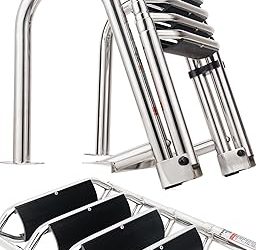
- Stabilizer design: Triangle stabilizer bars widen the base and stop side-to-side sway on uneven lawns. Some detach for storage, which matters if you’re squeezing the ladder into a tight vertical space.
- Locking mechanism quality: Look for one-touch or individual rung locks with clear engagement indicators, plus a 330-pound rating that accounts for you, your tools, and a bundle of shingles.
The Best Extension Ladder For 2 Story House (2026)s Reviewed
SocTone 12.5FT Telescoping Ladder with Stabilizers
The sweet spot for second-story window work and gutter cleaning on a standard build, this one collapses to about a yard tall and tucks behind a garage door or under a stairwell. The included stabilizers do real work on soft ground, and the 330-pound rating leaves headroom for a tool belt.
Louisville Ladder 16-foot Fiberglass Extension Ladder, FE3216
The conventional choice, and the right one if your work takes you near electrical service entries — fiberglass rails don’t conduct, and the Type IA 300-pound rating is job-site grade. Accept that it needs dedicated wall space or ceiling hooks; there’s no folding it down.
20FT A-Frame 6-Step Multi-Position Ladder with Wheels
The most versatile pick here: it converts between A-frame, extension, and stair configurations, so it replaces a step ladder and an extension ladder in one storage slot. The wheels are a genuine benefit when you’re moving 40-plus pounds across a driveway alone.
Soctone 17.5 Ft A-Frame Multi-Position Ladder
A slightly lighter multi-position option that still reaches most two-story eaves, with a stabilizer bar that stays put once locked. The high-visibility orange finish is practical, not cosmetic — it’s easy to spot leaning in a cluttered garage.
14.5FT Telescoping Extension Ladder with Triangle Stabilizers
Our pick for apartment dwellers and anyone storing indoors: it retracts small enough for a hall closet yet reaches attic hatches and lower roof edges. Non-slip feet and dual triangle stabilizers give it more planted feel than the length suggests.
Frequently Asked Questions
What length ladder do I need for a two-story house?
Most two-story gutter lines sit 18–20 feet up. Because a ladder leans at an angle and should extend three feet past the roof edge, plan on a 20–24 foot extension ladder or a 17.5–20 foot multi-position model for roof access, and 12–16 feet for windows and soffits.
Are telescoping ladders safe for roof work?
Reputable telescoping ladders carry the same ANSI ratings as fixed ones. The key is confirming every rung has clicked into its lock before you climb and using the stabilizer bar. For extended roof work, a rigid extension ladder still feels more solid underfoot.
Where can I store a ladder in a small garage?
Telescoping models stand vertically in a corner or hang on two heavy-duty hooks. For fixed extension ladders, ceiling-mounted horizontal brackets along a rafter line reclaim the wall entirely — just verify the joists can carry the load.
Aluminum or fiberglass for home use?
Aluminum is lighter, cheaper, and easier to store. Choose fiberglass if you’ll be near power lines, the electrical mast, or doing any wiring work — the non-conductive rails are the whole point.
Final Thoughts
For most two-story homes with limited storage, the SocTone 12.5FT telescoping ladder handles everyday window and gutter tasks while disappearing into a closet, and the 20FT multi-position A-frame with wheels covers full roof access and stair work in a single tool. If your projects put you anywhere near electrical service, the Louisville FE3216 fiberglass is the safer investment despite its storage demands.