Key takeaways
- Measure the collapsed size, not the extended: A 12.5 ft telescoping ladder folds to around 33 inches and stands vertically in a hall closet. A 20 ft model collapses closer to 45 inches, which is fine for a garage wall but will not fit under a stairwell or behind a door. Decide where it lives before you decide how high it goes.
- Match certification to real load: EN131 and ANSI Type 1A are the marks worth looking for. Type 1A is the more demanding of the two for professional duty ratings. If a listing quotes a capacity but skips the standard, treat the number as marketing.
- Check the retraction mechanism: Single-button one-touch release lets the whole ladder drop in one controlled motion. Rung-by-rung thumb tabs are slower but give you far more control on stairs and uneven ground. Neither is wrong; pick based on how you’ll actually use it.
- Stabilizer bars matter more than extra feet: A wide stabilizer foot converts a wobbly aluminum pole into something you’ll trust at full height. This single feature does more for confidence than another three feet of reach.
- Consider whether you need A-frame capability: Straight telescoping ladders need a wall. Multi-position models fold into an A-frame, which means you can change a ceiling bulb in the middle of a room or work over a stair landing without leaning against anything.
What's inside
The ladder problem in a small home is rarely about height. It’s about the eighteen inches of wall space behind the coat rack, or the sliver of closet floor next to the vacuum. A traditional extension ladder is a twelve-foot rigid object that has to live somewhere, and in an apartment or a townhouse with a single-car garage, “somewhere” doesn’t exist. So the gutter goes uncleaned, the smoke detector keeps chirping, and the light fixture in the stairwell stays dark for another season.
Telescoping and multi-position ladders solve this by collapsing to roughly the footprint of a golf bag. This guide looks at six models that reach 12 to 20 feet, all rated for 330 pounds, and evaluates them the way a storage-minded homeowner would: collapsed dimensions, whether they’ll stand upright in a closet, how the rung retraction feels after a year of dust, and whether the certifications actually mean something.
As an Amazon Associate we earn from qualifying purchases.


How to Choose a/an Extension Ladder For Home Use (2026)
- Measure the collapsed size, not the extended: A 12.5 ft telescoping ladder folds to around 33 inches and stands vertically in a hall closet. A 20 ft model collapses closer to 45 inches, which is fine for a garage wall but will not fit under a stairwell or behind a door. Decide where it lives before you decide how high it goes.
- Match certification to real load: EN131 and ANSI Type 1A are the marks worth looking for. Type 1A is the more demanding of the two for professional duty ratings. If a listing quotes a capacity but skips the standard, treat the number as marketing.
- Check the retraction mechanism: Single-button one-touch release lets the whole ladder drop in one controlled motion. Rung-by-rung thumb tabs are slower but give you far more control on stairs and uneven ground. Neither is wrong; pick based on how you’ll actually use it.
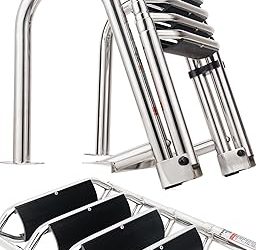
- Stabilizer bars matter more than extra feet: A wide stabilizer foot converts a wobbly aluminum pole into something you’ll trust at full height. This single feature does more for confidence than another three feet of reach.
- Consider whether you need A-frame capability: Straight telescoping ladders need a wall. Multi-position models fold into an A-frame, which means you can change a ceiling bulb in the middle of a room or work over a stair landing without leaning against anything.
The Best Extension Ladder For Home Use (2026)s Reviewed
SINMEIRUN Telescoping Ladder, 20.3 FT
At 20.3 feet this is the only model here that reaches a two-story roofline, and the EN131 certification plus 330 lb rating backs up the height. The tradeoff is collapsed length, so plan on garage wall storage rather than closet storage, and know that the orange finish makes it easy to spot in a cluttered space.
LANBITOU 4-Step A-Frame Extension Ladder, 14 FT
The multi-position design is what earns this one shelf space in a small home. It works as a 14 ft straight extension, folds to an A-frame for freestanding work, and locks into a stair configuration, which means one purchase replaces the step stool and the extension ladder both.
Prime 13.5 FT Telescopic Extension Ladder
ANSI Type 1A certification is the strictest rating in this group, and the included stabilizers make the difference you feel at the top of the extension. A sensible pick if you want maximum confidence in a ladder that still tucks into a narrow space.
Telescoping Ladder 12.5 FT, Silver
The dual EN131 and ANSI certification on a 12.5 ft frame makes this the most closet-friendly serious ladder here. It handles gutters on a single-story home, ceiling fixtures, and RV roof access without demanding dedicated storage real estate.
SocTone 12.5 FT Telescoping Ladder with Stabilizers
Same compact 12.5 ft class as the silver model above, but the integrated stabilizer bar widens the base considerably. Worth the small extra bulk if your work surfaces include soft ground, driveway slope, or anything less than perfectly level.
Frequently Asked Questions
How much space do I actually need to store a telescoping ladder?
Plan on a vertical space roughly 34 inches tall and about 20 inches wide for a 12.5 ft model. That fits behind a door, in a closet corner, or flat under a bed. Longer 20 ft models need closer to 45 inches of clearance.
Are telescoping ladders as safe as traditional ones?
Certified models are, provided you extend them fully to a locked rung and never leave a partial section engaged. Look for EN131 or ANSI Type 1A markings, inspect the locking pins before each use, and set the base at roughly a 75-degree angle.
What height do I need for a typical two-story home?
Gutters on a single-story house need 12 to 13 feet. A two-story roofline generally requires 20 feet or more, since the ladder should extend about three feet past the contact point.
Do the rungs get stuck over time?
Grit in the tubes is the usual culprit. Wipe the sections down after outdoor use and apply a dry silicone lubricant once or twice a year. Avoid oil-based products, which attract more dust.
Final Thoughts
For most small-space homes, the 12.5 FT Silver Telescoping Ladder hits the right balance of certified strength and genuinely closet-sized storage, while the SocTone 12.5 FT adds stabilizers for anyone working on uneven ground. If you need real height and have a garage wall to spare, the SINMEIRUN 20.3 FT is the one that actually reaches a second-story roof.