Key takeaways
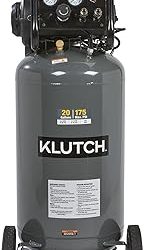
- Footprint over gallons: Measure your intended parking spot first, then shop. Pancake tanks are wide but short, sliding under a 24-inch bench; hot-dog and vertical tanks trade width for height and often fit a closet corner better.
- CFM at 90 PSI: This single number tells you whether a brad nailer, finish nailer, or framing gun will keep up. Roughly 2.0 CFM handles trim and furniture assembly comfortably; ignore peak PSI marketing.
- Decibels, honestly assessed: A standard compressor cycling at 80-plus dBA travels straight through drywall and floors. In a building with neighbors, a 60 dBA unit is the difference between finishing a project and fielding a complaint.
- Oil-free pump: No crankcase to check, no drips on a garage floor you also use for storage bins, and you can store the unit upright or on its side without worry.
- Cord and hose management: Look for integrated wraps, a top handle that clears a shelf lip, and dual couplers so you aren’t swapping fittings mid-task. Add a wall cleat and a retractable reel to reclaim the floor entirely.
What's inside
Anyone assembling flat-pack furniture in a 600-square-foot apartment eventually hits the same wall: the tool that would make the job faster is also the tool that has nowhere to live. An air compressor turns an afternoon of hand-driving brad nails into twenty minutes of clean, flush-set work, and it keeps bike tires, air mattresses, and sofa-cushion inserts properly filled. But most buyers picture a wheeled drum the size of a nightstand and quietly give up. Harbor Freight shoppers in particular tend to compare on horsepower and tank gallons alone, then discover the unit won’t clear the depth of a closet shelf or fit under a workbench without blocking the drawer below.
This guide reads compressors the way a small-space organizer reads furniture: by footprint, stacking behavior, noise transmission, and how easily the thing disappears when the project ends. Below are the models worth considering in 2026 for apartments, condos, shared garages, and single-car bays that double as storage. Each pick is judged on real capacity for furniture and trim work, then on whether it earns the cubic feet it occupies.
As an Amazon Associate we earn from qualifying purchases.



How to Choose a Harbor Freight Air Compressor (2026)
- Footprint over gallons: Measure your intended parking spot first, then shop. Pancake tanks are wide but short, sliding under a 24-inch bench; hot-dog and vertical tanks trade width for height and often fit a closet corner better.
- CFM at 90 PSI: This single number tells you whether a brad nailer, finish nailer, or framing gun will keep up. Roughly 2.0 CFM handles trim and furniture assembly comfortably; ignore peak PSI marketing.
- Decibels, honestly assessed: A standard compressor cycling at 80-plus dBA travels straight through drywall and floors. In a building with neighbors, a 60 dBA unit is the difference between finishing a project and fielding a complaint.
- Oil-free pump: No crankcase to check, no drips on a garage floor you also use for storage bins, and you can store the unit upright or on its side without worry.
- Cord and hose management: Look for integrated wraps, a top handle that clears a shelf lip, and dual couplers so you aren’t swapping fittings mid-task. Add a wall cleat and a retractable reel to reclaim the floor entirely.
The Best Harbor Freight Air Compressors Reviewed (2026)
DEWALT 6-Gallon Pancake (DWFP55126)
The reference standard for a reason: 165 max PSI and 2.6 SCFM at 90 PSI drive a finish nailer through hardwood face frames without stalling, and the flat 6-gallon profile tucks beneath a standard 36-inch bench with clearance to spare. High-efficiency motor start makes it the safer bet on older apartment circuits.
Bauer 12V/20V Inflator/Deflator
Not a compressor in the tank sense, but the smartest small-space purchase on this list if inflation is your actual need. It runs off a 20V battery or a 12V car outlet, hits 160 PSI, deflates as well as fills, and stores in a drawer rather than a corner. Note it ships as a tool only.
ECOMAX Pancake Compressor
Matches the class-leading 2.6 CFM at 90 PSI and adds dual quick couplers, which matters when two people are assembling and finishing at once. At 150 max PSI it’s slightly softer on paper than the DEWALT, but the practical difference for furniture work is negligible.
California Air Tools 8010A
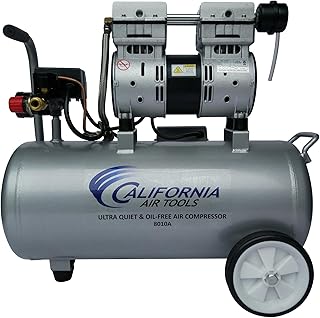
At 60 dBA this is the one you can run in a condo at 9 p.m. without incident, and the aluminum 8-gallon tank keeps weight low enough to reposition alone. The tradeoff is a taller silhouette and a 1.0 HP motor that recovers more slowly, so it suits trim and inflation rather than sustained high-demand tools.
DEWALT 4.5-Gallon Hand Carry (D55146)
The best answer when the compressor must be stored somewhere other than where it’s used. A 225 PSI maximum stores more usable air in a smaller tank, and the wheels plus retracting handle let it roll out of a closet like a piece of luggage.
Frequently Asked Questions
Can I run a compressor in an apartment?
Yes, with two caveats: choose a quiet model in the 60 dBA range, and set it on a rubber mat or carpet remnant so vibration doesn’t transmit through the floor to the unit below.
What size do I need for furniture assembly?
A 4 to 6 gallon tank delivering around 2.0 CFM at 90 PSI covers brad nailers, staplers, and finish nailers with room to spare. Larger tanks only matter for sanders, grinders, and framing guns.
Should I choose pancake or vertical?
Pancake for under-bench and low-shelf storage; vertical or hot-dog when floor space is scarce but height is available, such as a closet corner or beside a water heater.
How should I store it between projects?
Drain the tank, coil the hose on a wall hook or reel, and store the unit off the floor if possible. An oil-free pump tolerates any orientation, which opens up shelf and cabinet options a lubricated model can’t use.
Final Thoughts
For most small-space woodworkers, the DEWALT DWFP55126 pancake delivers the best capability per square foot and slides out of sight when the job’s done. If shared walls are your constraint, the California Air Tools 8010A is the quieter neighbor-proof alternative, and the Bauer 12V/20V inflator is the one to buy if you only ever needed air for tires and inflatables in the first place.