Key takeaways
- Cut depth versus your real stock: Most units in this class top out near 1/2 inch, which handles basswood, plywood offcuts, acrylic sheet, and PCB comfortably. If you regularly cut 3/4-inch hardwood, this category will frustrate you — check the millimeter spec, not the marketing copy.
- Motor count and what it buys you: Dual-motor designs let you keep a blade on one spindle and a sanding disc or drill chuck on the other, which eliminates the swap-out step. That’s a genuine time saver in a cramped space where you can’t leave tools scattered.
- Speed control granularity: Seven-speed adjustment isn’t marketing filler. Acrylic melts at blade speeds that cut wood cleanly, and PCB fiberglass dulls edges fast at high RPM. Variable speed is the difference between one saw and three.
- Table material and flatness: Aluminum alloy beds resist the slow warp that plagues plastic tables, and they stay flat after being stored on end in a closet. Run a straightedge across the surface when it arrives.
- Storage profile: Measure the unit’s height with the blade guard on and the power supply attached. A saw that lives on a shelf between sessions needs to actually fit that shelf, cables included.
What's inside
Anyone who has tried to rip a strip of basswood on a kitchen counter knows the real constraint isn’t skill, it’s square footage. A full-size contractor saw wants a dedicated bay, a dust collector, and eighteen inches of clearance on every side. If your shop is a closet, a balcony, or the third drawer of a dresser you cleared out last spring, that math never works. What you actually need is a saw that cuts clean at 1/8-inch scale, stores vertically, and doesn’t fill the apartment with airborne cedar.
Hobby table saws solve that problem, but the category is crowded with near-identical units under different brand names, and the specs that matter get buried. This guide breaks down what separates a saw that holds a straight line from one that wanders after a month, which motor configurations earn their footprint, and how to judge cut depth against the material you actually work with. Below are the models worth your bench space in 2026.
As an Amazon Associate we earn from qualifying purchases.


![Mini Table Saw for Crafts[Dual 795 Motors & Switches] Max 200W/12,000RPM/26mm Adjustable Height Table Saw with Accessories.Gift for Men and Women's Creating Handmade Gifts,Exploring Hobbies](https://m.media-amazon.com/images/I/71sGFH6lRdL._AC_UL320_.jpg)

How to Choose a/an Hobby Table Saw (2026)
- Cut depth versus your real stock: Most units in this class top out near 1/2 inch, which handles basswood, plywood offcuts, acrylic sheet, and PCB comfortably. If you regularly cut 3/4-inch hardwood, this category will frustrate you — check the millimeter spec, not the marketing copy.
- Motor count and what it buys you: Dual-motor designs let you keep a blade on one spindle and a sanding disc or drill chuck on the other, which eliminates the swap-out step. That’s a genuine time saver in a cramped space where you can’t leave tools scattered.
- Speed control granularity: Seven-speed adjustment isn’t marketing filler. Acrylic melts at blade speeds that cut wood cleanly, and PCB fiberglass dulls edges fast at high RPM. Variable speed is the difference between one saw and three.
- Table material and flatness: Aluminum alloy beds resist the slow warp that plagues plastic tables, and they stay flat after being stored on end in a closet. Run a straightedge across the surface when it arrives.
- Storage profile: Measure the unit’s height with the blade guard on and the power supply attached. A saw that lives on a shelf between sessions needs to actually fit that shelf, cables included.
The Best Hobby Table Saw (2026)s Reviewed
RTOVZON 7-Speed Portable Hobby Saw
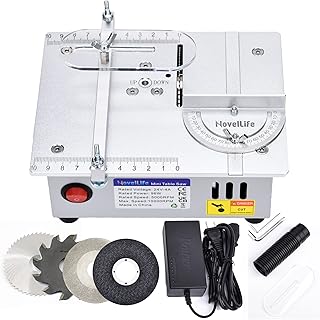
The aluminum alloy body earns its place here — it stays dimensionally stable across humidity swings that would bow a plastic bed, and four included blades cover wood, plastic, and softer metals without a separate purchase. Seven-speed control makes it the most versatile single-purchase option for someone building a shop from zero.
MXBAOHENG Mini Table Saw S3
A precision-first design with a 1/2-inch adjustable cut depth and seven-speed power supply, tuned for miniature woodworking where a half-millimeter of drift ruins a joint. The fence holds its setting better than most in this price bracket, which matters when you’re cutting twenty identical pieces for a dollhouse frame.
Dual 795 Motor Table Saw, 200W
At 200W and 12,000 RPM with two independent motors and switches, this is the most capable unit here for anyone pushing past balsa into harder stock. The 26mm adjustable height and dual-switch layout let you stage two operations at once — worth the extra footprint if your bench can spare it.
MXBAOHENG 96W 7-Speed Precision Saw
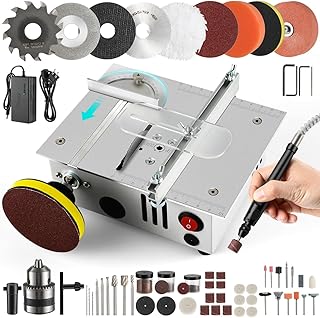
Ships with both a drill chuck and sanding disc, making it a legitimate three-tool station on a single base — a real advantage when storage, not budget, is your limiting factor. Well-suited to model builders working across wood, plastic, and PCB in the same session.
Mini Hobby Bench Saw with 63mm HSS Blade
The 63mm HSS circular blade gives it slightly more reach than the smaller-diameter competition, and the adjustable power supply keeps cuts clean in softer woods. A straightforward, no-frills pick for cutting stock rather than multi-tasking.
Frequently Asked Questions
Can these saws cut 3/4-inch hardwood?
No. Cut depths in this category run around 1/2 inch or less. For dimensional lumber you need a benchtop saw, which is a different tool class with a much larger footprint and dust output.
How much dust do they actually produce?
Considerably less than a full-size saw, but enough that you’ll want a shop vac nozzle nearby and a mat underneath. Cutting acrylic at the right speed produces chips rather than fine dust, which is far easier to contain in a living space.
Do I need a dedicated bench?
Not necessarily, but you do need to clamp or secure the unit. These saws are light enough to shift under lateral pressure, which is the main cause of wandering cuts. A folding workbench or a clamped-down cutting board works fine.
Are the included blades worth keeping?
Use them to learn the machine, then upgrade. Aftermarket blades in the same diameter cut noticeably cleaner and last longer, and they’re inexpensive enough that stocking two or three specialized blades makes sense.
Final Thoughts
For most small-space hobbyists, the RTOVZON 7-Speed Portable Hobby Saw offers the best balance of a stable aluminum bed, four blades out of the box, and a storable profile. If precision on repeat cuts is your priority, the MXBAOHENG Mini Table Saw S3 holds its settings more reliably, and anyone who needs sanding and drilling from the same footprint should look at the MXBAOHENG 96W 7-Speed with its included chuck and disc.