Key takeaways
- Pro: The Twin XL footprint fits standard bedroom layouts without dominating the space, which matters when the bed must coexist with a walker and bedside furniture.
- Pro: Electric adjustment at this price eliminates manual cranks that wear out quickly under daily use.
- Con: At under four hundred dollars, the rail attachment points and motor longevity carry noticeable risk over multi-year use.
What's inside
Caring for someone at home who needs a hospital bed is not the same as shopping for furniture. You are solving a concrete problem: a loved one with limited mobility, post-surgical recovery, or a chronic condition needs a surface that supports safe transfers, proper positioning for circulation and breathing, and a caregiver who can make adjustments without straining their own back. That is what separates a good bed from a bad one — motor reliability, rail strength, and how intuitive the controls feel at 2 a.m. when you are half asleep and the patient is in distress.
The market in 2026 has improved considerably, but the gap between products is wide. Some beds use cheap motors that fail within months, rails that flex under load, or controllers so poorly labeled that caregivers abandon them in favor of manual adjustments. Others deliver genuinely clinical-grade function at prices that do not require a second mortgage. We compared each of these eight on the metrics that matter in a home-care environment, and here is what we found.
As an Amazon Associate we earn from qualifying purchases at no extra cost to you. Product prices and availability are accurate as of the date shown and are subject to change.





Quick Picks
| Product | Best for | Price |
|---|---|---|
| AbyssZen Twin XL | Tightest budgets with a single user | $384.99 |
| ARMONYO 5 Function | Premium full-featured medical setup | $1990 |
| Full Electric Hospital Bed Package | Complete bundle with mattress included | $819.99 |
| HaiyoHBED 4 Function | Higher weight capacity needs | $1199 |
| SierraSquad | Simple handheld control for caregivers | $989.99 |
| Electric Hospital Bed Set | Straightforward medical adjustments | $798.98 |
| Real Relax 2 Function | Minimalist ICU-style care | $949.99 |
| Fuzren 5 Function | Height-adjustable bedside positioning | $1699.99 |
How We Picked
We evaluated each bed on four criteria that directly affect daily home care. First, motor quality and reliability — a bed that stops adjusting mid-use is worse than no bed at all. Second, rail and frame construction — solid attachment points and load ratings that tolerate real-world caregiver weight on the rails during transfers. Third, control usability — whether a tired caregiver or cognitively impaired patient can operate it without a manual. Fourth, included accessories — mattress, table, and IV pole availability determines whether you are building a complete care station or buying components separately and paying more.
The 8 Best Hospital Beds For Home Care in 2026
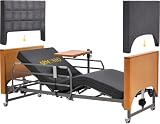
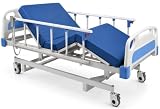
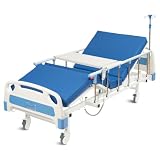
AbyssZen Home Care Electric Adjustable Bed Frame with Safety Rail, Twin XL
This is the entry point that makes sense when you need basic positioning support without spending triple digits on clinical features. It is for a single user in a smaller room who needs head and foot elevation plus a safety rail and nothing more.
- Pro: The Twin XL footprint fits standard bedroom layouts without dominating the space, which matters when the bed must coexist with a walker and bedside furniture.
- Pro: Electric adjustment at this price eliminates manual cranks that wear out quickly under daily use.
- Con: At under four hundred dollars, the rail attachment points and motor longevity carry noticeable risk over multi-year use.
Skip it if the patient exceeds the frame’s practical comfort weight or if you need Trendelenburg, chair position, or height adjustment. It is a stopgap, not a long-term care solution.
ARMONYO Electric Hospital Bed – 5 Functions
The ARMONYO is what you buy when you want near-institutional quality at home and budget is secondary to reliability. The German LIMOSS motor is the standout spec here — it is the same drivetrain class found in clinical settings, and the double solid wood panels with upholstered covers make it look like furniture rather than equipment.
- Pro: The five-function control set covers every positioning need including Trendelenburg and reverse Trendelenburg, which matters for circulatory issues and post-surgical protocols.
- Pro: The included medical overbed table and foldable rails create a complete care station without additional purchases.
- Con: The price is roughly double the mid-tier options, and the assembly requires more time than a single caregiver can manage alone.
Skip it if the care need is temporary or if a lower-cost bed with three functions would cover your daily routine without the premium.
Full Electric Hospital Bed Package
This package earns its spot because it bundles a foam mattress and half rail set with the frame at a price that saves you from sourcing components individually. It is for someone who wants a turnkey setup on a mid-range budget without worrying about compatibility between mattress firmness and frame slat spacing.
- Pro: The included half rails provide fall protection while still allowing the patient to exit the bed independently, which is a common preference for those maintaining mobility.
- Pro: Total package cost under the thousand-dollar mark undercuts buying comparable components separately.
- Con: The foam mattress included in bundled packages tends to be the thinnest and least durable element, often the first thing you replace.
Skip it if you already own a compatible medical mattress or if the patient requires a specific mattress type (pressure-relieving, alternating air) that overrides bundled foam.
HaiyoHBED 4 Function 600LBS Full Electric Hospital Bed
The 600-pound weight capacity puts this bed in a category most competitors cannot serve. It is designed for bariatric patients or heavier individuals whose home-care needs are underserved by standard beds rated well below that threshold. The IV pole and mattress inclusion round out a package built for real medical use.
- Pro: A 600-pound capacity provides genuine structural safety margin, which reduces frame flex and vibration noise during adjustment.
- Pro: Four functions cover head, foot, and height adjustment plus a chair position that most three-function beds omit.
- Con: The higher capacity demands a reinforced floor surface in older homes, and the footprint is larger than standard twin or full configurations.
Skip it if the patient weighs well under the rated capacity and does not need the extra structural reinforcement — you are paying for capacity you will not use.
SierraSquad Electric Home Care Hospital Bed with Handheld Control
The SierraSquad focuses on the one interaction that happens dozens of times per day: adjusting the bed while the patient is in it. The handheld control is the selling point — simple, large buttons that work from the pillow, from the chair side, or from a seated position in bed.
- Pro: The handheld control design reduces caregiver strain compared to side-mounted panels that require reaching across the patient.
- Pro: The price sits comfortably mid-range, offering electric adjustability without the cost of five-function clinical packages.
- Con: Fewer included accessories means you will likely purchase a mattress and overbed table separately, adding to total cost.
Skip it if you need height adjustment for caregiver ergonomics or Trendelenburg positioning for medical protocols.
Electric Hospital Bed for Home Use – Foam Mattress, Half Rails
This set occupies the same value tier as the Full Electric Hospital Bed Package but differentiates slightly on rail style and mattress thickness. It is for buyers who want adjustable positioning, basic fall protection, and an included mattress without any single component being a dealbreaker.
- Pro: The under-eight-hundred price with mattress and rails included is competitive for buyers assembling a complete care bed from scratch.
- Pro: Half rails preserve patient autonomy for self-transfers while preventing full bed exits.
- Con: Build quality and motor ratings are not detailed clearly enough to distinguish it from similarly priced generic frames, creating uncertainty about long-term reliability.
Skip it if you require documented load ratings or if the patient needs full-length rails for dementia-related safety concerns.
Real Relax Premium 2 Function Full Electric Hospital Bed
Two functions at under a thousand dollars positions the Real Relax as a minimalist medical bed for caregivers who know exactly what they need. Head and foot elevation, a locking caster set, an IV pole, a dining board, and a four-inch foam mattress cover the essentials without five-function complexity that many home users never activate.
- Pro: The 530-pound loading capacity exceeds most competitors in its price bracket, making it a viable option for heavier patients without jumping to bariatric pricing.
- Pro: The five-inch locking casters are a practical safety detail often overlooked in lower-tier beds, preventing unintended drift on hard floors.
- Con: Two functions means no height adjustment, which forces the caregiver into poor back mechanics during prolonged bedside care.
Skip it if the caregiver is shorter than average or if transfers require the bed to match wheelchair or toilet height.
Fuzren Premium Full Electric Hospital Bed, 5 Function
The Fuzren earns its premium price through height adjustability and individual locking — two features that materially change how a caregiver interacts with the bed throughout the day. Raising the bed to elbow height for wound care or lowering it for safe patient transfers eliminates the back strain that defines long-term caregiving.
- Pro: Height adjustment combined with five functions means the bed adapts to the task — feeding, wound care, therapy, or rest — without compromising positioning for any of them.
- Pro: Individual wheel locks and included sheets reduce the number of add-on purchases required after delivery.
- Con: At nearly seventeen hundred dollars, it sits just below ARMONYO pricing without matching its motor brand pedigree or table inclusion.
Skip it if height adjustment is not a daily need — the price premium over three-function beds is difficult to justify for static-position care routines.
Buying Guide
Motor Functions: Two, Four, or Five
Two-function beds move the head and foot sections only. Four-function beds add height adjustment and a chair position. Five-function beds include Trendelenburg (head down, feet up) and reverse Trendelenburg. For most home-care scenarios, three to four functions hit the sweet spot. Full five-function capability is genuinely useful only when a physician has prescribed specific positioning for circulatory, respiratory, or post-surgical reasons. Do not pay for functions your care plan does not require.
Rail Type and Patient Safety Needs
Full-length rails prevent a patient from rolling out entirely and are necessary for individuals with confusion, dementia, or nighttime disorientation. Half rails allow the patient to exit the bed independently, supporting mobility maintenance and reducing claustrophobia. The wrong rail choice is not a comfort issue — it is a safety decision. Assess whether the patient can perform a safe transfer unassisted before selecting rail style.
Weight Capacity and Structural Margin
Always add a buffer to the patient’s actual weight. Caregivers often lean on or sit on the bed during transfers, and therapy activities introduce dynamic load beyond static body weight. A bed rated at five hundred pounds handling a three-hundred-pound patient plus a caregiver’s weight during a transfer sits at practical capacity. Choose beds rated well above the patient’s weight to avoid long-term frame fatigue and motor strain.
Our Verdict
The ARMONYO 5 Function is our top pick for anyone building a permanent home-care station. The LIMOSS motor, included table, and five-function range make it the bed that covers every scenario without upgrades or workarounds. For budget buyers who need basic adjustability without compromise on core function, the AbyssZen Twin XL delivers electric head and foot elevation with a safety rail at a price that makes it a rational starting point. The one condition that changes this ranking: if height-adjustable caregiver ergonomics are your primary concern and five-function pricing feels excessive, the Fuzren 5 Function delivers height adjustment with strong included accessories at a lower premium than ARMONYO.
FAQ
Does Medicare or insurance cover hospital beds for home use?
Medicare Part B covers a semi-electric or fully electric hospital bed as durable medical equipment when a physician prescribes it for a documented medical need. You must order through a Medicare-approved supplier, and coverage typically applies only to the frame and motor, not the mattress or accessories.
How long do hospital bed motors last in home use?
A quality motor under daily two to four adjustment cycles should last five to eight years before meaningful wear. Lower-cost motors in budget beds often degrade noticeably within two to three years, producing slower response, increased noise, and eventual position drift.
What mattress type works best on a hospital bed frame?
A four-inch foam mattress is the standard for basic comfort and skin protection. For patients with limited mobility and pressure ulcer risk, an alternating air or gel-infused foam mattress provides superior pressure redistribution but requires a compatible frame with adequate clearance. Match mattress thickness to the rail height to maintain fall protection.
Can I use a hospital bed in a standard bedroom?
Yes, provided you have sufficient floor space for the bed footprint plus a three-foot clearance on at least one side for caregiver access. Many newer home-care beds like the ARMONYO and Fuzren use upholstered panels and wood finishes specifically to reduce the institutional appearance in a residential setting.