Key takeaways
- Slot compatibility: Confirm that the gauge matches your saw’s slot dimensions, most commonly a 3/4-inch-wide by 3/8-inch-deep track. A close fit with minimal side play is essential for accurate cuts.
- Fence length: A longer fence supports wider stock, but it also needs more storage room. Compact users should favor a manageable fence with a reliable flip stop rather than maximum length alone.
- Angle indexing: Positive stops make common settings faster and more repeatable. Look for clearly defined positions and a fine adjustment feature when joinery accuracy matters.
- Adjustment and stability: A spring-loaded plunger, adjustable bar, or similar anti-slop system helps the gauge track smoothly. The handle should lock the setting firmly without excessive force.
- Workpiece control: A sturdy fence and effective stop improve repeat cuts, especially on chair parts, face frames, and cabinet components. Removable stops are useful when cutting oversized or unusually shaped stock.
What's inside
Choosing a mitre gauge for a table saw is less straightforward than it looks. A loose fit, a short fence, or vague angle settings can turn a simple crosscut into a frustrating exercise in repeated measuring and correction. In a compact workshop, the problem is magnified: every tool must earn its storage space while still delivering dependable accuracy.
This guide focuses on the features that matter most in real furniture-making work, including slot compatibility, fence support, repeatability, angle adjustment, and space-saving design. The selections range from compact gauges for smaller benches to extended-fence models suited to wider panels and repeated production cuts.
As an Amazon Associate we earn from qualifying purchases.


How to Choose a Mitre Gauge For Table Saw (2026)
- Slot compatibility: Confirm that the gauge matches your saw’s slot dimensions, most commonly a 3/4-inch-wide by 3/8-inch-deep track. A close fit with minimal side play is essential for accurate cuts.
- Fence length: A longer fence supports wider stock, but it also needs more storage room. Compact users should favor a manageable fence with a reliable flip stop rather than maximum length alone.
- Angle indexing: Positive stops make common settings faster and more repeatable. Look for clearly defined positions and a fine adjustment feature when joinery accuracy matters.
- Adjustment and stability: A spring-loaded plunger, adjustable bar, or similar anti-slop system helps the gauge track smoothly. The handle should lock the setting firmly without excessive force.
- Workpiece control: A sturdy fence and effective stop improve repeat cuts, especially on chair parts, face frames, and cabinet components. Removable stops are useful when cutting oversized or unusually shaped stock.
The Best Mitre Gauge For Table Saw (2026)s Reviewed
GOINGMAKE Compact Table Saw Miter Gauge
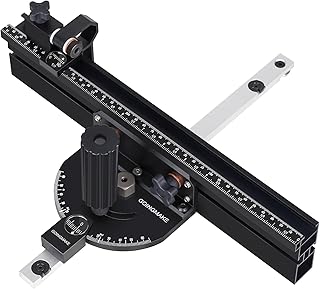
This compact GOINGMAKE model is a sensible choice for a small-space workshop where bench area and storage are limited. Its 360mm fence, flip stop, and positive angle stops provide useful control for crosscuts and mitres without the bulk of a full-length production gauge. It is particularly appealing for trim, narrow furniture parts, and occasional cabinet work, provided your saw uses a 3/4-inch by 3/8-inch slot.
GOINGMAKE 18-Inch Micro-Adjust Miter Gauge
With an 18-inch fence, micro-adjust flip stop, and 13 indexed angle positions, this GOINGMAKE gauge balances versatility with a relatively compact footprint. The indexed settings speed up common operations, while micro-adjustment helps fine-tune repeat cuts when a nominal angle is not quite enough. It is a strong all-purpose option for home furniture projects.
GOINGMAKE Extendable 18–32-Inch Miter Gauge
The extendable GOINGMAKE model is designed for users who need more support occasionally but do not want a permanently oversized setup. Its fence expands from 18 to 32 inches, making it better suited to wider panels and longer components, while the 13 angle stops and micro-adjust flip stop support repeatable work. Plan a dedicated storage location for the extended fence hardware.
VEVOR Precision Miter Gauge
VEVOR’s precision gauge combines an 18-inch aluminum-alloy fence with 15 angle stops, an adjustable spring-loaded plunger, and a removable disc. That combination gives it useful flexibility for general woodworking, particularly where smooth tracking and quick angle changes are priorities. Its standard 3/4-inch by 3/8-inch sizing makes slot measurement a necessary pre-purchase check.
WEN WA1401 Premium Miter Gauge
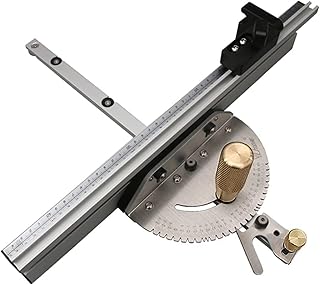
The WEN WA1401 stands out for its 27 angle stops, offering more indexed positions than most budget-oriented gauges. Its steel-and-brass construction is suited to woodworkers who want a traditional, substantial feel across table saws, router tables, and band saws. It may take more room than a compact gauge, but the broad angle range is valuable for varied furniture designs.
Frequently Asked Questions
Are all table saw mitre gauges interchangeable?
No. Many saws use a 3/4-inch by 3/8-inch slot, but dimensions and tolerances can vary. Measure the slot before buying and check whether the gauge includes adjustments to remove side-to-side play.
Do I need a long fence for furniture making?
Not always. A long fence helps stabilize wide or lengthy stock, but it can be awkward in a compact shop. For small components, a shorter fence with a dependable stop is often easier to control and store.
What is a micro-adjust feature useful for?
Micro-adjustment allows small corrections after setting an approximate angle or stop position. It is helpful when fitting mitred frames, aligning repeated parts, or compensating for tiny inaccuracies in a project.
Can a mitre gauge replace a crosscut sled?
It can handle many crosscuts, but a crosscut sled usually offers greater support and can improve safety when cutting larger panels. A mitre gauge remains more flexible for angled work and takes less storage space.
Final Thoughts
For compact workshops, the GOINGMAKE Compact is an efficient starting point, while the GOINGMAKE 18-Inch Micro-Adjust offers the best balance of control and versatility. Choose the extendable GOINGMAKE for wider stock, or the WEN WA1401 if a broad range of indexed angles matters most.