Key takeaways
- Room fit: A 1,500-watt radiator is commonly suited to a modest bedroom, office, or living zone, but insulation, ceiling height, and drafts affect performance. Choose a heater for the space you actually occupy rather than trying to heat an entire open-plan home.
- Controls: Dual knobs are simple and quick, while digital thermostats, remotes, timers, and ECO modes make it easier to maintain comfort without repeated trips across the room.
- Safety: Look for tip-over protection, overheat protection, and a reputable safety certification. Keep the heater on a hard, level surface with generous clearance from curtains, bedding, upholstery, and stored items.
- Footprint: Radiators are relatively slim but often tall. Measure the intended parking spot, including space for the power cord, and avoid placing one where a door, drawer, or walkway could collide with it.
- Daily comfort: Oil-filled heaters are quiet because they do not rely on a fan. Expect slower startup than a forced-air heater, but more even, less drafty warmth once the radiator comes up to temperature.
What's inside
Cold rooms are not always a whole-home heating problem. In a compact bedroom, drafty home office, or apartment living area, the challenge is finding a heater that adds steady warmth without consuming valuable floor space, creating distracting fan noise, or becoming a trip hazard. Oil-filled radiators are especially appealing for small homes because they warm gradually and continue radiating heat after the heating element cycles off.
This guide compares five practical options for 2026, with attention to room placement, controls, safety features, and everyday usability. Rather than focusing only on wattage, I’m looking at how each heater fits into real furniture layouts—beside a desk, under a window, or in an open corner where airflow and clearance matter.
As an Amazon Associate we earn from qualifying purchases.



How to Choose a/an Oil-Filled Space Heater (2026)
- Room fit: A 1,500-watt radiator is commonly suited to a modest bedroom, office, or living zone, but insulation, ceiling height, and drafts affect performance. Choose a heater for the space you actually occupy rather than trying to heat an entire open-plan home.
- Controls: Dual knobs are simple and quick, while digital thermostats, remotes, timers, and ECO modes make it easier to maintain comfort without repeated trips across the room.
- Safety: Look for tip-over protection, overheat protection, and a reputable safety certification. Keep the heater on a hard, level surface with generous clearance from curtains, bedding, upholstery, and stored items.
- Footprint: Radiators are relatively slim but often tall. Measure the intended parking spot, including space for the power cord, and avoid placing one where a door, drawer, or walkway could collide with it.
- Daily comfort: Oil-filled heaters are quiet because they do not rely on a fan. Expect slower startup than a forced-air heater, but more even, less drafty warmth once the radiator comes up to temperature.
The Best Oil-Filled Space Heater (2026)s Reviewed
PELONIS Radiator Heater for Large Space
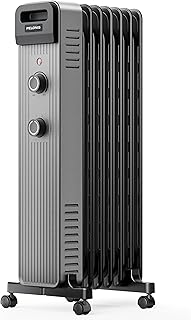
This straightforward PELONIS radiator is a strong choice for shoppers who prefer physical controls and uncomplicated operation. Its 1,500-watt output, three heat modes, dual knobs, and quiet radiant design suit a bedroom or home office where a bright display or remote would feel unnecessary. Tip-over protection adds useful peace of mind, though its larger profile deserves a deliberate spot away from busy walkways.
Pelonis 2025 Upgraded Oil-Filled Radiator
The upgraded Pelonis model is built around the same practical appeal: quiet warmth, three heating modes, an adjustable thermostat, and protective shutdown features. Its black finish can blend neatly with darker desks, shelving, and media furniture, making it a sensible option when a white radiator would stand out too much in a carefully arranged room.
Amazon Basics Portable Oil Radiator Heater
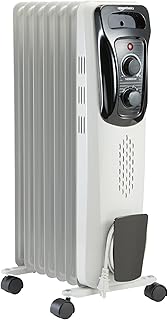
The Amazon Basics model is particularly useful when dimensions matter because its listed size makes planning easier before purchase. Seven oil-filled steel fins provide the familiar radiator format, while three heat settings, tip-over protection, overheat protection, and ETL certification cover the basics. Its white finish is visually clean, but reserve enough open space around the taller body for safe operation.
DREO Oil-Filled Radiator Heater
DREO is the most feature-rich pick in this group, adding a digital thermostat, remote control, ECO mode, four operating modes, child lock, and a 24-hour timer. Those controls are valuable in a multipurpose room where the heater needs to fit around work, sleep, or family routines. It is a particularly compelling choice for someone who wants precise adjustments without bending down to reach manual dials.
CAYNEL Space Oil-Filled Radiator Heater
The CAYNEL combines an adjustable thermostat and 24-hour timer with three heat modes in an understated black design. It makes sense for a home office or compact bedroom where predictable scheduling can reduce fiddling throughout the day. As with any tall radiator, place it where the cord can reach an outlet without crossing a walking path.
Frequently Asked Questions
Are oil-filled heaters expensive to run?
Operating cost depends on the heater’s wattage, local electricity rate, and how long it runs. A 1,500-watt model uses more electricity while actively heating than a lower-wattage unit, but its thermostat can cycle the element off once the room reaches the target temperature. Use the lowest comfortable setting and heat the occupied zone rather than an empty room.
Do oil-filled radiators need oil added?
No. The oil is sealed inside the radiator at the factory and is not intended to be drained, topped up, or replaced by the user. If the casing is damaged or oil appears to leak, unplug the unit and discontinue use.
Can I leave an oil-filled heater on overnight?
Only follow the manufacturer’s instructions and use a model with appropriate overheat and tip-over protection. Keep it on a clear, level, nonflammable surface, never cover it, and do not run it through an extension cord or power strip unless the manufacturer specifically permits that arrangement. A timer can provide an extra layer of convenience, not a substitute for safe placement.
Where should an oil-filled radiator go in a small room?
Choose an open location near the area you want to warm, often along an interior wall or beneath a window if clearance requirements allow. Keep it away from beds, curtains, sofas, clothing, and paper; never tuck it behind furniture, since blocked airflow and heat buildup can create hazards.
Final Thoughts
For simple, dial-based heating, the PELONIS Radiator Heater is an appealing everyday pick, while the Amazon Basics model is helpful when its clearly stated dimensions simplify furniture planning. If you want the most control, the DREO Oil-Filled Radiator stands out with its digital thermostat, remote, ECO mode, child lock, and timer—features that can make a small room more comfortable without adding organizational clutter.