Key takeaways
- Non-detergent formulation: Pump crankcases have no filter. Detergent oils suspend particles that then circulate through the bearings instead of settling harmlessly at the bottom, so verify the label says non-detergent before anything else.
- Viscosity match: Most axial and triplex pumps call for SAE 30 or a 15W-40 equivalent. Check the plate on your pump housing rather than the washer’s model number — pump manufacturers and washer brands are often different companies.
- Container size versus your shelf: A gallon is the better per-ounce value but a poor choice if it lives sideways in a bin. For a single homeowner machine, a 21-ounce or 1-liter bottle covers several oil changes and fits upright on a narrow shelf.
- Anti-foam and corrosion additives: Plunger movement whips air into the oil. Look for stated anti-foam properties plus rust inhibitors, especially if your unit sits unused through humid months.
- Pump-brand compatibility: CAT, General, AR, and Comet pumps each publish approved fluids. Buying the oil listed for your pump brand removes any warranty argument later.
What's inside
If your pressure washer lives in a hall closet, under a stairwell, or wedged behind the patio door, you already know the storage math: every quart of fluid you keep has to earn its shelf space. That’s exactly why pump oil gets forgotten. It isn’t glamorous, the bottle is small, and it disappears behind the paint cans until the day your pump starts groaning and you realize the crankcase has been running on whatever was left from two seasons ago.
Pump oil is non-detergent, non-foaming lubricant designed for the reciprocating plungers inside your washer’s pump — and it is not interchangeable with motor oil, no matter what the internet says. This guide covers the bottles worth keeping in a tight space: which formulations actually protect brass and ceramic components, how to read a viscosity spec without a manual in hand, and which sizes make sense when you only service one machine a year.
As an Amazon Associate we earn from qualifying purchases.

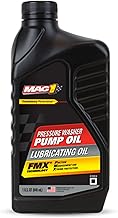
How to Choose a Oil For Pressure Washer Pump (2026)
- Non-detergent formulation: Pump crankcases have no filter. Detergent oils suspend particles that then circulate through the bearings instead of settling harmlessly at the bottom, so verify the label says non-detergent before anything else.
- Viscosity match: Most axial and triplex pumps call for SAE 30 or a 15W-40 equivalent. Check the plate on your pump housing rather than the washer’s model number — pump manufacturers and washer brands are often different companies.
- Container size versus your shelf: A gallon is the better per-ounce value but a poor choice if it lives sideways in a bin. For a single homeowner machine, a 21-ounce or 1-liter bottle covers several oil changes and fits upright on a narrow shelf.
- Anti-foam and corrosion additives: Plunger movement whips air into the oil. Look for stated anti-foam properties plus rust inhibitors, especially if your unit sits unused through humid months.
- Pump-brand compatibility: CAT, General, AR, and Comet pumps each publish approved fluids. Buying the oil listed for your pump brand removes any warranty argument later.
The Best Oil For Pressure Washer Pump (2026)s Reviewed
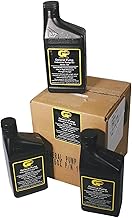
Stens Pump Oil for General Pump 100214
This is the straightforward answer for anyone running a General Pump, matching the OEM 100214 spec without the OEM markup. The single-use bottle size is genuinely convenient in a small utility area — you use it, you toss it, nothing half-full takes up residence on your shelf.
Valley Industries Premium Pump Oil, 1 Liter
A liter is the sweet spot for most homeowners: enough for three or four crankcase changes on a consumer-grade unit, in a bottle that stands upright without tipping. The pour spout is well shaped for the tight fill ports on axial pumps, which matters more than you’d expect when you’re working in a cramped corner.
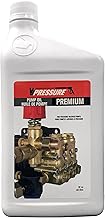
Pressure Washer Pump Oil, 21 Oz. (CAT Compatible)
Formulated specifically for CAT pump maintenance intervals, with corrosion and wear protection called out on the label. At 21 ounces it’s the most space-efficient pick here — roughly the footprint of a water bottle, easy to slot into a door caddy or wall-mounted rack.
60694 Pump Oil, 1 Quart
A dependable general-purpose quart that covers a wide range of consumer pumps without brand-specific fuss. If you own more than one machine or a small trailer setup, this is the practical middle ground between single-use bottles and a full gallon.
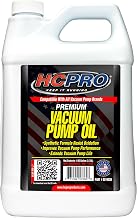
HCPRO HCVPO128 Synthetic Pump Oil, 1 Gallon
A non-misting synthetic built for vacuum and refrigeration pumps that also suits high-cycle pressure washer service, made in the USA. The gallon size is for people with real shelf depth — worth it if you’re maintaining multiple units, overkill for a single seasonal washer.
Frequently Asked Questions
Can I use regular motor oil in my pressure washer pump?
Not advisably. Motor oils carry detergent packages designed for engines with filters; your pump has none, so those additives keep abrasive particles in circulation. Some manufacturers void warranties over it.
How often should the pump oil be changed?
Most manufacturers specify an initial change after 50 hours, then every 200 to 300 hours or annually — whichever arrives first. For a homeowner using the machine a few weekends a year, once per season is the honest interval.
What if my pump has no drain plug?
Many entry-level axial pumps are sealed and not intended for oil service. Check for a plug or a fill cap with a dipstick; if neither exists, the pump is designed to run its life on factory fluid.
How should I store pump oil in a small home?
Upright, capped tightly, away from temperature swings. A shallow bin on a closet shelf with your other maintenance supplies keeps it visible — oil you can’t see is oil you’ll forget to use.
Final Thoughts
For most readers with one machine and limited storage, the Valley Industries 1-liter bottle hits the best balance of value, size, and quality. General Pump owners should default to the Stens 100214-spec oil for a guaranteed match, and anyone running a CAT pump will be well served by the 21-ounce specialized lubricant — compact, correctly formulated, and easy to tuck away until next season.