Key takeaways
- Match BTU to the room, not the house: Around 8,000 BTU suits a bedroom or study up to roughly 350 sq ft. Reach for 14,000–16,000 BTU only for open-plan living space or a converted loft with significant glazing. Oversizing wastes energy and cycles the compressor too quickly to dehumidify properly.
- Single hose versus dual hose: Single-hose units expel indoor air, creating negative pressure that draws warm air back in through gaps around doors and floorboards. Dual-hose designs draw and expel outdoor air separately, which makes a measurable difference in a draughty period property.
- Check your window before you buy: UK casement and sash windows rarely suit the sliding-window kits supplied. Measure the opening and confirm the kit adapts, or budget for a bespoke panel. This is the single most common source of buyer frustration.
- Drainage and evaporation: Auto-evaporation or drainage-free operation means no bucket to empty at 2am. In cooling mode most modern units recycle condensate; in dehumidifier mode you will still need a hose or tray.
- Storage volume, not just floor area: Measure the unit’s height and depth, then find where it will overwinter. Units with rear-recessed hose ports and stowable cables sit flatter against a wall or slide into a fitted wardrobe base more easily.
What's inside
British homes were built to hold heat in, not push it out. Solid brick walls, sash windows that only open four inches, listed-building rules that rule out a split system, and rental agreements that forbid drilling anything into an external wall. When a July heatwave pushes a top-floor flat past 30°C, a portable unit is often the only realistic option — but it also has to live somewhere the rest of the year, and that is where most buyers come unstuck. A 14,000 BTU box is roughly the footprint of a bedside table and the height of a kitchen bin.
This guide approaches portable air conditioning the way I approach any bulky appliance in a compact home: cooling power matters, but so does hose routing, off-season storage, and whether the thing can sit in a corner without dominating the room. Below are the units worth considering in 2026, followed by the specifications that actually change how a machine performs in a small British interior.
As an Amazon Associate we earn from qualifying purchases.


How to Choose a Portable Air Conditioner In Uk (2026)
- Match BTU to the room, not the house: Around 8,000 BTU suits a bedroom or study up to roughly 350 sq ft. Reach for 14,000–16,000 BTU only for open-plan living space or a converted loft with significant glazing. Oversizing wastes energy and cycles the compressor too quickly to dehumidify properly.
- Single hose versus dual hose: Single-hose units expel indoor air, creating negative pressure that draws warm air back in through gaps around doors and floorboards. Dual-hose designs draw and expel outdoor air separately, which makes a measurable difference in a draughty period property.
- Check your window before you buy: UK casement and sash windows rarely suit the sliding-window kits supplied. Measure the opening and confirm the kit adapts, or budget for a bespoke panel. This is the single most common source of buyer frustration.
- Drainage and evaporation: Auto-evaporation or drainage-free operation means no bucket to empty at 2am. In cooling mode most modern units recycle condensate; in dehumidifier mode you will still need a hose or tray.
- Storage volume, not just floor area: Measure the unit’s height and depth, then find where it will overwinter. Units with rear-recessed hose ports and stowable cables sit flatter against a wall or slide into a fitted wardrobe base more easily.
The Best Portable Air Conditioner In Uk (2026)s Reviewed
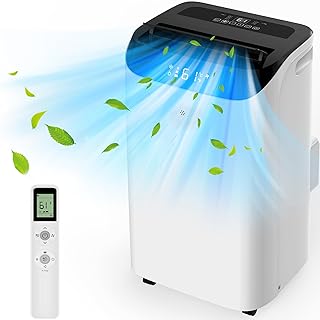
8,000 BTU 4-in-1 Portable Air Conditioner
The most sensible choice for a single bedroom or home office up to 350 sq ft, and the easiest of this group to tuck into a corner. Sleep mode combined with the 24-hour timer means it can cool the room before bed and drop to a low murmur overnight rather than running full tilt until morning.
ZAFRO Smart Inverter 16,000 BTU Dual Hose
The inverter compressor modulates output instead of hammering on and off, which delivers steadier temperatures and noticeably lower running costs over a long hot spell. Drainage-free cooling and dual-hose operation make this the strongest technical package here for a poorly sealed British room.
Garvee 14,000 BTU 3-in-1
Rated for spaces up to 750 sq ft, this is the unit to consider for a knocked-through ground floor or a kitchen-diner where a smaller machine simply cannot keep pace. The supplied window kit and remote cover the basics competently without inflating the price.
14,000 BTU Smart WiFi with Voice Control
App and voice control earn their keep in practice: you can start cooling a top-floor bedroom on your commute home rather than walking into stored afternoon heat. Auto-evaporation handles condensate in cooling mode, so there is no reservoir to monitor.
ZAFRO 16,000 BTU Upgraded 38dB
The revised model drops to 38dB on its lowest setting, quiet enough for a bedroom where a conventional compressor would be intrusive. Worth the small premium over the 42dB version if the unit will run through the night.
Frequently Asked Questions
Do I have to vent it out of a window?
Yes. Every portable air conditioner extracts heat and must discharge it outdoors through the exhaust hose. Venting into a room, cupboard or loft simply moves heat around and will make the space warmer, not cooler.
How much does one cost to run in the UK?
A 14,000 BTU unit typically draws 1.2–1.5kW, so expect roughly 30–40p per hour at current tariffs. Inverter models cut this significantly once the target temperature is reached, since they reduce output rather than shutting down and restarting.
Can I use it in a rented flat?
Generally yes, which is precisely why portables remain popular here. Nothing is permanently fixed, and window kits are removable. Check your tenancy agreement regarding window seals and confirm noise levels if you share walls with neighbours.
What is the best way to store it over winter?
Run it on fan mode for a few hours to dry the interior, drain any residual water, then coil the hose and store the unit upright. Keeping it vertical protects the compressor oil, so avoid laying it on its side under a bed.
Final Thoughts
For most British homes the 8,000 BTU 4-in-1 is the right answer — appropriately sized for a bedroom, easy to store, and quiet enough to sleep beside. If you are cooling an open-plan space or a heat-trapping loft conversion, the ZAFRO 16,000 BTU Upgraded 38dB offers the best combination of inverter efficiency and genuinely low noise, while the Garvee 14,000 BTU covers larger rooms at a more modest outlay.