Key takeaways
- Cooling method: Confirm whether the unit is an evaporative cooler or a compressor-based air conditioner. Evaporative models need water and perform best in dry air; true air conditioners usually need exhaust ventilation.
- Room conditions: Match the design to your climate and space. A water-based cooler can be useful in a dry bedroom or office, but it will not remove humidity and may feel less effective in a damp room.
- Tank capacity: Larger tanks reduce refill frequency, which is valuable when the unit sits in a hard-to-reach corner. Check whether the tank is removable and easy to clean.
- Footprint and mobility: Measure the intended parking spot before buying. Casters, a carry handle, and a slim profile make it easier to reposition the unit without blocking walkways.
- Controls and noise: Look for a remote, timer, oscillation, sleep mode, and several fan speeds. These features help you cool only when needed and avoid adding unnecessary noise to a small room.
What's inside
Finding a cooling solution for a room without a usable window can be surprisingly difficult. Traditional portable air conditioners need an exhaust hose, while many compact “ventless” models are actually evaporative coolers that work best in dry climates and require regular water or ice refills. The right choice depends on your room size, humidity, noise tolerance, and how much floor space you can spare.
This guide compares portable, window-free cooling options with a small-space organization mindset. We focus on tank capacity, controls, airflow direction, portability, and practical placement so you can choose a unit that cools comfortably without turning a bedroom, office, or apartment corner into a cluttered equipment zone.
As an Amazon Associate we earn from qualifying purchases.


How to Choose a Portable Air Conditioner Ventless (2026)
- Cooling method: Confirm whether the unit is an evaporative cooler or a compressor-based air conditioner. Evaporative models need water and perform best in dry air; true air conditioners usually need exhaust ventilation.
- Room conditions: Match the design to your climate and space. A water-based cooler can be useful in a dry bedroom or office, but it will not remove humidity and may feel less effective in a damp room.
- Tank capacity: Larger tanks reduce refill frequency, which is valuable when the unit sits in a hard-to-reach corner. Check whether the tank is removable and easy to clean.
- Footprint and mobility: Measure the intended parking spot before buying. Casters, a carry handle, and a slim profile make it easier to reposition the unit without blocking walkways.
- Controls and noise: Look for a remote, timer, oscillation, sleep mode, and several fan speeds. These features help you cool only when needed and avoid adding unnecessary noise to a small room.
The Best Portable Air Conditioner Ventless (2026)s Reviewed
Best for Compact Offices: Windowless 3-in-1 Evaporative Air Cooler
This white cooler is a sensible fit for a desk-adjacent office, reading nook, or small bedroom where a full-size appliance would crowd the floor. Its ice packs, seven-hour timer, and 70-degree oscillation offer targeted relief, while the compact design makes storage less disruptive when the weather changes.
Best for Longer Runtime: 24-Inch Windowless Portable AC
With a two-gallon tank, 15-hour timer, remote control, and 120-degree oscillation, this taller model is designed for extended use with fewer interruptions. It makes better sense in a bedroom or home office where broad airflow and a consistent routine matter more than the smallest possible footprint.
Best for Overnight Cooling: Windowless Portable Air Conditioner with Dual Tanks
The dual-tank setup and advertised 24-hour cooling focus on reducing refill chores, a helpful advantage for overnight use or anyone who prefers a set-and-forget arrangement. Its 28-foot remote, smart timer, and 120-degree oscillation also make it convenient when the unit is positioned across the room.
Best for Flexible Airflow: 4-in-1 Evaporative Air Cooler
This model combines three operating modes with six speeds and a three-gallon tank, giving you more control over airflow than a basic fan-style cooler. The larger reservoir suits shared living spaces, although its broader feature set may be more than a very small room needs.
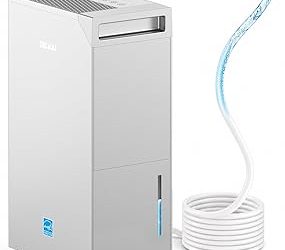
Best for Buyers Wanting Dehumidification: 8000 BTU 4-in-1 Portable Air Conditioner
Unlike the evaporative units above, this 8000 BTU model is positioned as a floor air conditioner with cooling, fan, dehumidifier, and sleep functions. Buyers should verify the installation requirements carefully: compressor-based portable AC units generally need a way to exhaust warm air, so “ventless” should not be treated as interchangeable with “no hose required.”
Frequently Asked Questions
Do ventless portable air conditioners need a window?
Evaporative coolers do not need a window hose because they cool air through water evaporation. Conventional compressor-based portable air conditioners typically do need exhaust ventilation, even when product titles use the term “ventless.”
Are evaporative coolers effective in humid climates?
They are generally most effective in dry climates. Because they add moisture to the air, performance can feel limited in humid rooms, and a dedicated air conditioner or dehumidifier may be a better choice.
How often should I clean a portable evaporative cooler?
Empty and dry the tank regularly, and follow the manufacturer’s instructions for cleaning the reservoir, filter, and cooling media. Frequent maintenance helps control odor, mineral buildup, and reduced airflow.
Where should I place one in a small room?
Leave clearance around the air intake and outlet, keep the unit on a level surface, and avoid blocking doors or narrow walkways. Positioning it near your seating or sleeping area can provide more comfort than placing it in the center of the room.
Final Thoughts
For compact, low-commitment cooling, the Windowless 3-in-1 Evaporative Air Cooler is a practical office pick, while the 24-Inch Windowless Portable AC offers longer runtime and broader airflow. If you need a true compressor-based appliance, the 8000 BTU model is worth considering—but only after confirming its required exhaust setup and suitability for your room.