Key takeaways
- Grip surface: EVA foam or high-friction rubber outperforms bare plastic on laminate, plywood, and anything waxed. If your stock tends to be finished or slippery, prioritize a tipped or padded contact face over a notched hardwood edge.
- Storage footprint: Look for a molded hang hole or flat back that sits against pegboard or a French cleat. A push stick you can hang in the blade’s shadow gets used; one that lives in a bin gets skipped.
- Handle geometry: Dual handles give you downward and forward pressure at the same time, which matters most on narrow rips where your hand would otherwise drift toward the blade. Single-handle sticks are quicker but ask more of your wrist.
- Sacrificial by design: Assume the tool will eventually meet the blade. Choose materials that cut cleanly without shattering, and buy in pairs so a chewed-up stick gets retired rather than nursed along.
- Cross-machine fit: In a small shop, one accessory should serve the table saw, router table, jointer, and band saw. Multi-machine designs cut your total accessory count and free up hooks.
What's inside
When your table saw shares floor space with a washer, a bike, or a folding workbench that doubles as a laundry table, every accessory has to earn its keep. Push sticks are where that tension gets uncomfortable: the cheap plastic one that shipped with the saw slips on melamine, cracks under a knot, and somehow always ends up behind the dust collector. Meanwhile the ergonomic block you actually want costs more than the blade you’re feeding, and it needs a hook, a shelf, or a drawer you don’t have.
This guide looks at push sticks through a compact-shop lens: grip that holds on slick sheet goods, profiles that clear a low ceiling or a wall-mounted rack, and multi-packs that let you keep one at the saw and one at the router table without hunting between cuts. Below you’ll find the models worth the wall space in 2026, plus a short buying framework so you can match a tool to your setup instead of buying three and keeping one.
As an Amazon Associate we earn from qualifying purchases.


How to Choose a Push Stick For Table Saw (2026)
- Grip surface: EVA foam or high-friction rubber outperforms bare plastic on laminate, plywood, and anything waxed. If your stock tends to be finished or slippery, prioritize a tipped or padded contact face over a notched hardwood edge.
- Storage footprint: Look for a molded hang hole or flat back that sits against pegboard or a French cleat. A push stick you can hang in the blade’s shadow gets used; one that lives in a bin gets skipped.
- Handle geometry: Dual handles give you downward and forward pressure at the same time, which matters most on narrow rips where your hand would otherwise drift toward the blade. Single-handle sticks are quicker but ask more of your wrist.
- Sacrificial by design: Assume the tool will eventually meet the blade. Choose materials that cut cleanly without shattering, and buy in pairs so a chewed-up stick gets retired rather than nursed along.
- Cross-machine fit: In a small shop, one accessory should serve the table saw, router table, jointer, and band saw. Multi-machine designs cut your total accessory count and free up hooks.
The Best Push Stick For Table Saw (2026)s Reviewed
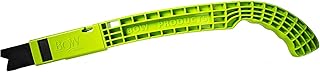
BOW Products PushPRO PP1
The EVA-tipped face is the standout here, damping the chatter you feel when pushing thin stock and holding fast on veneered panels that would slide under a rigid plastic nose. It’s the one to reach for on finish-critical rips where a slipped stick means a scorch mark.
POWERTEC Deluxe Push Stick 2-Pack (71338)
Two ergonomic, dual-handle sticks at a price that makes redundancy easy, which is exactly what a shared-space shop needs: one hanging at the saw, one at the jointer, no walking. The grip pattern bites well on rough lumber and the handles keep your knuckles comfortably above the table.
Table Saw Push Stick, 16.5″ Red
At 16.5 inches long and under half an inch thick, this one slides into the gap behind a fence rail or a tool cabinet where nothing else fits. The bright red body is genuinely useful when your work surface is cluttered and you need to spot the safety tool in a half-second.
POWERTEC Deluxe Push Stick 2-Pack (71511)
A slightly different handle profile from the 71338, favoring a more upright grip that suits taller users and stand-mounted contractor saws. Same broad machine compatibility, so it earns a hook whether you’re at the band saw or feeding a router table.
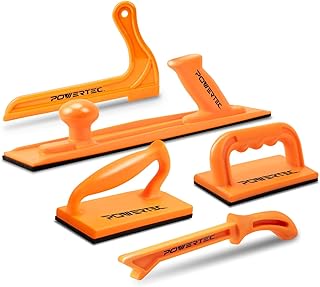
POWERTEC Push Block and Push Stick Set (71009V)
Five pieces covering both blocks and sticks, which sounds like a lot for a tight shop until you realize it replaces the mismatched pile most of us accumulate. The blocks handle wide panel work on the jointer while the sticks cover narrow rips, and everything mounts flat to a wall.
Frequently Asked Questions
Do I need a push stick if my saw has a riving knife?
Yes. A riving knife prevents the workpiece from pinching and kicking back; a push stick keeps your fingers away from the blade. They solve different problems and work best together.
Push stick or push block?
Sticks excel at narrow rips where there’s no room for your hand between fence and blade. Blocks apply broad downward pressure and are better for jointers and wide panels. Most shops want at least one of each.
Is it worth buying one instead of making one?
Shop-made sticks are fine and cost nothing but scrap. Commercial versions buy you a high-friction grip surface, a comfortable handle, and a hang hole, which in a small space is the difference between a tool you use and one you lose.
Where should I store it?
Within arm’s reach of the operating position, hung rather than stacked. A magnet or a screw hook on the saw’s stand leg or nearby wall keeps it visible and out of the cut path.
Final Thoughts
For most compact shops, the POWERTEC Deluxe 2-Pack (71338) is the sensible default: two solid, dual-handle sticks that cover multiple machines for the cost of one premium tool. Step up to the BOW Products PushPRO PP1 if you work a lot of slick sheet goods and want the best grip available, or go with the POWERTEC 5-Piece Set (71009V) if you’d rather solve blocks and sticks in a single purchase and clear the clutter for good.