Key takeaways
- Look for a decibel number, not an adjective: “ultra quiet” means nothing on its own. A published rating in the 35–40 dB range is roughly a whisper and safe for a bedroom. If a listing avoids the number entirely, assume it’s louder than the ones that publish it.
- Know your cooling technology: thermoelectric units have no compressor, so they hum faintly and never cycle, but they only pull the room temperature down about 30°F. Compressor fridges get genuinely cold and can freeze, at the cost of periodic on-off noise. Match the technology to whether you need cold drinks or frozen food.
- Measure clearance, not just footprint: compact fridges need two to three inches of breathing room at the back and sides to vent heat. Wedge one into a tight cabinet cubby and the compressor runs longer, louder, and hotter. Add that clearance to your tape-measure number before you commit.
- Check that shelves come out: fixed wire racks are the reason small fridges feel smaller than their cubic footage. Removable or height-adjustable glass shelves let you store a tall bottle upright instead of laying it on its side and losing a whole tier.
- Confirm the freezer is separate: a single-door fridge with a chest-style freezer box inside frosts over and steals fresh-food space. A second insulated door with its own compartment holds temperature better and keeps the fridge side from working overtime.
What's inside
In a studio apartment or a shared dorm room, the fridge is rarely just a fridge. It’s a nightstand, a printer stand, a bar cart, sometimes the only thing standing between your bed and the wall. Which means the compressor cycling on at 2 a.m. isn’t a minor annoyance you can shut a kitchen door on. It’s happening eighteen inches from your ear. Anyone who has organized a small home professionally knows the pattern: people buy the fridge that fits the footprint, then quietly resent it for two years.
Noise is the spec manufacturers bury and buyers discover too late. This guide sorts the genuinely quiet compact refrigerators from the ones that merely claim it, with attention to how each one behaves in a room where you also sleep, work, or take calls. I’ve grouped picks by the job they actually do, from full two-door units with real freezers to thermoelectric coolers small enough to sit on a desk without eating your work surface.
As an Amazon Associate we earn from qualifying purchases.


How to Choose a Quiet Mini Fridge (2026)
- Look for a decibel number, not an adjective: “ultra quiet” means nothing on its own. A published rating in the 35–40 dB range is roughly a whisper and safe for a bedroom. If a listing avoids the number entirely, assume it’s louder than the ones that publish it.
- Know your cooling technology: thermoelectric units have no compressor, so they hum faintly and never cycle, but they only pull the room temperature down about 30°F. Compressor fridges get genuinely cold and can freeze, at the cost of periodic on-off noise. Match the technology to whether you need cold drinks or frozen food.
- Measure clearance, not just footprint: compact fridges need two to three inches of breathing room at the back and sides to vent heat. Wedge one into a tight cabinet cubby and the compressor runs longer, louder, and hotter. Add that clearance to your tape-measure number before you commit.
- Check that shelves come out: fixed wire racks are the reason small fridges feel smaller than their cubic footage. Removable or height-adjustable glass shelves let you store a tall bottle upright instead of laying it on its side and losing a whole tier.
- Confirm the freezer is separate: a single-door fridge with a chest-style freezer box inside frosts over and steals fresh-food space. A second insulated door with its own compartment holds temperature better and keeps the fridge side from working overtime.
The Best Quiet Mini Fridges of 2026, Reviewed
4.5 Cu.Ft Mini Fridge with Freezer, 2-Door (Satin Black)
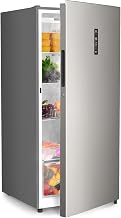
This is the most fridge you can reasonably put in a bedroom, with a true second door, adjustable thermostat, and removable glass shelves that let you reconfigure around tall containers. The satin black finish reads more like furniture than appliance, which matters when it’s serving double duty as a surface.
4.5 Cu.Ft Mini Fridge Freezer for Dorm/Office, Quiet 38dB
Same generous capacity, but with a published 38 dB rating and a seven-level thermostat, so you can dial cooling down and reduce cycling in cooler months. The separate freezer compartment is the deciding feature if you want ice cream and frozen meals rather than just cold storage.
Midea 1.6 Cu.Ft Mini Fridge
Midea builds compressors for other brands, and it shows in how unobtrusively this one runs. Energy Star certification keeps operating costs low, and the 1.6 cubic foot footprint slides under a desk or beside a bed without dominating the room.
EUHOMY 18L Beverage Refrigerator, 24 Cans
A countertop beverage cooler with digital control from 40°F to 61°F, which makes it equally useful for soda, wine, or seltzer at cellar temperature. The LED interior light and glass front turn it into a small display piece rather than something to hide.
Cooluli 4L Mini Fridge, Cooler & Warmer
Thermoelectric, compressor-free, and quiet in a way mechanical fridges can’t be, this 4L unit is the right answer for skincare, insulin, or a few cans on a desk. AC, DC, and USB power make it the only pick here that travels.
Frequently Asked Questions
How quiet is quiet enough for a bedroom?
Under 40 dB is the practical threshold. At that level the compressor is audible in a silent room but disappears under a fan, white noise, or ordinary breathing. Above 45 dB, light sleepers will notice every cycle.
Can a mini fridge sit on carpet?
It can, but raise it slightly on a hard board or fridge mat. Carpet blocks the underside vents, traps heat, and transmits vibration into the floor, all of which make the unit louder and less efficient.
Why is my new mini fridge louder than expected?
Usually placement. Check that it’s level, has clearance at the back, and isn’t touching a wall or another appliance. A fridge in contact with drywall turns the wall into a resonator.
Do compact freezers actually freeze?
Two-door compressor models do, reliably. Single-door units with an internal freezer box will make ice and hold frozen food short-term, but temperature swings more. Thermoelectric coolers never freeze at all.
Final Thoughts
For a bedroom that needs to function as a full kitchen annex, the 4.5 Cu.Ft two-door with its published 38 dB rating is the strongest all-around choice, with the satin black version worth the swap if appearance matters. The Midea 1.6 Cu.Ft is the smarter pick when floor space is the binding constraint, and the Cooluli 4L remains unmatched for desktop use where absolute silence beats capacity.