Key takeaways
- Folded footprint, not just folded height: Measure the wall or closet gap you plan to park it in. A stand that folds to a narrow upright profile stores in a 12-inch slot; one that collapses into a wide flat pallet needs floor area you may not have. Check both dimensions before you buy.
- Wheel diameter: Small casters stall on cracked concrete, garage thresholds, and lawn transitions. Wheels in the 6.75- to 8-inch range roll over obstacles instead of stopping dead at them, which matters most if your saw lives inside but works outside.
- Quick-release mounting brackets: If you share the stand between a miter saw and another benchtop tool, tool-free brackets let you swap in seconds. If the saw stays mounted permanently, universal rails with bolt-through mounting give you a more rigid connection.
- Usable material support length: Extension arms rated for 8 to 10 feet let you crosscut trim and framing lumber without a helper or an outfeed table. This is the single feature that most reduces how much extra gear you need to store.
- Onboard outlets and trays: A stand with integrated outlets means one extension cord instead of a tangle, and storage trays keep blades, squares, and pencils on the tool rather than on a shelf you’d otherwise have to find room for.
What's inside
A miter saw is one of the few tools that eats floor space even when it’s off. Mounted on a fixed bench, it claims a permanent four-foot footprint plus clearance on both sides for stock infeed and outfeed — in a one-car garage or a shared basement, that’s a corner you never get back. The rolling stand exists to solve exactly this: it turns the saw into something you park against a wall at the end of the day, then wheel out and deploy in under a minute.
The catch is that folding stands vary enormously in how well they actually fold, how flat they store, and whether the wheels can handle a door threshold or a gravel driveway. This guide breaks down what matters when floor space is the constraint, then walks through the stands worth your money in 2026 — including how each one behaves once collapsed, since that’s the spec most listings bury.
As an Amazon Associate we earn from qualifying purchases.

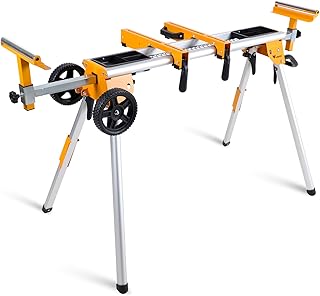


How to Choose a Rolling Miter Saw Stand (2026)
- Folded footprint, not just folded height: Measure the wall or closet gap you plan to park it in. A stand that folds to a narrow upright profile stores in a 12-inch slot; one that collapses into a wide flat pallet needs floor area you may not have. Check both dimensions before you buy.
- Wheel diameter: Small casters stall on cracked concrete, garage thresholds, and lawn transitions. Wheels in the 6.75- to 8-inch range roll over obstacles instead of stopping dead at them, which matters most if your saw lives inside but works outside.
- Quick-release mounting brackets: If you share the stand between a miter saw and another benchtop tool, tool-free brackets let you swap in seconds. If the saw stays mounted permanently, universal rails with bolt-through mounting give you a more rigid connection.
- Usable material support length: Extension arms rated for 8 to 10 feet let you crosscut trim and framing lumber without a helper or an outfeed table. This is the single feature that most reduces how much extra gear you need to store.
- Onboard outlets and trays: A stand with integrated outlets means one extension cord instead of a tangle, and storage trays keep blades, squares, and pencils on the tool rather than on a shelf you’d otherwise have to find room for.
The Best Rolling Miter Saw Stand (2026)s Reviewed
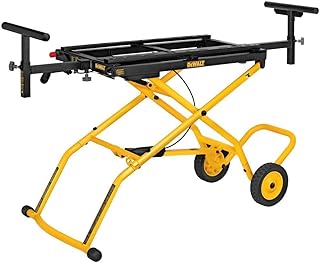
DEWALT DWX726 Rolling Miter Saw Stand
The benchmark for a reason: heavy-gauge steel construction, adjustable working height, and 8 feet of material support that deploys without fuss. It folds upright and rolls like a hand truck, so a narrow gap between the wall and the water heater is enough storage — this is the pick if you want one stand to last a decade.
POWERTEC MT4000V Portable Miter Saw Stand
The 8-inch wheels are the standout here, clearing thresholds and rough ground that defeat smaller casters, and the quick-release brackets make tool swaps genuinely fast. Triple onboard outlets keep your saw, shop vac, and light on a single cord run.
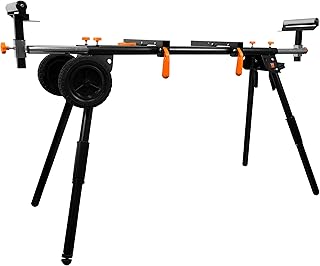
WEN MSA330 Collapsible Rolling Stand
The value option that doesn’t feel like a compromise: three onboard outlets, a proper collapsing frame, and enough rigidity for accurate repeat cuts. Best suited to a homeowner running a 10-inch saw on occasional trim and deck projects rather than daily production work.
WK-MS080 Portable Miter Saw Stand
A 330-pound capacity and 6.75-inch wheels at a competitive price, with tool storage trays that consolidate your small gear onto the stand itself. Universal mounting means it accepts most saw brands, useful if you’re upgrading the saw before the stand.
Channellock Folding Miter Saw Stand
Heavy-duty steel with a rolling base and a generous 10-foot extension span — the longest support here, which pays off on baseboard and long framing stock. The folding action is straightforward and the stand stores flatter than most against a wall.
Frequently Asked Questions
Will a rolling stand fit my specific miter saw?
Most stands use universal mounting rails or adjustable brackets that accommodate the large majority of 10- and 12-inch saws. Check your saw’s base bolt-hole spacing against the stand’s listed range, and note that some sliding compound saws need extra rear clearance.
How much floor space does a folded stand actually need?
Upright-folding stands like the DEWALT typically need a strip roughly 12 to 18 inches deep against a wall. Flat-folding designs lie down and need more floor area but less height, which suits under-bench storage.
Are rolling stands stable enough for accurate cuts?
Yes, provided you deploy the legs fully and lock them. Steel-framed stands with a wide stance and a locked-out wheel position are comparable to a fixed bench for trim and framing accuracy.
Do I need a stand with a rotating top?
The BORA Portacube’s rotating top is genuinely useful if you want the stand to double as a workbench and mount more than one tool. For a single dedicated miter saw, a conventional folding stand is lighter and stores smaller.
Final Thoughts
For most buyers, the DEWALT DWX726 is the stand to get — it stores in the least floor space, handles 8-foot stock, and will outlive several saws. If wheels and terrain are your real problem, the POWERTEC MT4000V’s 8-inch rollers are worth the trade, and the WEN MSA330 delivers the essentials at a price that makes sense for weekend project work.