Key takeaways
- Diameter: Match the blade diameter specified for your saw—most miter saws use 10-inch or 12-inch blades. Never install a larger blade than the guard and manufacturer’s instructions allow.
- Tooth count: Higher tooth counts generally produce smoother crosscuts, while lower counts remove material faster. For furniture joinery and visible edges, 60 to 100 teeth is a useful range.
- Tooth design: ATB teeth are versatile for wood crosscuts, while TCG profiles are often a better fit for abrasive sheet goods, laminates, and aluminum-rated applications. Confirm the blade’s intended materials before cutting.
- Arbor size: The arbor hole must match your saw exactly or use only a manufacturer-approved bushing. Common sizes include 5/8 inch for 10-inch blades and 1 inch for many 12-inch blades.
- Cut quality versus speed: Ultra-fine blades leave cleaner edges but cut more slowly and may produce more heat. Choose a general-purpose blade if you regularly switch between rough construction cuts and finish work.
What's inside
Finding the best saw blade for a miter saw can be surprisingly difficult. Tooth count, blade diameter, arbor size, kerf, and cutting material all affect the result—and choosing the wrong combination can leave furniture parts with chipped edges, fuzzy grain, or cuts that need time-consuming sanding.
This guide focuses on blades that suit home workshops, compact garages, and furniture-making stations where one tool may handle trim, shelving, plywood, MDF, and solid wood. We compare practical options for clean crosscuts, occasional ripping, ultra-fine finishing, and value-minded blade changes, so you can match the blade to the work instead of buying by tooth count alone.
As an Amazon Associate we earn from qualifying purchases.


How to Choose a Saw Blade For Miter Saw (2026)
- Diameter: Match the blade diameter specified for your saw—most miter saws use 10-inch or 12-inch blades. Never install a larger blade than the guard and manufacturer’s instructions allow.
- Tooth count: Higher tooth counts generally produce smoother crosscuts, while lower counts remove material faster. For furniture joinery and visible edges, 60 to 100 teeth is a useful range.
- Tooth design: ATB teeth are versatile for wood crosscuts, while TCG profiles are often a better fit for abrasive sheet goods, laminates, and aluminum-rated applications. Confirm the blade’s intended materials before cutting.
- Arbor size: The arbor hole must match your saw exactly or use only a manufacturer-approved bushing. Common sizes include 5/8 inch for 10-inch blades and 1 inch for many 12-inch blades.
- Cut quality versus speed: Ultra-fine blades leave cleaner edges but cut more slowly and may produce more heat. Choose a general-purpose blade if you regularly switch between rough construction cuts and finish work.
The Best Saw Blade For Miter Saw (2026)s Reviewed
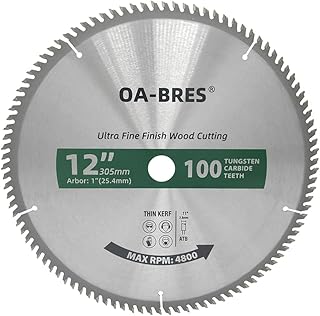
12-Inch 100-Tooth ATB TCT Ultra Fine Finish Blade
This high-tooth-count blade is aimed at exceptionally clean crosscuts in solid wood, trim, and furniture components. Its ATB profile and carbide teeth make it a strong choice for visible edges, though the fine tooth spacing is better suited to controlled cuts than fast stock removal.
10-Inch 120-Tooth TCG Aluminum Working Blade
With 120 teeth and a TCG profile, this blade prioritizes a refined finish and is designed for miter saw, table saw, and circular saw use. It is especially interesting for users who work with laminates or aluminum-rated applications, but verify your saw’s compatibility and follow the blade’s material guidelines carefully.
KENDO 10-Inch Circular Saw Blade Set, 40T and 60T
This two-blade set is practical for a small workshop because it covers two distinct jobs: the 40-tooth blade for faster material removal and the 60-tooth blade for plywood, MDF, and cleaner finish cuts. It offers useful flexibility when storage space is limited and you do not want a separate blade for every project.
10-Inch 80-Tooth Fine Finish Woodworking Blade
The 80-tooth configuration is a sensible middle ground for furniture parts, molding, and crosscutting where edge quality matters. Its listed 7,000 RPM maximum should be checked against your saw’s operating speed before installation, and the 5/8-inch arbor suits many common 10-inch machines.
10-Inch Three-Pack: 32T, 60T, and 80T Blades
This three-pack is a space-efficient option for households that need one set to cover framing, general work, and progressively finer finish cuts. The range is more useful than a single specialized blade for mixed projects, although each blade should be reserved for the material and cut style it is designed to handle.
Frequently Asked Questions
What tooth count is best for a miter saw?
For furniture and trim, a 60-tooth or 80-tooth blade is a dependable starting point. Choose 100 or more teeth when the cleanest possible crosscut is the priority, and use fewer teeth when speed matters more than edge refinement.
Is a 10-inch or 12-inch blade better?
Neither size is automatically better. A 10-inch blade is common, relatively easy to store, and often offers a wide selection, while a 12-inch saw can provide greater cutting capacity. The blade must match the saw’s approved diameter.
Can I use a table-saw blade on a miter saw?
Sometimes, but only if the blade is compatible with the miter saw’s diameter, arbor, speed, guard, and intended cutting direction. Check the manufacturer’s instructions, particularly for blades marketed for multiple saw types or for aluminum and other non-wood materials.
How can I prevent tear-out on furniture cuts?
Use a sharp, fine-tooth blade, support the workpiece firmly, and let the saw reach full speed before entering the material. Cutting with the finished face oriented appropriately for your saw, plus using painter’s tape or a sacrificial backing board, can further reduce splintering.
Final Thoughts
For the smoothest visible edges, the 12-inch 100-tooth ATB blade and the 10-inch 80-tooth woodworking blade are compelling choices. Small workshops that value versatility should consider the KENDO 40T/60T set or the three-pack, while the 120-tooth TCG blade is best reserved for users whose projects specifically benefit from its fine-cut, multi-material focus.