Key takeaways
- Diameter: Match the blade to your saw’s specification, most commonly 10 or 12 inches. A blade that is too large can be unsafe or incompatible, while a smaller blade may reduce cutting capacity.
- Tooth count: Lower counts generally remove material quickly for framing, while 60 to 80 teeth are better suited to cleaner furniture and trim cuts. Very high counts prioritize a smooth finish over speed.
- Tooth design: Carbide-tipped teeth are a sensible choice for repeated woodworking. Alternating-top-bevel designs commonly produce clean crosscuts, while aggressive designs are better for fast general-purpose work.
- Kerf and arbor: Confirm the blade’s kerf and arbor match your miter saw. A 5/8-inch arbor is common on many 10-inch models, but the owner’s manual should be the final reference.
- Storage: In a small workshop, choose a blade set that earns its shelf space. A three-blade assortment can cover rough cuts, general finish work, and detail cutting without requiring a separate blade for every material.
What's inside
Choosing a miter saw blade can feel surprisingly complicated when workshop space is limited. Tooth count, blade diameter, kerf, arbor size, and the difference between rough framing cuts and polished furniture joints all affect the result—and buying the wrong blade can mean wasted material, extra sanding, and an awkward collection of accessories.
This guide focuses on practical blade choices for compact home workshops and furniture projects. We compare versatile multipacks, fine-finish options, and high-tooth-count blades so you can match one blade to everyday construction work or keep a small, purposeful selection for trim, shelving, cabinetry, and other precise cuts.
As an Amazon Associate we earn from qualifying purchases.


How to Choose a/an Saw Blades For Miter Saws (2026)
- Diameter: Match the blade to your saw’s specification, most commonly 10 or 12 inches. A blade that is too large can be unsafe or incompatible, while a smaller blade may reduce cutting capacity.
- Tooth count: Lower counts generally remove material quickly for framing, while 60 to 80 teeth are better suited to cleaner furniture and trim cuts. Very high counts prioritize a smooth finish over speed.
- Tooth design: Carbide-tipped teeth are a sensible choice for repeated woodworking. Alternating-top-bevel designs commonly produce clean crosscuts, while aggressive designs are better for fast general-purpose work.
- Kerf and arbor: Confirm the blade’s kerf and arbor match your miter saw. A 5/8-inch arbor is common on many 10-inch models, but the owner’s manual should be the final reference.
- Storage: In a small workshop, choose a blade set that earns its shelf space. A three-blade assortment can cover rough cuts, general finish work, and detail cutting without requiring a separate blade for every material.
The Best Saw Blades For Miter Saws (2026)s Reviewed
WEN BL1080 10-Inch 80-Tooth Blade
The WEN BL1080 is designed for clean, ultra-fine cuts in wood, making it a strong fit for visible edges, trim, and furniture components that will receive minimal post-cut cleanup. Its 10-inch format suits many compact and full-size miter saws, but verify arbor and saw compatibility before ordering.
WEN BL1280 12-Inch 80-Tooth Blade
For owners of a 12-inch miter saw, the WEN BL1280 offers the same fine-cutting focus in a larger format. The 80-tooth configuration is particularly useful when your storage is limited and you want one dedicated blade for neat crosscuts rather than keeping several specialized finishing blades.
WEN BL1060 10-Inch 60-Tooth Blade
The WEN BL1060 is a practical middle ground between speed and surface quality. Its 60 teeth make it more versatile than an ultra-fine blade for everyday furniture building, including dimensional lumber, plywood, shelving parts, and general trim work.
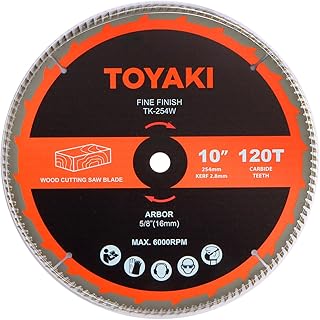
10-Inch 120-Tooth Fine-Finish Blade
This 120-tooth blade is aimed at exceptionally smooth cuts where reducing visible tooth marks matters most. It can be a useful dedicated option for delicate trim or finished stock, although its dense tooth pattern is better reserved for controlled, detail-oriented work than fast rough cutting.
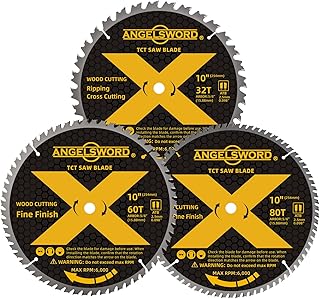
10-Inch Three-Pack, 32T/60T/80T
This three-pack is one of the most space-efficient choices for a home workshop because it covers three distinct jobs: fast framing cuts, general fine finishing, and ultra-fine cutting. The 5/8-inch arbor and 10-inch size are common specifications, but check your saw’s manual before installation.
Frequently Asked Questions
What tooth count is best for a miter saw?
For general woodworking, a 60-tooth blade is a useful starting point because it balances cutting speed with a relatively clean finish. Choose 80 teeth or more for visible trim, furniture edges, and projects where sanding should be kept to a minimum.
Can a miter saw blade be used in a table saw?
Some blades are marketed for both miter and table saws, but compatibility depends on diameter, arbor, saw capacity, and the material being cut. Always follow the blade and saw manufacturer’s instructions, and never exceed the tool’s rated speed or cutting limits.
Is a 120-tooth blade better than an 80-tooth blade?
Not universally. A 120-tooth blade may leave a smoother surface on suitable stock, but it usually cuts more slowly and is less appropriate for rough lumber or rapid work. An 80-tooth blade is often the more flexible furniture-shop choice.
How often should a miter saw blade be replaced?
Replace or sharpen a blade when cuts become noticeably rough, burning appears, the saw requires excessive force, or the cut begins wandering. Cleaning pitch and resin from the teeth can restore performance, but damaged or missing carbide tips require replacement.
Final Thoughts
For a compact workshop, the three-blade 32T/60T/80T set offers the broadest coverage with minimal storage demands. Choose the WEN BL1060 for an adaptable everyday blade, the WEN BL1080 for particularly clean 10-inch cuts, or the WEN BL1280 when your saw accepts 12-inch blades and your projects regularly involve larger stock.