Key takeaways
- Depth over width: Measure the walkway clearance you can surrender before anything else. Slim benches around 11.8″ deep keep a hallway passable, while 13.8″ and up gives you room for wider men’s sizes but eats into circulation space. Adult sneakers typically need 11–12″ of usable depth laid flat.
- Open shelving vs. closed doors: Doors and barn-style panels visually quiet a small room by hiding the mess, but they trap moisture and odor. Open tiers dry wet shoes faster and encourage grab-and-go use. Pick doors for bedrooms and formal entries, open racks for high-traffic side doors.
- Verified seat capacity: A bench you actually sit on takes real load. Look for stated weight ratings — 300 lb is adequate, 550 lb means solid wood joinery rather than particleboard held together with cam locks. Skip anything that omits the number.
- Adjustable or removable shelves: Fixed shelf spacing is the most common regret. Boots, heeled ankle styles, and kids’ shoes have wildly different heights, so a shelf that repositions turns one cabinet into three configurations as your household changes.
- Cushion quality and cleanability: A thin foam pad flattens within months. Thicker padded seats hold up to daily use, and a removable or wipeable cover matters more than you’d think in a space that collects road salt, rain, and dog paws.
What's inside
The entryway is usually the smallest square footage in a home doing the heaviest work. Shoes pile up by the door because that’s where they come off, and once four or five pairs land in a heap, the floor stops reading as a threshold and starts reading as a dumping ground. The fix isn’t more discipline. It’s giving footwear a defined boundary at the exact spot where people naturally shed it, ideally on a surface sturdy enough to sit on while you do.
A shoe storage bench solves two problems with one footprint, which is why it earns its place in narrow hallways, rental mudrooms, and bedrooms where a closet floor has already surrendered. This guide breaks down the specs that actually matter when depth is tight, then reviews the benches worth considering in 2026, from enclosed cabinet styles that hide clutter to open bamboo racks that let damp soles breathe.
As an Amazon Associate we earn from qualifying purchases at no extra cost to you. Product prices and availability are accurate as of the date shown and are subject to change.



🛒 Best Price Today on Amazon
Prime members get fast, free shipping on everything above, plus member-only deals. New members get a 30-day free trial — cancel anytime.
How to Choose a Shoe Bench Storage (2026)
- Depth over width: Measure the walkway clearance you can surrender before anything else. Slim benches around 11.8″ deep keep a hallway passable, while 13.8″ and up gives you room for wider men’s sizes but eats into circulation space. Adult sneakers typically need 11–12″ of usable depth laid flat.
- Open shelving vs. closed doors: Doors and barn-style panels visually quiet a small room by hiding the mess, but they trap moisture and odor. Open tiers dry wet shoes faster and encourage grab-and-go use. Pick doors for bedrooms and formal entries, open racks for high-traffic side doors.
- Verified seat capacity: A bench you actually sit on takes real load. Look for stated weight ratings — 300 lb is adequate, 550 lb means solid wood joinery rather than particleboard held together with cam locks. Skip anything that omits the number.
- Adjustable or removable shelves: Fixed shelf spacing is the most common regret. Boots, heeled ankle styles, and kids’ shoes have wildly different heights, so a shelf that repositions turns one cabinet into three configurations as your household changes.
- Cushion quality and cleanability: A thin foam pad flattens within months. Thicker padded seats hold up to daily use, and a removable or wipeable cover matters more than you’d think in a space that collects road salt, rain, and dog paws.
The Best Shoe Bench Storage (2026)s Reviewed
Homleke 4-Door Shoe Storage Bench
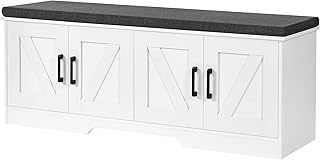
At 45.3″ wide with four doors and an adjustable interior shelf, this is the pick when you want shoes fully out of sight and a genuine two-person seat. The 13.8″ depth is on the generous side, so confirm your hallway can spare it before committing.
VASAGLE CUSTOS Shoe Bench
Fifteen compartments in an 11.8″-deep frame makes this the most space-efficient organizer here, and the one-pair-per-slot layout stops shoes from being stacked and forgotten. The soft cloud white and dove gray finish reads calm rather than utilitarian, which helps in bedrooms.
HOMSHO Farmhouse Barn Door Bench
A 47.2″ span with four barn doors, adjustable shelves, and hidden storage gives you cabinet-level concealment with millwork character instead of flat-pack anonymity. Best suited to entries wide enough that a nearly four-foot piece doesn’t dominate the wall.
Solid Wood Flip-Top Shoe Bench
The 550 lb capacity and walnut finish signal real construction, and at 31.5″ wide it slips into tight corners where longer benches won’t fit. The flip-top compartment plus side hooks handles leashes, keys, and gloves, making it the strongest small-footprint multitasker.
XKZG Rubber Wood Shoe Rack Bench
Rubber wood construction, 47.2″ of length, and a slim 11.8″ depth deliver open airflow along a long wall without crowding the path. At 16.5″ high it sits slightly lower than average, which suits kids and anyone who prefers a relaxed perch for lacing up.
Frequently Asked Questions
How many pairs can a shoe bench realistically hold?
A two-tier bench in the 45–47″ range typically handles 8–12 pairs of adult shoes. Compartment-style units like the VASAGLE hold one pair per slot, so the count is fixed but the organization is far tidier. Bulky boots and high-tops cut those numbers by roughly a third.
Are enclosed shoe benches bad for odor?
They can be if you close wet shoes inside. Leave doors ajar for an hour after coming in during wet weather, or add a small charcoal deodorizer sachet per compartment. Open-tier designs like the Pipishell bamboo rack sidestep the issue entirely.
What height works best for a seat?
Aim for 17–19″ from the floor, which matches standard dining chair height and lets most adults sit and stand without pushing off. Lower benches near 16.5″ feel comfortable for children but require more effort for anyone with knee or hip limitations.
Should I anchor a shoe bench to the wall?
Tall or narrow units benefit from an anti-tip strap, especially in homes with toddlers. The benches here are low and wide enough to be inherently stable, but if a unit ships with hardware, use it.
Final Thoughts
For most small entryways, the VASAGLE CUSTOS is the smartest use of limited depth, keeping every pair visible and separated in under 12″. If you’d rather hide the clutter behind doors, the Homleke 4-Door bench offers the best balance of concealed capacity and seating comfort, while the solid wood flip-top bench is the one to buy when durability and a genuinely compact footprint matter more than maximum storage.