Key takeaways
- Measure the full footprint: Record the sofa’s width, depth, and height, then map those measurements with painter’s tape before ordering. Leave a clear route around doors, windows, and major furniture.
- Prioritize useful flexibility: A sleeper, reclining back, reversible ottoman, or removable armrest can make one compact sofa serve several purposes without adding another large piece.
- Check seat depth: Deep cushions can feel luxurious but may consume valuable floor space. A moderate depth is often more comfortable for upright lounging and easier movement in tight rooms.
- Choose the upholstery strategically: Performance-minded, removable, or washable covers are especially valuable in small homes, where a sofa often handles several daily activities.
- Plan delivery and assembly: Measure hallways, stairwells, elevators, and door openings. Tool-free or easy assembly can be just as important as the sofa’s listed dimensions.
What's inside
Finding a sofa for a small room is less about squeezing in the smallest frame and more about making every inch work harder. A couch that blocks a walkway, overwhelms the visual balance, or cannot accommodate overnight guests quickly becomes a daily frustration. The best compact sofas deliver useful seating without making the room feel crowded.
This guide compares small-space-friendly designs for apartments, bedrooms, offices, and multipurpose living rooms. I’m focusing on practical dimensions, flexible functions, setup, upholstery, storage-friendly proportions, and how each style can support a more efficient room layout.
As an Amazon Associate we earn from qualifying purchases.


How to Choose a/an Sofa For Small Spaces (2026)
- Measure the full footprint: Record the sofa’s width, depth, and height, then map those measurements with painter’s tape before ordering. Leave a clear route around doors, windows, and major furniture.
- Prioritize useful flexibility: A sleeper, reclining back, reversible ottoman, or removable armrest can make one compact sofa serve several purposes without adding another large piece.
- Check seat depth: Deep cushions can feel luxurious but may consume valuable floor space. A moderate depth is often more comfortable for upright lounging and easier movement in tight rooms.
- Choose the upholstery strategically: Performance-minded, removable, or washable covers are especially valuable in small homes, where a sofa often handles several daily activities.
- Plan delivery and assembly: Measure hallways, stairwells, elevators, and door openings. Tool-free or easy assembly can be just as important as the sofa’s listed dimensions.
The Best Sofa For Small Spaces (2026)s Reviewed
Best Multiuse Pick: 55-Inch Boneless Convertible Sofa
This 55-inch boneless couch is a particularly adaptable choice for a studio, guest room, or reading area. Its 3-in-1 configuration can shift from loveseat-style seating to a sleeper, while the armless, flexible silhouette makes it easier to position against a wall or beneath a window. The included pillows add comfort without requiring extra accent furniture, and the no-assembly design is helpful when access is limited.
Best Soft, Compact Loveseat: Welzona 51-Inch Teddy Loveseat
The Welzona Loveseat keeps its footprint restrained while adding a softer, more inviting look through teddy fabric. Washable covers are a practical advantage for smaller households where the sofa may also function as a lounge, work seat, or occasional dining perch. Its all-wood construction and tool-free setup make it a strong choice for a bedroom, apartment living room, or compact sitting nook.
Best Larger Loveseat: DOPEDIO Small-Space Chenille Loveseat
At 71.25 inches, the DOPEDIO is better suited to a narrow living room than an extremely tiny studio, but it offers more generous seating than many compact loveseats. Spring cushions, a solid wood frame, and a removable cover support everyday use, while the reclining design adds relaxation without requiring a separate chair. Consider its depth carefully if your main circulation path runs directly in front of the sofa.
Best Mid-Century Style: Vesgantti 48-Inch Loveseat
The 48-inch Vesgantti is one of the easiest options to place in a genuinely tight room. Its raised solid wood legs create visual openness beneath the frame, helping a small space feel less boxed in, and the mid-century shape works well with clean-lined tables and narrow media consoles. The compact size makes it best for two people who prefer upright seating rather than sprawling.
Best Sectional Layout: 73.6-Inch Convertible Sectional
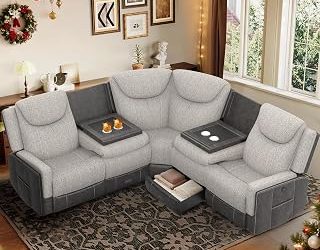
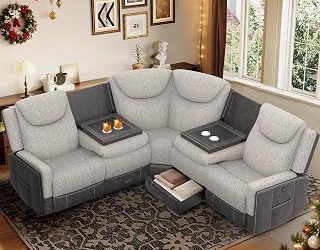
This compact L-shaped sofa makes smart use of a corner and includes a reversible ottoman, allowing the chaise orientation to change as your layout evolves. That flexibility is useful in rentals, shared rooms, and apartments where doors or windows may limit one fixed configuration. At 73.6 inches, it needs more floor area than a loveseat, but it can provide three-seat capacity without the footprint of a full-size sectional.
Frequently Asked Questions
What sofa size works best in a small living room?
There is no universal ideal width, but loveseats around 48 to 55 inches are often easier to place in very compact rooms. Before buying, account for depth and arm width as well as the advertised overall length.
Is a sleeper sofa practical for a small apartment?
Yes, provided you measure the open bed position, not just the closed sofa. A convertible model can eliminate the need for a guest bed, but make sure there is room to walk around it when extended.
Are raised sofa legs useful in a small space?
Raised legs expose more of the floor, which can make the room look lighter and simplify cleaning underneath. They do not reduce the sofa’s actual footprint, so treat them as a visual benefit rather than a substitute for measuring.
Should I choose a loveseat or a small sectional?
Choose a loveseat when flexibility and minimal floor coverage are your priorities. A small sectional is worthwhile when you need more seating and have a usable corner, especially if its ottoman or chaise can be repositioned.
Final Thoughts
For the most adaptable footprint, the 55-Inch Boneless Convertible Sofa is a smart starting point. The Vesgantti 48-Inch Loveseat is especially appealing for truly tight rooms, while the reversible-ottoman sectional is the better choice when you need extra seating and corner efficiency.