Key takeaways
- Dual-sensor safety, not single: Look for both a tip-over switch and an independent thermal cutoff. The first handles knocks; the second handles blocked intakes, which is the more likely failure in a crowded room where fabric and furniture crowd the vents.
- Footprint versus throw: A tower unit takes up roughly the same floor area as a paperback but pushes heat higher and further. A squat desktop model works better on a shelf or dresser where you want warmth at seated height, not ankle height.
- Thermostat behavior: A degree-specific thermostat lets the heater idle instead of blasting and quitting. In a small room that reaches temperature fast, this is the difference between comfortable and stifling.
- Timer resolution: A 12-hour timer is standard now, but hourly increments matter more than the maximum. Set two hours to fall asleep to, not eight you’ll sweat through.
- Noise floor and certification: Anything above 40dB is audible in a room where the bed is four feet from the heater. Confirm ETL or UL listing on the model itself, not just the brand.
What's inside
In a studio apartment or a converted box room, a space heater has to earn its footprint twice over: once for the warmth it delivers, and again for the peace of mind it gives you when it sits eighteen inches from a bedskirt or a stack of books. That proximity is exactly why automatic shut-off has stopped being a bonus feature and become the baseline. A heater that cuts power the moment it tips, overheats, or gets shoved against a wall by a passing chair leg is the only kind worth plugging in when your living space and your heating space are the same room.
This guide looks at compact 1500W PTC ceramic heaters with layered safety systems — tip-over cutoff, overheat protection, and cool-touch housings — with an eye toward how they actually behave in tight quarters. I’ve weighed shelf and nightstand compatibility, noise at sleeping distance, timer granularity for people who don’t want a heater running unattended, and whether the thermostat holds a temperature or just cycles wildly. Below are the models that hold up.
As an Amazon Associate we earn from qualifying purchases.


How to Choose a/an Space Heater With Automatic Shut-Off (2026)
- Dual-sensor safety, not single: Look for both a tip-over switch and an independent thermal cutoff. The first handles knocks; the second handles blocked intakes, which is the more likely failure in a crowded room where fabric and furniture crowd the vents.
- Footprint versus throw: A tower unit takes up roughly the same floor area as a paperback but pushes heat higher and further. A squat desktop model works better on a shelf or dresser where you want warmth at seated height, not ankle height.
- Thermostat behavior: A degree-specific thermostat lets the heater idle instead of blasting and quitting. In a small room that reaches temperature fast, this is the difference between comfortable and stifling.
- Timer resolution: A 12-hour timer is standard now, but hourly increments matter more than the maximum. Set two hours to fall asleep to, not eight you’ll sweat through.
- Noise floor and certification: Anything above 40dB is audible in a room where the bed is four feet from the heater. Confirm ETL or UL listing on the model itself, not just the brand.
The Best Space Heater With Automatic Shut-Off (2026)s Reviewed
DREO 2026 Upgraded 34dB Quiet Heater
At a claimed 34dB, this is the model I’d put in a bedroom where the heater sits within arm’s reach of a pillow, and the five modes give you enough range to use it as a low-output night companion rather than an all-or-nothing blast. The gold finish is also one of the few heater aesthetics that doesn’t read as rented-appliance beige.
DREO 70° Oscillation Room Heater
Oscillation is underrated in small rooms because it stops the hot-spot-and-cold-corner problem that plagues fixed heaters in awkwardly shaped spaces. Paired with ECO mode and a real thermostat, it holds a narrow band of comfort without you having to move furniture around the airflow.
DREO 1500W Heater for Large Rooms
This is the pick if your “small space” is actually an open-plan studio where the sleeping area and kitchen share air. ETL certification plus the same oscillation and 12-hour timer as its siblings, with enough output to keep a larger volume from stratifying into warm ceiling and cold floor.
VOCRS 1500W PTC Heater with Remote
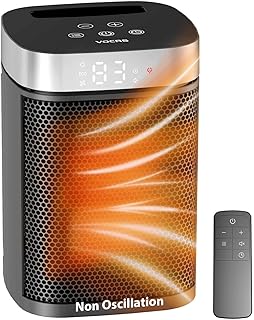
A genuinely compact unit with rapid PTC heat-up, eco and fan modes, and a remote — the last matters more than it sounds when the heater lives on a high shelf to keep it clear of clutter. Good choice for a home office nook where you want warmth at the desk without a floor obstruction.
WINHL Portable Heater with Oscillation
Effectively the value entry in this category, offering 70° oscillation, five modes, thermostat, and timer at a lower tier than the DREO models. Build feels a touch lighter, but the safety stack and PTC element are the same fundamentals.
Frequently Asked Questions
How does automatic shut-off actually work?
Two mechanisms run in parallel. A weighted or spring-loaded tip switch breaks the circuit if the unit leaves vertical, while a thermal fuse or bimetallic sensor inside the housing cuts power when internal temperature exceeds a set threshold, usually from blocked airflow.
Can I leave one running while I sleep?
With ETL-listed models, a working thermostat, and clear space on all sides, many people do. The safer habit in a small room is a two- or three-hour timer, which gets you to sleep in a warm room without eight unattended hours of operation.
Why PTC ceramic instead of a coil heater?
PTC elements self-regulate: resistance rises as they heat, so they plateau rather than climb indefinitely. That’s an inherent safety property, and it also means faster warm-up with less surface temperature on the housing.
Is 1500W too much for a small bedroom?
Not if the thermostat is competent. A 1500W heater in a 120-square-foot room will reach target temperature quickly and then idle at a fraction of that draw — the wattage is a ceiling, not a constant.
Final Thoughts
For most small spaces, the DREO 34dB Quiet Heater is the one I’d buy first: it’s the quietest option here and the safety stack is thorough. If your room shape fights you, the DREO 70° Oscillation model spreads heat more evenly for roughly the same money, and the VOCRS 1500W PTC remains the smartest choice when shelf or desktop clearance is your real constraint.