Key takeaways
- Measure the swing arc, not the chair: A swivel base traces a circle. Take the widest point of the chair, treat that as your diameter, and confirm the circle clears your coffee table, floor lamp, and baseboard heater. Chairs that fit statically can still knock things over mid-rotation.
- Check rear clearance before recline depth: Manual rocker recliners typically need four to eight inches behind them; wall-hugger mechanisms need less. If your only viable spot is against a wall, this spec matters more than seat comfort.
- Prioritize built-in storage in small rooms: Side pockets and cup holders replace the end table you don’t have space for. A chair with both eliminates a piece of furniture, which is a bigger win than it sounds.
- Match seat height to your other seating: Deep, high-back chairs read as visually heavy and can make a compact room feel crowded. Lower profiles and exposed legs keep sightlines open and floor visible, which reads as more space.
- Decide manual versus powered early: Power recline and USB ports require cord management and a fixed outlet position. Manual mechanisms let you float the chair anywhere, including mid-room as a divider between zones.
What's inside
A recliner that needs three feet of clearance behind it to function is not a recliner you can use in an apartment. That’s the wall most buyers hit: they measure the footprint of the chair, fall in love with the dimensions, and only later discover the seat back needs runway. Swivel recliners solve a different problem than standard ones. Because the base rotates in place, one chair can serve a TV corner, a window view, and a conversation with the sofa without ever being dragged across the floor. In a room where every square foot is doing double duty, that rotation is functional storage of a sort: you’re storing three seating arrangements in one footprint.
The catch is that “swivel recliner” now covers everything from compact nursery gliders to oversized barrel chairs that will swallow a small living room whole. This guide sorts them by how they actually behave in tight quarters, what to verify before you order, and which models earn their space. I’ve weighted rear clearance, base diameter, and whether the reclining mechanism is manual or powered, since a power model tethers you to an outlet and changes where the chair can live.
As an Amazon Associate we earn from qualifying purchases.


How to Choose a/an Swivel Recliner (2026)
- Measure the swing arc, not the chair: A swivel base traces a circle. Take the widest point of the chair, treat that as your diameter, and confirm the circle clears your coffee table, floor lamp, and baseboard heater. Chairs that fit statically can still knock things over mid-rotation.
- Check rear clearance before recline depth: Manual rocker recliners typically need four to eight inches behind them; wall-hugger mechanisms need less. If your only viable spot is against a wall, this spec matters more than seat comfort.
- Prioritize built-in storage in small rooms: Side pockets and cup holders replace the end table you don’t have space for. A chair with both eliminates a piece of furniture, which is a bigger win than it sounds.
- Match seat height to your other seating: Deep, high-back chairs read as visually heavy and can make a compact room feel crowded. Lower profiles and exposed legs keep sightlines open and floor visible, which reads as more space.
- Decide manual versus powered early: Power recline and USB ports require cord management and a fixed outlet position. Manual mechanisms let you float the chair anywhere, including mid-room as a divider between zones.
The Best Swivel Recliner (2026)s Reviewed
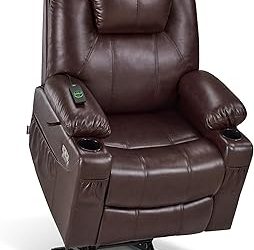
Korser 360° Swivel Rocker Recliner with Massage and Heat
This is the do-everything option for a room that only has space for one chair: massage, lumbar heat, rocking, full rotation, and a cup holder in a single unit. The dark gray fabric hides wear well, which matters when a chair is the room’s primary seat rather than an accent piece.
Korser Small-Space Recliner with Side Pockets
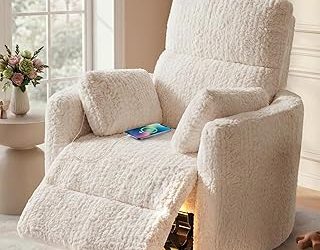
My default recommendation for studios and narrow living rooms. The chenille upholstery and trimmed proportions keep it from dominating a corner, and the side pockets absorb remotes, a book, and a phone charger, so no side table is required.
Harkawon Swivel Rocker Recliner, Beige
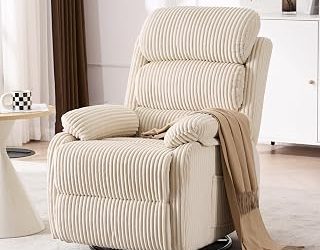
A high back and deep seat make this the most genuinely restful pick here, and the neutral beige keeps it visually quiet in a room that’s already busy. Budget the extra rear clearance the tall back demands before committing to a wall placement.
DaVinci Suzy Electronic Swivel Recliner
The GREENGUARD Gold and CertiPUR-US certifications make this the one to choose for a nursery or a bedroom where off-gassing is a real concern. The integrated USB port is a practical touch, though the power mechanism means you’ll need to plan around an outlet.
Oversized Swivel Rocker with Massage, Heat, and Adjustable Headrest
The most generous seat in this group, with two removable pillows and a headrest that actually adjusts to your height. Reserve it for rooms with real floor area; in a small space, the barrel silhouette eats visual room fast.
Frequently Asked Questions
How much space does a swivel recliner really need?
Plan for the full rotation circle plus recline depth. For most models here, that means roughly a 40- to 48-inch diameter of clear floor plus four to eight inches behind the chair. Measure with painter’s tape on the floor before ordering.
Can a swivel recliner go on carpet?
Yes, on low-pile carpet. Thick or plush pile can drag on the base and make rotation stiff. A low-profile rug pad or a hard chair mat under the base restores smooth movement.
Are massage and heat features worth it?
They’re genuinely useful for lower-back tension and cost little extra on these models. Treat them as a bonus rather than a deciding factor, since the motors add weight and require a nearby outlet.
Do these work as nursery gliders?
The rocking models do, and several are marketed for exactly that. For a nursery, prioritize certified low-emission foam and fabric, and confirm the glide motion is quiet enough not to wake a sleeping baby.
Final Thoughts
For tight apartments and studios, the Korser small-space recliner with side pockets is the most efficient use of a footprint you’ll find. If you want one chair to handle comfort duty for the whole room, the Korser 360° model with massage and heat delivers the most per square foot, while the DaVinci Suzy is the clear pick for a nursery where material certifications matter.