Key takeaways
- Folded footprint, not table size: Measure the saw collapsed on its stand and confirm it clears your storage wall, and check the folded height against any shelving that hangs above your parking spot or workbench.
- Rolling versus fixed stands: A wheeled stand you can tip and pull one-handed is worth more in a tight garage than extra rip capacity you’ll rarely use. Fixed scissor legs are lighter but usually require lifting the whole assembly.
- Working clearance on all four sides: Ripping a 6-foot board needs roughly 14 feet of runway. If you can’t get that indoors, prioritize a saw light enough to roll into a driveway or open bay for long cuts.
- Rip capacity versus your actual projects: A 32-inch rip handles full sheet goods down the middle; 24 inches is plenty for cabinet parts, shelving, and trim. Larger fences add width to the machine even when it’s parked.
- Dust management and onboard storage: A shrouded blade with a 2.5-inch port keeps a shared garage livable, and integrated slots for the fence, miter gauge, and push stick mean fewer loose parts hunting for a home.
What's inside
The table saw is the tool most DIYers want and the one they hesitate over longest, and the reason usually has nothing to do with cutting ability. It’s the footprint. A saw that lives in the middle of a one-car garage turns that garage into a workshop you can’t park in, and a saw that gets buried behind bikes and storage totes stops earning its keep entirely. If you’ve been measuring your floor space more carefully than your lumber, you’re asking the right question.
This guide looks at table saws through a spatial lens first: how compact the machine gets when folded, whether it rolls out solo or needs a helper, how much clearance the rip fence actually demands on each side, and what kind of dust footprint you’re inheriting. Cutting performance still matters, and we cover it, but the saw you’ll reach for is the one that fits back where it came from in under a minute.
As an Amazon Associate we earn from qualifying purchases.



How to Choose a Table Saw For Diyers (2026)
- Folded footprint, not table size: Measure the saw collapsed on its stand and confirm it clears your storage wall, and check the folded height against any shelving that hangs above your parking spot or workbench.
- Rolling versus fixed stands: A wheeled stand you can tip and pull one-handed is worth more in a tight garage than extra rip capacity you’ll rarely use. Fixed scissor legs are lighter but usually require lifting the whole assembly.
- Working clearance on all four sides: Ripping a 6-foot board needs roughly 14 feet of runway. If you can’t get that indoors, prioritize a saw light enough to roll into a driveway or open bay for long cuts.
- Rip capacity versus your actual projects: A 32-inch rip handles full sheet goods down the middle; 24 inches is plenty for cabinet parts, shelving, and trim. Larger fences add width to the machine even when it’s parked.
- Dust management and onboard storage: A shrouded blade with a 2.5-inch port keeps a shared garage livable, and integrated slots for the fence, miter gauge, and push stick mean fewer loose parts hunting for a home.
The Best Table Saw For Diyers (2026)s Reviewed
DEWALT DWE7491RS 10-Inch with Rolling Stand
The rack-and-pinion fence tracks with unusual precision for a portable, and the 32-1/2-inch rip capacity clears the center of a plywood sheet without an outfeed jig. The foldable rolling stand is the real story for tight shops: it tips vertical and parks against a wall like a hand truck.
SKIL TS6307-00 10-Inch Portable Jobsite Saw
SKIL’s rack-and-pinion fence and integrated dust port punch above the price, and the 15-amp motor handles hardwood rips without bogging. The folding stand collapses tighter than most competitors, making this a strong pick when storage clearance is the binding constraint.
DEWALT DWE7485 8-1/4-Inch Compact Saw
Dropping to an 8-1/4-inch blade shrinks the whole machine to something one person can carry up stairs or slide onto a shelf. Cut depth is shallower, so it suits sheet goods, trim, and nominal one-by and two-by stock rather than thick slabs.
SKIL SPT99-11 Worm Drive Table Saw
Worm drive gearing delivers noticeably more torque at the blade, which shows up when you’re pushing wet framing lumber or dense hardwood. It’s the heaviest option here, so treat it as a semi-permanent shop anchor rather than a saw you reposition daily.
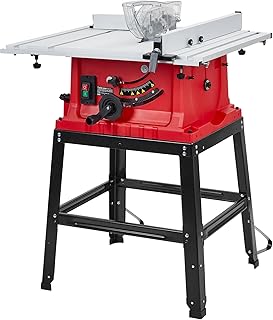
10-Inch 15-Amp Saw with Stand and Protective Cover
The 36 x 25-inch tabletop gives you real support for wider panels, and the included cover is a small but genuine advantage in a dusty shared garage. Fence accuracy needs checking on setup, but the value proposition is hard to argue with.
Frequently Asked Questions
Can I run a table saw in a single-car garage?
Yes, provided you can open the door and use the driveway as outfeed space for long rips. Position the saw so the blade faces the opening and keep the immediate path clear.
Is 8-1/4 inches enough blade for DIY work?
For furniture, shelving, cabinet carcasses, and trim, yes. You’ll feel the limit only on thick stock or bevel cuts through 2x material.
Do I need a dust collector?
A shop vac on the dust port captures most of it. In a garage that doubles as storage, that difference is significant for anything fabric or food-adjacent nearby.
How much should a first table saw cost?
Reliable portable saws with accurate fences start in the mid-range; going cheaper usually means fighting fence drift on every cut.
Final Thoughts
For most DIYers balancing capability against square footage, the DEWALT DWE7491RS is the best all-around choice thanks to its rolling stand and genuine sheet-goods capacity. The SKIL TS6307-00 delivers similar precision for less, and the compact DEWALT DWE7485 is the pick when storage space is the deciding factor.