Key takeaways
- Small pieces and building blocks: Choose a shallow bin 8–12 inches deep. A removable tray or two internal containers prevent the pieces from becoming a single mixed pile.
- Stuffed animals: A deep, open basket or fabric hamper generally works better than a rigid chest. Look for 15–25 gallons and a wide opening.
- Dolls and pretend-play accessories: Select a box at least 24 inches wide, or use a trunk with divided pouches for clothing, shoes, and accessories.
- Vehicles and larger toys: Measure the longest toy first. A box with internal dimensions of about 28 × 14 × 14 inches will accommodate many larger play items, but wheels and handles can consume usable space.
- Craft supplies: Use several small lidded containers rather than one deep chest. Paint, scissors, and small parts should remain sorted and supervised.
The best toy boxes are chosen by the toys they must hold, the child who will use them, and the space available—not by capacity alone: a low open bin suits toddlers, a lidded solid-wood chest suits a larger playroom, and a lightweight fabric cube is often the most practical choice for renters or small apartments.
Best toy boxes by household situation
| Situation | Best choice | Useful capacity | Why it fits |
|---|---|---|---|
| Small apartment or 10 × 12 ft playroom | Low, narrow open bin or two cube bins | 8–15 gallons total | Uses vertical or under-table space without blocking walkways |
| Toddler aged 1–3 | Open-top bin with rounded edges | 5–12 gallons | Easy to reach, lift toys from, and tidy without a heavy lid |
| Kids and pets sharing the room | Rigid box with a secure, slow-closing lid | 15–25 gallons | Protects small toys from curious pets while keeping contents contained |
| Many blocks, dolls, or dress-up clothes | Deep lidded chest plus smaller inner baskets | 20–40 gallons | Combines bulk storage with compartments for sorting |
| Renter or frequent mover | Collapsible fabric cube or folding soft-sided trunk | 8–18 gallons | Lightweight, compact when empty, and less likely to mark walls |
| Back pain or limited bending | Raised storage bench or rolling bin | 12–25 gallons | Allows toys to be stored between knee and waist height |
Choose capacity by toy type, not the advertised gallon figure
A toy box filled to the top is difficult for a child to use. Leave roughly 20–30% of its interior empty so small hands can find items and the lid can close without crushing them. Capacity also varies by shape: a tall, narrow box may hold the same volume as a wide bin but be harder to reach into.

Large Toy Storage Box with Lid, Toy Chest Bin Boxes Basket with Dividers
Included for 'Best Toy Boxes for Tidier Playrooms' because the listing specifies Toy Chest Bin Boxes Basket with Dividers, details this guide uses to compare options.
View on Amazon
SpaceAid Toy Storage Organizer with 6 Shelves and 12 Bins, Bookshelf/Bookcase, Kids Bin Shelf, Toys Box for Playroom Organization for Bedroom & Room Decor, White, 52.3" W
Included for 'Best Toy Boxes for Tidier Playrooms' because the listing specifies Bookshelf/Bookcase and Kids Bin Shelf, details this guide uses to compare options.
View on Amazon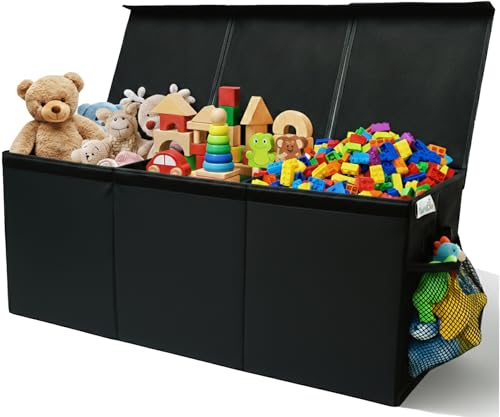
SoftOwl Extra Large Toy Storage Organizer with Lid - Sturdy, Collapsible Toy Chest Storage Box Design - Toys Bin with Dividers for Kids, Nursery, Bedroom, Playroom 37"x16"x14"
Included for 'Best Toy Boxes for Tidier Playrooms' because the listing specifies Sturdy and Collapsible Toy Chest Storage Box Design, details this guide uses to compare options.
View on Amazon
YOLOXO Toy Box Chest, Collapsible Sturdy Storage Bins with Lids, Extra Large Kids Toy Storage Organizer Boxes Bins Baskets for Kids, Boys, Girls, Nursery Room, Playroom, Closet (BLACK)
Included for 'Best Toy Boxes for Tidier Playrooms' because the listing specifies Collapsible Sturdy Storage Bins with Lids and Boys, details this guide uses to compare options.
View on Amazon- Small pieces and building blocks: Choose a shallow bin 8–12 inches deep. A removable tray or two internal containers prevent the pieces from becoming a single mixed pile.
- Stuffed animals: A deep, open basket or fabric hamper generally works better than a rigid chest. Look for 15–25 gallons and a wide opening.
- Dolls and pretend-play accessories: Select a box at least 24 inches wide, or use a trunk with divided pouches for clothing, shoes, and accessories.
- Vehicles and larger toys: Measure the longest toy first. A box with internal dimensions of about 28 × 14 × 14 inches will accommodate many larger play items, but wheels and handles can consume usable space.
- Craft supplies: Use several small lidded containers rather than one deep chest. Paint, scissors, and small parts should remain sorted and supervised.
Open bins versus lidded toy chests
Open bins: fastest for daily cleanup
Open storage is usually the best option for toddlers and preschoolers learning to put toys away. There is no lid to misplace, no hinge to pinch fingers, and no need to lift a heavy container. A front cutout or low wall lets a child see the contents. The trade-off is that open bins do not hide visual clutter and offer less protection from dust and pets.
Lidded chests: neater appearance and more protection
A lidded box keeps a room looking calmer and can protect toys from dust, sunlight, and pets. It is particularly useful for dress-up clothes, seasonal toys, or a collection that is rotated rather than used every day. However, a lid can become a hazard if it drops unexpectedly or if a child climbs on the box.
For any lidded chest, prioritize a lid that stays open at multiple angles, has a slow-close mechanism, or uses a lightweight flexible cover. Avoid a heavy, free-falling lid. Do not treat a toy chest as a seat unless the manufacturer specifies a load limit; where a product is designed as a bench, a stated limit of about 150–250 pounds is common, but the exact figure must come from its specifications.
Materials compared: what lasts and what weighs less
| Material | Strengths | Drawbacks | Best use |
|---|---|---|---|
| Solid wood | Durable, repairable, stable, furniture-like appearance | Heavy; can dent floors or be difficult to move | Permanent playrooms and storage benches |
| Engineered wood | More uniform and usually less expensive than solid wood | Edges can chip; screw joints may loosen after repeated moving | Moderate-use chests and budget furniture |
| Metal | Strong, wipeable, and resistant to chewing | Can be noisy, cold to touch, and prone to sharp exposed edges if poorly finished | Older children, garages, or highly durable storage |
| Canvas or polyester fabric | Lightweight, foldable, and quiet | Can sag, stain, or lose shape; seams and handles wear first | Renters, bedrooms, and low-frequency storage |
| Plastic | Easy to clean, lightweight, and suitable for spills | May crack in cold conditions or discolor in sunlight | Art supplies, bathrooms, and younger children |
For a fabric box, a reinforced base and panels are more important than a decorative pattern. A removable washable liner is useful for stuffed toys and dress-up clothes. For wood, inspect the underside and inside edges for smooth finishing, rounded corners, and covered fasteners. A thin decorative veneer may look attractive but is less forgiving of repeated impacts than a thicker solid or engineered-wood panel.
Measure the room before buying
Allow at least 30 inches of clear walking space in front of a toy chest, and about 36 inches where children will regularly open the lid, kneel, or play. In a 10 × 12 ft room, a box around 30–36 inches wide and 15–18 inches deep can usually fit against a wall without dominating the floor, provided the room does not already contain a large bed, desk, or play table.
Check the lid’s full opening arc, not only the box’s footprint. A 16-inch-deep chest may need another 16–20 inches of clearance behind or above it depending on its hinges. Keep boxes away from door swings, radiator covers, heater vents, and window blind cords. A storage bench placed under a window should not obstruct the window’s emergency exit path.
Measure the route into the room as well. A fully assembled wooden chest 36 inches wide may not pass through a 28-inch interior doorway at an angle. For large furniture, confirm the narrowest doorway, hallway turn, stair landing, and elevator opening. Fabric boxes and flat-packed engineered-wood units are easier to move, but assembly can add 30–90 minutes and requires checking every cam, screw, and hinge before a child uses the box.
Child-friendly details worth paying for
- Soft-close or stay-open hardware: Reduces sudden lid drops and makes access easier.
- Ventilation: Helpful for fabric, costumes, and blankets stored in a closed chest.
- Rounded corners: Prefer genuinely softened edges rather than sharp corners covered only by thin trim.
- Stable feet or anti-tip hardware: Essential for tall furniture and useful even for low chests on smooth floors.
- Low opening height: For toddlers, an opening around 18–24 inches from the floor is generally easier to reach than a tall cabinet.
- Easy-clean surfaces: A wipeable finish matters when the box will hold snacks, art supplies, or outdoor toys.
- Handles that do not protrude excessively: Recessed handles reduce snags in narrow rooms.
Do not store medicines, batteries, sharp craft tools, or other hazardous items in an ordinary toy box. A child-friendly chest is not a childproof container, and a lockable box should not be used for items a young child may need in an emergency.
Which type is the best overall?
For most families, the most versatile option is a low, rigid box with a lightweight stay-open lid, rounded corners, and about 15–25 gallons of usable space. Add small removable baskets inside rather than buying one extremely deep container. This arrangement keeps larger toys together while preventing small pieces from disappearing at the bottom.
Choose open fabric or plastic bins when independent cleanup is the priority. Choose solid or engineered wood when the box must look like permanent furniture. Choose a collapsible model when moving, storage flexibility, or a tight budget matters most. The right toy box leaves enough floor space for play, can be opened safely by the intended child, and remains light enough that an adult can move it for cleaning.