Key takeaways
- A cheap tv stand is easy to find and easy to get wrong, because the lowest sticker often hides a low weight limit or a top too narrow for your TV’s feet. The four verified picks here run from about…
A cheap tv stand is easy to find and easy to get wrong, because the lowest sticker often hides a low weight limit or a top too narrow for your TV’s feet. The four verified picks here run from about $25 to $62, and each one lists a real screen and weight ceiling so you buy on capacity, not just price.
As an Amazon Associate we earn from qualifying purchases.
By KK Home Furnishings Editorial Team
How to Choose a Cheap TV Stand
With a budget unit the risk is not looks, it is load and fit. A low price usually comes with a strict weight cap and a modest top width, so the job is to confirm your TV’s weight and base footprint both sit inside the stand’s published limits before you reward any listing for simply being inexpensive.
Check TV Weight Before Screen Size
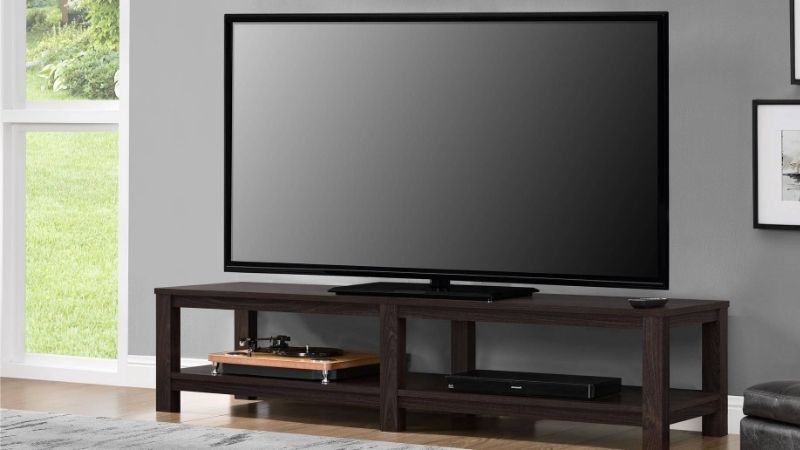
Weight, not diagonal, is what a budget top has to survive over time. The IKEA LACK is rated for a 22-pound TV, Mainstays for 25 pounds, Furinno for 40, and Target’s Room Essentials unit for 50 pounds. Find your exact TV’s weight in its spec sheet and keep it under the stand’s number with room to spare.
Match that limit to what you own today and what you might upgrade to later. A 43-inch LED can weigh anywhere from the teens to the mid-20s of pounds depending on the model, so a 22-pound ceiling leaves little margin. If a bigger screen is on the horizon, size the stand to the heavier future set now.
Overloading a budget top is where these units fail first. Particleboard flexes under a set past its rating, the finish lifts at the screw points, and a top-heavy TV turns a cheap stand into a real tip-over risk. Staying under the published weight is the single habit that keeps an inexpensive unit stable for years.
Measure the TV Feet, Not Just the Diagonal
Screen size tells you nothing about whether the TV will balance on the top. A 50-inch set might have feet spread 40 inches apart or a single central pedestal, and the stand top must support that span. The Furinno 12250 top is 43.8 inches wide, so measure your TV’s foot spacing before trusting the diagonal.
This matters most on legged TVs with a wide stance. If the feet sit wider than the stand top, the set overhangs and loads the edges, which a budget board handles poorly. A central-stand TV is more forgiving but still needs the top deep enough, and these picks vary from 11.7 to 20 inches, so check depth too.
Marketing lines like fits up to a 50-inch TV describe the diagonal, not the base plate. A set that technically fits by screen size can still hang off both ends, so the real check is foot width against top width in inches. Confirm that overlap and a value stand safely carries the set it was bought for.
Match Stand Width to Your Room and TV Base
Width has to serve the room and the TV at once. The Mainstays Gamer stand is 31.5 inches long for a small setup, while the Furinno stretches to 43.8 inches for larger screens and more gear below. Measure the wall space and the devices you need to store before deciding how wide a unit really should be.
Height is the quiet variable. The Furinno top sits just 11.7 inches off the floor, which looks sleek but can push the screen below comfortable eye level from a sofa, while the Room Essentials unit stands 20 inches tall with four shelves. Pick the height that lines the screen up with how you actually sit.
Think about what lives below the TV as well. A soundbar, console or streaming box needs clearance, and open-shelf designs like these show cables plainly. Plan the layout against the stand’s shelf heights so a cheap unit does not leave a tangle on display or a device with nowhere sensible to sit nearby.
Compare Cheap Price Against Usable Capacity
A price-per-capacity lens separates a real bargain from a false one. Dividing price by weight limit, the IKEA LACK works out near $1.14 per pound, Target’s unit around $1.24, the Furinno about $1.37, and Mainstays roughly $1.59. It is a rough value proxy, not a quality score, but it exposes thin capacity.
Read it alongside what each stand can actually hold. The LACK is cheapest outright at around $24.99, yet its 22-pound ceiling limits it to small sets; Target’s $62 unit carries 50 pounds. The better buy is the one whose limits clear your TV, even when its per-pound figure is not the lowest on the list.
Budget furniture often ships flat and uses cam-lock joints, which loosen over time if the piece is moved or overloaded. Keep the TV within the rating, snug the fittings after a few weeks, and a low-cost stand earns its price; chase the rock-bottom sticker past your TV’s weight and it costs more in the end.
Top Picks
Each pick below fills a distinct role, and all four are current from a named retailer as of October 2026, with weight and screen limits taken straight from their own listings. Prices and stock shift, so re-check before buying. The table pairs the standout spec with the main catch for each unit first.
| Product | Best For | Key Spec | Watch Out For |
|---|---|---|---|
| Furinno 12250 | Best Overall | up to 50 in / 40 lb; ~$55 | Very low 11.7 in stand height |
| IKEA LACK | Best Value | ~$25; up to 32 in / 22 lb | Must anchor; low load ceiling |
| Mainstays Gamer | Best for Small Setups | 31.5 in long; 32 in / 25 lb | Only smaller, lighter TVs |
| Room Essentials | Best Higher Published Load | 50 lb; 4 shelves; 40 in wide | 43 in stated screen limit |
Furinno 12250: Best Overall
The Furinno 12250 is the overall pick because it carries the most screen for the least compromise. It is rated for a TV up to 50 inches and 40 pounds, measures 43.8 inches wide by 16.2 deep by 11.7 tall, and costs about $54.99 direct from Furinno as of October 2026, which still lands in the budget tier.
It suits a living room with a mid-size set and a few devices, since the three-tier open frame holds a console and a streamer with room over. The 43.8-inch top takes most 50-inch TVs’ feet, but measure your foot spacing first. No-tools assembly keeps setup quick, a real plus for a flat-pack unit at this price.
The drawback is height: at 11.7 inches tall it places the screen low, which can mean looking down from a standard sofa. There is no cable management beyond the open shelves, and the engineered-wood build wants its fittings kept snug. For a wall-mounted TV with gear below, though, the low profile works well.
IKEA LACK: Best Value
The IKEA LACK is the value pick at around $24.99 as of October 2026, the lowest price in the group by a wide margin. It takes a TV up to 32 inches and 22 pounds, measures 35 inches wide by 14 deep by 17.75 tall, and keeps a clean, simple look that slots into almost any small living room or bedroom corner.
It fits a secondary set, a bedroom, or a compact first apartment where the TV is genuinely small and light. The modest footprint leaves floor space free, and the open shelf holds a streaming box. Because the ceiling is 22 pounds, confirm your TV’s weight closely; many 32-inch sets sit near that figure.
IKEA warns that the unit must be anchored to the wall because of tip-over risk, which is the condition of using it safely rather than a formality; do not generalize that exact instruction to the other three without each manual. The low 22-pound limit also rules out any step up to a larger, heavier screen.
Mainstays Gamer: Best for Small Setups
The Mainstays Gamer stand suits a compact gaming or desk-side setup where space is tight. It is rated for a TV up to 32 inches and 25 pounds, measures 31.5 inches long by 14.06 wide by 18.94 tall, and sells for about $39.67 at Walmart as of October 2026, a budget price with a higher load than the LACK.
It works where space is tight and the screen stays small, such as a bedroom console corner or a monitor-plus-TV desk. The 31.5-inch length keeps the footprint narrow, and the extra three pounds of capacity over the LACK give a little more headroom. Still, check your set’s weight against the 25-pound cap.
Its limit is scope: only smaller, lighter TVs belong on it, so it is a poor choice if a larger screen is coming. Like most flat-pack units it uses cam-lock joinery that benefits from re-tightening after assembly, and the open styling means any cables behind the screen stay visible unless you route them yourself.
Room Essentials: Best Higher Published Load
Target’s Room Essentials stand is the pick when published load is the main priority. It carries up to 50 pounds, lists a 43-inch screen limit, offers four shelves across a 40-by-15-by-20-inch frame, and costs around $62 at Target as of October 2026, the most of this group but still firmly in budget.
It fits a living room that needs real storage under the screen, since four shelves hold a console, soundbar and boxes. The 50-pound ceiling gives the widest weight margin here, so a heavier 40-something-inch TV is comfortable. Measure the 40-inch top against your TV’s feet, which can exceed the stated screen size.
The catch is the 43-inch screen limit despite the generous weight rating, so a wider set may overhang even if it is light enough. A higher weight ceiling does not make a stand automatically stronger than a lower-rated one; build quality and foot support still matter, so keep the TV inside both stated limits.
Frequently Asked Questions
Buyers tend to ask the same practical things about budget media furniture, usually around weight, width and safety. Each answer below starts with the direct reply, then adds the condition that changes it, so you can line the guidance up against your own TV and room instead of a one-size figure that may mislead.
Can a 43-inch TV sit on a cheap TV stand?
Yes, if the stand’s weight and width both clear your set with margin. A 43-inch TV often weighs in the teens to mid-20s of pounds, so a unit like the Furinno at 40 pounds or Target’s at 50 handles it, while the 22-pound LACK is too light. Check your TV’s exact weight against the figure in the listing.
Width is the second gate to clear. A 43-inch set can have feet spread near 38 inches, so the top must be at least that wide; the Furinno’s 43.8-inch top works, a 31.5-inch unit does not. Measure the foot spacing and compare it to the top width in inches rather than trusting the diagonal to tell the fit.
If both numbers clear, an inexpensive stand is perfectly fine for a 43-inch screen. The exception is a model near the edge of its rating, where even a modest future upgrade would overload it; in that case, buy one size up in capacity now so the stand still serves you after the next TV, not only this one.
Is TV screen size the same as stand width?
No, and treating them as equal causes most overhang problems. Screen size is a corner-to-corner diagonal, while stand width is the flat top the TV’s feet actually rest on. A 50-inch TV can have feet wider than a 40-inch top, so the two figures describe different things and should be checked separately.
The number that governs fit is the distance between the TV’s feet, not the diagonal itself. On a central-pedestal TV you instead need a top both deep and wide enough for the base plate. Pull both measurements from the TV before matching them to the stand’s top in inches, so nothing hangs off the edges.
When a listing says it fits a given screen size, read that as a rough guide to the diagonal only, not a promise about the base. Legged sets with a wide stance are the common trap, so confirm foot width against top width first, and a value stand that looked too small on paper may actually suit the TV.
How much weight should a TV stand hold?
It should clear your TV’s weight with margin, not just barely meet it. Across these picks the weight ceilings run 22, 25, 40 and 50 pounds, so pick one that sits comfortably above your set’s figure. A small gap between the TV weight and the rating leaves nothing for a soundbar or a knock to the frame.
The right target depends on what else goes on top. Add the weight of any center-channel speaker or console sitting beside the TV, since a budget top’s rating covers everything on it, not the screen alone. Distribute that load toward the center rather than one edge, where a thin top is most likely to sag.
If you expect to upgrade, size for the heavier future TV now rather than later. Stepping from a 32-inch to a larger screen can double the weight, so a 22-pound stand that fits today may be unusable later. Buying a little extra capacity is cheaper than replacing both the TV and the stand in one year.
Is a $25 TV stand safe for a TV?
It can be, within strict limits and with anchoring in place. The IKEA LACK at around $25 is rated for a 32-inch, 22-pound TV, and IKEA directs owners to secure the unit to the wall because of a tip-over risk. Kept under that rating and anchored, a budget stand is safe; pushed past it, no price is safe.
The deciding factor is the match between TV and rating, not the sticker. A light 32-inch set on a $25 stand is stable; a heavy 40-inch set on the same unit is not, regardless of cost. Anchoring matters most in homes with children or pets, where a climbing hazard turns a tip-over into an injury risk.
Follow the maker’s own instruction for each model rather than assuming one rule covers all. IKEA’s anchoring note applies to the LACK specifically; the other picks have their own manuals and hardware. Match the set to the rating, secure the unit as its guide says, and a low price does not mean a low margin of safety.
Final Thoughts
Buying a cheap tv stand well comes down to capacity over cost: confirm your TV’s weight and foot spread, then match them to a unit whose limits clear both with margin. The Furinno carries the most screen, the LACK wins on price for small sets, the Mainstays suits gaming corners, and Target’s holds the most. Anchor as the maker directs.