Key takeaways
- The point of a console table with drawers is hidden storage in a shallow footprint, so it is chosen by depth and real drawer space first, not just drawer count. The four tables below are compared on overall depth, drawer…
The point of a console table with drawers is hidden storage in a shallow footprint, so it is chosen by depth and real drawer space first, not just drawer count. The four tables below are compared on overall depth, drawer dimensions and the top and drawer load each maker publishes so the one you pick hides clutter without blocking the wall.
As an Amazon Associate we earn from qualifying purchases.
By KK Home Furnishings Editorial Team
How to Choose a Console Table with Drawers
Choosing a console table with drawers works best when you measure depth before width, compare real drawer space rather than drawer count, check the published top and drawer load, and match the height to where it sits. Those four steps keep the focus on usable hidden storage in a shallow footprint against a wall.
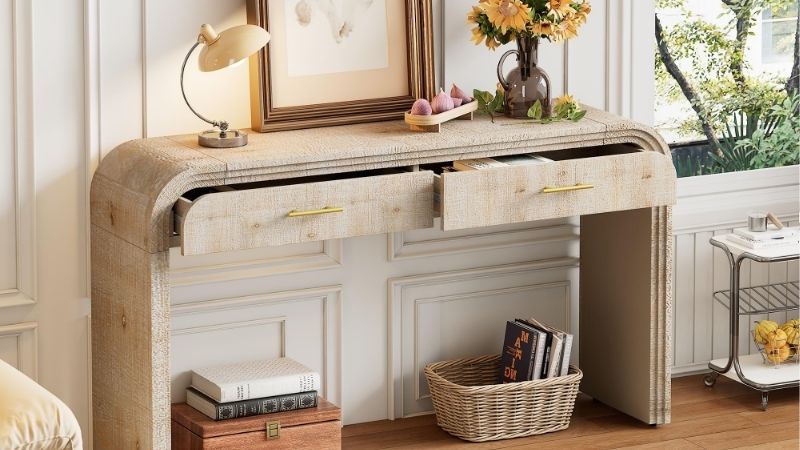
Measure Depth Before Width
Depth is the number that decides whether a console fits against a wall, behind a sofa or in an entryway, so measure it first. These picks run from 14 inches on the Nathan James Jasper to 15 inches on the Walker Edison and Pottery Barn tables, a narrow band that still matters in a tight hall or walkway.
Match the depth to the spot: a hallway or entryway needs a shallow table that does not catch passers-by, while behind a sofa the depth has to clear the gap without pushing into the room. Measure the clear space and subtract a little for baseboard, since a console that overhangs a walkway is the common regret.
Width matters too, but it is the easier number to accommodate once depth fits. A longer console suits a long wall or a large sofa, while a shorter one fits a tight entry, so settle the depth against your space first and then choose the width that matches the wall or the furniture it sits behind.
Compare Drawer Space, Not Just Drawer Count
Two drawers can hold very different amounts, so compare the real drawer space rather than the count. The Article Leif lists soft-close drawers measuring about 15.25 by 12.5 by 6 inches inside, while the Pottery Barn Benchwright lists drawers around 17.5 by 9 by 3.5 inches, so a deeper drawer holds more than a wider, shallower one.
Match the drawer shape to what you store: tall items like remotes and chargers suit a deeper drawer, while flat items like mail or placemats suit a wide, shallow one. A higher drawer count is not automatically more storage, so read the interior dimensions where they are published rather than counting drawer fronts.
Keep in mind that drawer interior dimensions and drawer load are different measures, so a roomier drawer is not necessarily a stronger one. Compare the usable volume where makers publish it, and avoid assuming one console holds more simply because a drawer looks taller, until the real interior sizes line up across the tables.
Check Top And Drawer Load Where Published
Published load figures tell you what the console can safely hold, and they vary widely here. The Walker Edison Fluted Curve lists a 150-pound top and a 26.4-pound drawer, while the Nathan James Jasper lists a 60-pound top and 20 pounds per drawer, so the stronger table carries far more on its surface.
Match the load to the use: a console topped with a heavy lamp, a mirror and decor benefits from a high top rating, while one holding a few framed photos needs less. Keep drawer contents within the stated drawer load, since a drawer rated to 20 pounds is for light items rather than stacks of books.
Where a maker does not publish a figure, treat the table as suited to lighter loads and spread weight evenly rather than guessing a capacity. Reading the published top and drawer loads, where they exist, keeps you from overloading a surface or a drawer, which is where budget consoles begin to sag or stick over time.
Match Height To Sofa, Wall Or Entryway Use
Height decides how the console reads in its spot, so match it to the use. These tables run from about 29.5 to 31.9 inches tall, which suits standing against a wall or in an entryway, while behind a sofa the top should sit near or just below the back rather than towering over the cushions.
Match the height to the setting: an entryway console at standing height suits dropping keys and mail, while one behind a sofa reads best when it lines up with the sofa back. A table much taller than the sofa shows its underside and looks disconnected, so measure the back height if the console will sit behind the seating.
The practical point is that the right height depends on where the console lives, not a single figure. For an entry or a wall, standing height works; behind a sofa, match the back; and in every case confirm any drawer opens clear of nearby furniture, since a console that fits the wall can still be blocked in use.
Top Picks
These four picks cover a high-load all-rounder, a value console, a compact soft-close option and a premium traditional piece, with dimensions and prices verified as of October 2026. Each is matched to a use and a budget rather than ranked on drawer count, since drawer space and load matter more than the number of fronts.
| Product | Best For | Key Spec | Watch Out For |
|---|---|---|---|
| Walker Edison Fluted Curve | Best Overall (High Load) | 54.3 x 15 x 31.9 in; 150-lb top; ~$276 | Longer footprint |
| Nathan James Jasper | Best Value | 36.2 x 14 x 30.1 in; 60-lb top; ~$149.99 | Lower top load |
| Article Leif 37″ | Compact Soft-Close Storage | 37 x 14.5 x 29.5 in; 2 soft-close drawers; ~$549 | Premium price |
| Pottery Barn Benchwright 54″ | Premium Traditional | 54 x 15 x 30 in; 2 drawers; ~$1,259 | Highest price here |
Walker Edison Fluted Curve – Best Overall For High Published Load Capacity
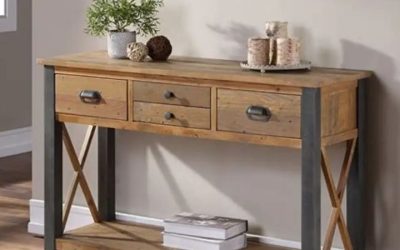
The Walker Edison Fluted Curve is the all-rounder, measuring 54.3 by 15 by 31.9 inches with a published 150-pound top and a 26.4-pound drawer split into two compartments, listed around $276 on sale as of October 2026. Its high top rating makes it the pick for a console that holds a heavy lamp, a mirror and decor.
That 150-pound top is comfortably the strongest here, so it suits a styled entry or living-room wall where the surface carries real weight. The drawer split into two compartments helps organize small items, and at about $276 it pairs that capacity with a mid-range price that undercuts the premium options considerably.
The caveat is footprint: at 54.3 inches wide it needs a long wall or a large sofa to sit behind, and its roughly 815 square inches of floor space is the largest here, within a whisker of the Benchwright. Measure the wall first, and keep drawer contents within the stated 26.4-pound rating for the pair of compartments.
Nathan James Jasper – Best Value
The Nathan James Jasper is the value pick, measuring 36.2 by 14 by 30.1 inches with a published 60-pound top and 20 pounds per drawer, listed around $149.99 on sale as of October 2026. It is comfortably the most affordable here, and its shallow 14-inch depth suits a tight hallway or a narrow entry.
The compact footprint and low price make it the easiest to place in a small space, and it ships with anti-tip hardware for the model, a genuine safety point for a taller, narrower console. For an entryway or a wall where a lamp and a few photos sit on top, its 60-pound rating is enough.
The caveats are its lower top load and drawer capacity: at 60 pounds on top and 20 per drawer, it is for lighter items rather than a heavy mirror or stacks of books. The included anti-tip hardware is specific to this model rather than a feature of all consoles, so use it, and anchor the table to a wall stud.
Article Leif 37″ – Best For Compact Soft-Close Storage
The Article Leif is the compact soft-close pick, measuring 37 by 14.5 by 29.5 inches with two soft-close drawers of about 15.25 by 12.5 by 6 inches inside, listed around $549 at Article as of October 2026. The deep drawer interiors suit remotes, chargers and taller items that a shallow drawer cannot hold.
The soft-close drawers are its standout feature, closing gently rather than slamming, and the deeper drawer boxes give real usable volume despite the compact 37-inch width. At 29.5 inches tall it is the lowest here, which suits sitting behind a sofa or lining up neatly under a mirror in a hallway.
The caveat is price: at about $549 it sits well above the value picks, so it suits a buyer who values the soft-close mechanism and the drawer depth. Keep in mind that a deeper drawer interior means more volume but not necessarily a higher load, so store heavier items within sensible limits rather than filling it with books.
Pottery Barn Benchwright 54″ – Best Premium Traditional Option
The Pottery Barn Benchwright is the premium traditional pick, measuring 54 by 15 by 30 inches with two drawers of about 17.5 by 9 by 3.5 inches inside, listed around $1,259 on a limited-time offer as of October 2026. Its wide, traditional styling suits a formal entry or a long living-room wall behind a sofa.
The craftsmanship and classic look are its appeal, giving a substantial, finished piece for a traditional interior. Its roughly 810 square inches of floor space is within about half a percent of the Walker Edison, so the two are effectively tied on footprint despite the large price gap between them.
The caveats are price and drawer shape: at about $1,259 it is by far the most expensive here, and its drawers are wide but shallow at 3.5 inches inside, better for flat items like mail and placemats than tall ones. Confirm the current offer, since the price reflects a limited-time promotion rather than a standing figure.
Frequently Asked Questions
Shoppers comparing storage consoles tend to ask the same practical questions, and most come back to depth and drawers rather than style. These answers keep the numbers tied to the picks above while being clear that drawer space and load are separate measures and that a tall, narrow console should be anchored.
How Deep Should A Console Table Be?
Shallow enough to sit against a wall or behind a sofa without catching passers-by, which usually means a narrow footprint. These picks run from 14 to 15 inches deep, a band that suits a hallway, an entry or a gap behind a sofa, so measure your spot and shop to a depth that leaves the walkway clear.
The right depth depends on the location: a busy hallway wants the shallower end of that range, while a console behind a sofa needs only to clear the gap without pushing into the room. Subtract a little from the measured space for baseboard, and confirm any drawer opens fully without hitting nearby furniture.
A deeper console holds roomier drawers but claims more of a tight space, so balance storage against footprint. For most hallway and entry uses, a depth around 14 to 15 inches is the sweet spot, deep enough for useful drawers yet shallow enough to keep the path clear in a narrow space.
How Many Drawers Does A Console Table Need?
As many as the storage you need, but drawer count matters less than drawer space. These picks pair two drawers with very different interiors, from the deep 6-inch Article drawers to the shallow 3.5-inch Pottery Barn ones, so two roomy drawers can hold more than several shallow ones despite the lower count.
Match the drawers to what you store: deep drawers suit remotes, chargers and bulkier items, while wide, shallow ones suit mail, keys and flat items. Rather than counting fronts, read the interior dimensions where a maker publishes them, since the usable volume is what actually decides how much a console can hide away.
For most entryway and living-room use, two well-sized drawers are plenty, with open shelving below if you want display space too. Choose the drawer shape that fits your clutter, and treat drawer count as a rough guide rather than a measure of capacity on its own, since interior size tells the real story.
Can A Console Table Go Behind A Sofa?
Yes, provided its depth clears the gap and its height suits the sofa back. A shallow console like the 14-inch Nathan James Jasper slots behind a sofa without pushing into the room, and a top near or just below the sofa back reads best, so measure both the gap and the back height before buying.
The reason height matters behind a sofa is appearance: a console taller than the back shows its underside and looks disconnected, while one that lines up hides its edge. The lower 29.5-inch Article Leif suits a lower sofa, so match the console height to your seating rather than assuming any console works in that spot.
Confirm the drawer opens clear of the sofa and the walkway, since a console that fits the gap can still be awkward to use if a wall or the seating blocks the pull. Behind a sofa, prioritize a shallow depth and a matching height first, and let the drawer storage be a bonus on top of a good physical fit.
Should A Tall Narrow Console Table Be Anchored?
Yes, a tall, narrow console is more prone to tipping, so anchoring it to a wall is sensible, especially in a home with children. The Nathan James Jasper ships with anti-tip hardware for the model, which is a feature of that specific table rather than a given on every console, so use it where it is supplied.
The reason is physics: a narrow base and a higher center of gravity make a loaded console easier to pull over, and a child leaning on an open drawer adds leverage. Anchoring the table to a wall stud removes that risk, and keeping heavier items in lower drawers lowers the center of gravity as well.
Use the supplied hardware where a maker provides it, or add an anti-tip strap rated for the wall, and attach to a stud rather than drywall alone. The task takes a few minutes and is far easier than dealing with a toppled console, so treat anchoring as part of setup for any tall, narrow piece.
Final Thoughts
The best console table with drawers is the one whose depth fits your space and whose drawers and load suit what you store, chosen before drawer count: the high-load Walker Edison Fluted Curve, the shallow Nathan James Jasper for a tight entry, the deep-drawered Article Leif for soft-close storage, or the Pottery Barn Benchwright for a premium look.