Key takeaways
- A couch that turns into a bed is really two pieces of furniture, so the number that matters is the actual sleeping surface and the space it claims when open. A sofa that looks compact can need a lot of…
A couch that turns into a bed is really two pieces of furniture, so the number that matters is the actual sleeping surface and the space it claims when open. A sofa that looks compact can need a lot of floor once it converts, so measure for the bed, not just the couch.
How to Choose a Convertible Couch
Judge a convertible couch by the real sleeping surface it provides and the footprint it occupies when open, then the mechanism and mattress. Marketing sizes can be nominal rather than standard, so compare the actual stated sleep dimensions and plan the open space before you focus on looks or the closed-sofa size alone.
Actual Sleeping Surface
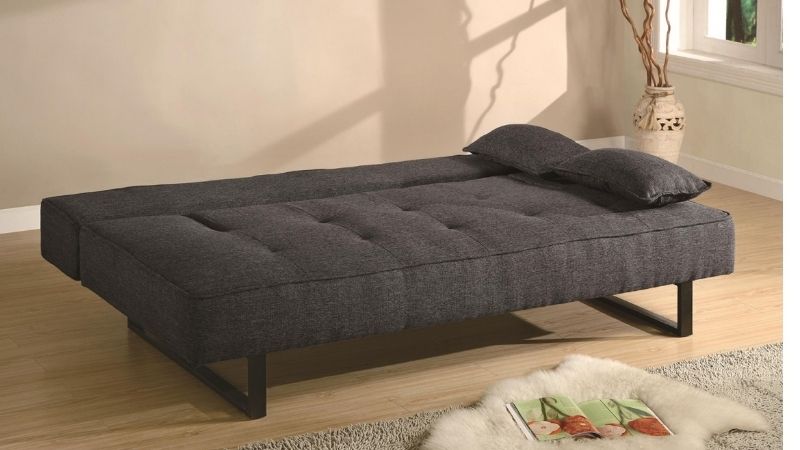
The sleeping surface is the spec that defines this category, and it is often smaller than a standard bed name suggests. IKEA lists the HYLTARP sleeper at a 59.875 by 78.75-inch bed and the NYHAMN at 55.125 by 78.75 inches, while Room & Board lists the Berin opening to a 60 by 77-inch mattress surface.
Compare the stated sleep width and length to who will sleep on it, since a 55 to 60-inch width is the difference between comfortable for one and snug for two. Measure against a bed you know, because a convertible labeled as a queen can offer less width than a standard queen, which affects how two people sleep.
Note that a nominal size is not a standard size: the NYHAMN’s 55.125-inch width, for example, is not a standard US queen, so standard queen sheets may not fit. Read the actual dimensions rather than the size name, since matching sheets and judging comfort both depend on the real measured surface, not the label.
Total Depth When Open
The open footprint, especially the total depth, is the figure people forget until the sofa is in the room. IKEA lists the HYLTARP’s opened depth at 94.5 inches, a manufacturer-stated figure that tells you how far the bed extends into the room, which is far more than the closed sofa’s depth suggests.
Measure the open depth against your floor plan, because a convertible that fits as a sofa can block a walkway or hit furniture as a bed. The point of a convertible is to use the space twice, so you need to confirm there is room for the full open footprint, not just the closed couch against the wall.
Plan where the bed will extend and what it will reach, including coffee tables and doorways, since the open position is the constraint. A sofa bed that cannot fully open without moving other furniture every night is a daily chore, so the open depth deserves as much attention as the sleeping surface itself.
Mechanism Type
How the couch converts shapes both the ease of use and the sleep quality, so weigh the mechanism. The IKEA NYHAMN and HYLTARP use different conversion approaches than a traditional pull-out, and some designs fold or unfold the seat into a bed while others house a separate mattress, each with trade-offs in effort and comfort.
A simpler fold-out is quicker to set up nightly, while a pull-out with a dedicated mattress can sleep more like a real bed but takes more effort and space. Match the mechanism to how often you will convert it, since a guest sofa used occasionally has different needs than one slept on every night.
Consider who will operate it, too, as some mechanisms are heavier or more awkward than others to pull out and fold away. Try the conversion if you can, because a mechanism that is stiff or fiddly discourages use, and the best convertible is one you will actually convert rather than leave as a permanent sofa or bed.
Mattress Thickness
Mattress thickness and type decide how the bed actually sleeps, not just its dimensions. IKEA lists the HYLTARP with a 4.75-inch mattress and Room & Board lists the Berin with a 60 by 77 by 4-inch mattress, so these are thinner than a standard bed, which is typical for a convertible but affects comfort for regular use.
A thinner convertible mattress suits occasional guest use well but can feel firmer or less supportive for nightly sleeping than a full-depth bed. If someone will sleep on it often, factor in a mattress topper or choose a model with a thicker, more supportive mattress, since the stock mattress is built to fold, not to rival a bed.
Check what mattress comes with the couch and whether it can be upgraded, as some systems accept a replacement and others do not. For long-term nightly use, the mattress is as important as the frame, so weigh the stated thickness against how the couch that turns into a bed will actually be used in your home.
Best Convertible Couches
Each pick below leads with its actual sleeping surface and open footprint where published, since those decide whether it works as a bed, plus the mattress and price where available. Confirm the open depth against your room and check the current price at the retailer before you buy any of these.
| Product | Best For | Key Spec | Watch Out For |
|---|---|---|---|
| IKEA HYLTARP | Best verified sleep size | Bed 59.875×78.75 in; 94.5 in open depth; 4.75 in mattress | Deep 94.5 in open footprint |
| IKEA NYHAMN | Best budget convertible | Bed 55.125×78.75 in; ~$549 at IKEA | 55.125 in width is not standard queen |
| Room & Board Berin 76" Queen | Best near-queen sleep surface | Open 76×85 in; mattress 60×77×4 in | Low stock; confirm availability |
| Crate & Barrel Peyton 88" | Verify sleep size first | Closed 88×41 in; sleep surface not published | Sleep dimensions not published |
IKEA HYLTARP
The IKEA HYLTARP is the pick with the most fully verified sleep specs, listing a 59.875 by 78.75-inch bed, a 94.5-inch opened depth, and a 4.75-inch mattress. Having the sleep surface, open depth, and mattress thickness all stated makes it the easiest convertible here to plan around for real overnight use.
The nearly 60-inch sleep width is the widest clearly stated surface in this group, which suits two occasional guests better than the narrower options. Because the open depth is published at 94.5 inches, you can confirm the bed fits your room before buying rather than discovering the footprint problem on the first night.
The trade-off is exactly that depth: at 94.5 inches open, the HYLTARP needs substantial floor space as a bed, so measure your room carefully. The 4.75-inch mattress is fine for guests but thin for nightly use, so plan a topper if someone sleeps on it often, and check the current price at the retailer before buying.
IKEA NYHAMN
The IKEA NYHAMN is the budget convertible, listed around $549 at IKEA as of October 2026 with a 55.125 by 78.75-inch bed. The lower price and compact form make it an accessible choice for a guest room or small apartment where an occasional bed is needed without a large investment or footprint.
At a clear price point and a tidy size, it suits buyers who want a sofa that occasionally sleeps one or two without committing to a larger pull-out. The stated sleep dimensions let you plan the surface, and the modular approach fits smaller living rooms where a bulkier convertible would dominate the space.
The key caveat is that its 55.125-inch width is not a standard US queen, so standard queen sheets may not fit and two adults will find it snug. Treat the size name as nominal, measure the real surface against your sheets and sleepers, and check the current price at the retailer before buying.
Room & Board Berin 76-inch Queen
The Room & Board Berin offers the closest-to-queen sleep surface here, opening to a 76 by 85-inch footprint with a 60 by 77 by 4-inch mattress. The 60-inch mattress width is the nearest to a true queen in this group, which makes it the best sleeper for two among these options when availability allows.
A near-queen surface and a defined open footprint make it a genuine occasional bed rather than a compromise, suiting households that host overnight guests regularly. The published open dimensions let you plan the space, and the quality associated with the brand appeals to buyers prioritizing the sleep experience over the lowest price.
The important caveat is stock: this pick is listed as low stock, so confirm availability before counting on it and be ready to choose an alternative if it sells out. The 4-inch mattress is thin for nightly use, so plan a topper for regular sleeping, and check the current price and availability at the retailer before buying.
Crate & Barrel Peyton 88-inch – Verify Sleep Size First
The Crate & Barrel Peyton is a larger convertible with a closed footprint of 88 by 41 inches, but its sleeping-surface width and length are not clearly published, so it sits in the verify-first group. It is a legitimate sofa bed; you simply cannot confirm the actual sleep dimensions from the listing alone.
The generous closed size suggests a roomy sofa, but because the sleep surface is unpublished, you cannot plan the bed or match sheets to it without more information. For a buyer focused on the sleeping function, that missing figure is the key gap, since the whole point of a convertible is the bed it makes.
Before relying on it as a bed, contact the seller for the exact sleep-surface dimensions and the open footprint, and treat it as a sofa with an unconfirmed bed until then. Confirm those figures against your room and sleepers, and check the current price at the retailer before deciding on this larger option.
Space Planning
A convertible only earns its keep if the space works in both modes. Planning the sofa versus bed footprint, the coffee-table clearance, the delivery path, and the sheets you will actually need turns a good sleep spec into a couch that genuinely functions as both furniture pieces in your real room.
Sofa Versus Bed Footprint
The whole idea of a convertible is that it occupies two footprints, so plan both. A couch like the HYLTARP sits compact against the wall but extends to a 94.5-inch open depth as a bed, so map where it goes in both modes rather than assuming the sofa footprint is all the space you need.
Mark the open position on your floor and check it against walls, doorways, and traffic paths, because the bed footprint is usually the limiting one. A convertible that fits beautifully as a sofa but cannot fully open without blocking a doorway defeats its purpose, so the open mode should drive the placement decision.
If the room is tight, favor a model with a shallower open footprint or plan to rearrange other furniture nightly. Knowing both footprints up front prevents the common disappointment of a sofa bed that technically converts but is impractical to use because the open bed takes over the whole room.
Coffee-Table Clearance
Coffee tables are the usual casualty of a convertible, since the bed extends into the space the table occupies. Measure how far the bed reaches and whether your coffee table must move each time you convert, because a table that has to be shifted nightly quickly becomes a reason the sofa bed goes unused.
Choose a lightweight or easily moved table, or plan a layout where the open bed clears it, so converting is a quick step rather than a furniture rearrangement. The less effort it takes to open the bed, the more likely the convertible actually gets used for guests the way you intended when you bought it.
For frequent use, consider a nesting or rolling table that tucks away easily when the bed is open. Planning the coffee-table interaction is a small step that makes a big difference, since the smoothest convertibles are the ones where opening the bed does not trigger a chain of other furniture moves.
Delivery Path
A convertible sofa is heavy and bulky, so plan the delivery path before ordering. Measure doorways, hallways, and stairs against the sofa’s closed dimensions, since these pieces are dense and often cannot be disassembled, and a sofa that will not fit through the door is an expensive return and a wasted day.
Check tight turns and low ceilings on the route, not just the front door, because a long sofa needs swing room to round a corner. For upper floors or apartments, confirm the stairwell and elevator can take the closed footprint, and ask whether the model ships in parts that reassemble inside the room.
If the path is genuinely tight, favor a modular convertible like some IKEA designs that arrive in sections and assemble indoors. Confirming the delivery route in advance is the step that keeps a well-chosen sofa bed from becoming a logistics problem on the day it arrives at your door.
Sheets by Actual Mattress
Buy sheets to the real mattress size, not the sofa’s size name, since convertibles often use nonstandard dimensions. The NYHAMN’s 55.125-inch width is not a standard queen, and the Berin and HYLTARP surfaces have their own measurements, so measure the actual mattress before buying bedding that may not otherwise fit.
A sheet that is too large bunches and a too-small one pops off, both of which make the convertible uncomfortable to sleep on, so matching the sheet to the measured surface matters. Where the size is nonstandard, look for sheets sized to the actual dimensions or use deep-fitted options that accommodate the thin mattress.
Factor a topper into the bedding plan too, since the thin 4 to 4.75-inch mattresses here benefit from one for nightly use. Sizing the sheets and topper to the real mattress rather than the size label is the finishing step that makes the bed mode comfortable rather than a frustrating approximation of a proper bed.
Final Thoughts
The best couch that turns into a bed is the one whose actual sleeping surface and open footprint fit your room and your sleepers, not the one with the most impressive size name. Compare the HYLTARP, NYHAMN, and Berin on real sleep dimensions, verify the Peyton’s size with the seller, measure the open depth against your room, and check the current price.