Key takeaways
- Three blades: A clean, contemporary look with efficient air movement. These fans can feel more directional and may be a good match for modern, uncluttered rooms.
- Four or five blades: A versatile middle ground. They often provide comfortable circulation without overwhelming the ceiling, making them a dependable choice for bedrooms and living areas.
- Six or more blades: A fuller appearance and typically a softer-feeling breeze at comparable speeds. They can work well where quiet comfort matters more than maximum air volume.
What's inside
Choosing a ceiling fan is not simply a matter of counting blades. In a compact bedroom, apartment living room, or multipurpose space, blade count affects airflow character, visual weight, sound, cleaning effort, and how well the fixture fits the room. The right fan should move air comfortably without making a small ceiling feel crowded.
This guide explains how many blades are best in 2026, how blade count relates to motor design and room size, and which features deserve more attention than the number printed on the box. I’ll also point out where several current models make sense, especially for low ceilings and small-space layouts.
As an Amazon Associate we earn from qualifying purchases.


Start With the Room, Not the Blade Count
For most homes, a three- to five-blade fan offers an effective balance of airflow, efficiency, and visual simplicity. Fewer blades often create a more open, streamlined appearance and can move air with less drag when paired with a capable motor. More blades usually produce a smoother, gentler breeze, but they may also add visual density and require more motor torque.
In a small room, diameter is often more important than blade count. A 44-inch fan generally suits bedrooms and offices around 75 to 100 square feet, while a 52-inch model is more appropriate for many living rooms and larger bedrooms. Always check the manufacturer’s recommended room size and maintain safe clearance from walls and furniture.
What Different Blade Counts Actually Change
- Three blades: A clean, contemporary look with efficient air movement. These fans can feel more directional and may be a good match for modern, uncluttered rooms.
- Four or five blades: A versatile middle ground. They often provide comfortable circulation without overwhelming the ceiling, making them a dependable choice for bedrooms and living areas.
- Six or more blades: A fuller appearance and typically a softer-feeling breeze at comparable speeds. They can work well where quiet comfort matters more than maximum air volume.
Blade count alone does not predict performance. Blade pitch, motor power, blade shape, ceiling height, and the fan’s cubic-feet-per-minute rating all matter. A well-designed six-blade fan can outperform a poorly designed three-blade model, while a high-efficiency DC motor may deliver strong airflow with less noise and energy use.
Match the Fan to a Small-Space Layout
Low-profile or flush-mount fans are usually the safest choice for ceilings near the minimum recommended height. They reduce the sense of visual clutter and keep the fixture out of the path of tall occupants. The Asyko 46-inch Black 6-Blade Modern Low Profile Ceiling Fan is worth considering for a bedroom or kitchen where a compact footprint, integrated light, remote control, and multiple speeds are useful.
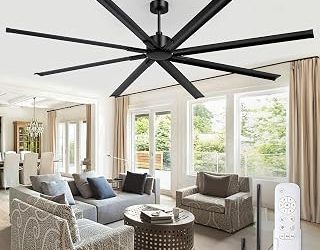
For a larger open room, a 52-inch fan may circulate air more effectively without needing to run at full speed. The TCL 52-inch Low Profile Ceiling Fan with Light and Remote is a practical, understated option for a bedroom, while the ZMISHIBO 52-inch eight-blade fan suits shoppers who prefer a fuller silhouette and do not need an integrated light.
Prioritize the Motor and Controls
A quiet DC motor is often a better investment than extra blades. DC motors commonly offer several speed settings, efficient operation, and smooth reversing for seasonal comfort. Look for a reversible motor, especially if the fan will run year-round: downdraft mode cools occupants in warm weather, while a low-speed updraft can help redistribute warm air during heating season.
Controls also matter in compact rooms. A wall switch may be enough for a simple bedroom, but a remote or app can prevent awkward furniture rearrangement just to reach a pull chain. Smart models such as the DREO Smart Ceiling Fan with Lights offer app, remote, and Alexa control, along with extensive speed adjustment and timer functions. The DREO Smart RGBIC Ceiling Fan adds color-tunable lighting for a living room or game room where atmosphere matters.
Choose Lighting That Supports the Space
When ceiling area is limited, a fan with an integrated light can replace a separate fixture and make the room feel less crowded. Dimmability is especially valuable in bedrooms and small living rooms: bright light supports cleaning and tasks, while a lower setting is more comfortable in the evening. Adjustable color temperature can be helpful if the same room serves as an office, lounge, and guest space.
For a smaller bedroom or compact office, the DREO 44-inch Flush Mount Smart Ceiling Fan with Remote keeps the proportions restrained. For a larger room, consider a 52-inch DREO model or TCL’s low-profile fan, but verify the light’s brightness, color settings, and whether the fixture is compatible with your existing wall controls.
Tips
- Measure the room and ceiling height before shopping; do not choose by blade count alone.
- Check the fan’s airflow rating, but remember that installation height and room layout affect real-world circulation.
- Leave adequate clearance from walls, cabinets, lighting, and bunk beds or loft furniture.
- Use the lowest comfortable speed in a bedroom; a quiet motor is more useful than excessive maximum airflow.
Frequently Asked Questions
Is a five-blade ceiling fan better than a three-blade model?
Not automatically. A five-blade fan may feel smoother and look more substantial, while a three-blade fan can be efficient and visually lighter. Compare motor quality, blade pitch, airflow rating, noise, and controls before choosing.
Are more blades quieter?
More blades can create a softer breeze, but noise depends primarily on motor quality, balance, mounting, and speed. An unbalanced fan with many blades may be louder than a well-built three- or four-blade model.
How many blades are best for a bedroom?
Four to six blades are excellent starting points for a bedroom because they can provide comfortable circulation without an overly forceful breeze. Choose a smaller diameter for a compact room and prioritize quiet operation, dimmable lighting, and a timer.
Does a 52-inch fan work in a small room?
It can, provided the room meets the manufacturer’s size guidance and the blades have enough clearance from walls and furniture. In a very small room, however, a 42- to 46-inch fan may look more balanced and be easier to position.
Conclusion
For most small-space homes, the best ceiling fan is not the one with the most blades. A well-sized four- to six-blade fan with a quiet reversible DC motor, useful speed control, and suitable lighting will usually deliver the strongest combination of comfort and practicality. Measure first, evaluate the whole design, and treat blade count as one piece of the decision rather than the deciding feature.