
Key takeaways
- Lists 122-inch assembled width, a compact long run for dual-power layouts
- Pairs right-arm power recliner with left-arm power-reclining-back chaise, opposite-handed
- Includes a 13-inch-wide center storage console between seating sections
Shopping for a reclining sectional with chaise means weighing two things at once: the extended footprint when every seat opens, and whether the chaise reclines or simply holds a fixed footrest. We compare six verified configurations by width, depth, and mechanism; the recurring trade-off is that more powered motion often needs more rear clearance.
As an Amazon Associate we earn from qualifying purchases.
By KK Home Furnishings Editorial Team
How to Choose a Reclining Sectional with Chaise
Three variables decide whether a given sectional works in your room: the mechanism you choose, the space the seats need when fully open, and where the power has to come from. Walk these in order before you fall for a color or a price, because the wrong call on any one is hard to undo after delivery.
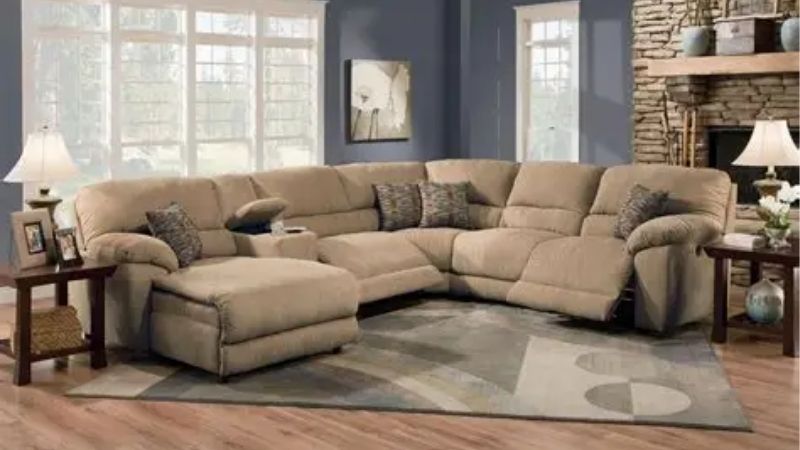
Choose Manual, Dual Power, or Reclining-Back Chaise
Reclining sectionals with a chaise split into three mechanisms: manual press-back seats, single or dual powered recliners, and a chaise that either reclines or stays fixed. Mechanism drives size, and the Ashley Acklen Place dual-power layout lists 122 inches of assembled width (a long horizontal run, not usable seat width), a compact footprint for a room where two powered seats sit opposite the chaise.
Pick the wrong mechanism and you inherit a long-term cost. Manual press-back seats need no outlet but cannot hold a preset position, while powered seats add a motor and control box that become the first service point years later. Decide which matters most before you commit to a width and handedness you cannot change after delivery.
Find the True Open Length and Rear Wall Gap
The number that decides whether one of these sectionals fits is not the closed depth but the opened depth plus the gap the backrest needs behind it. The Living Spaces Wilson lists a 6-inch rear clearance with a 66.54-inch opened recliner length, measured as maximum exterior projection rather than seat depth, which tells you how far the piece lives off the wall.
Skip this and a reclining sectional that looked fine against the tape measure jams into the wall or a walkway the first time someone leans back. Closed installed depth, such as the Wilson’s 68.5 inches, is merely the resting envelope; the motion envelope is larger, so leave room or the recline mechanism takes the strain on every use.
Locate Power Outlets and Check the Module Layout
Powered configurations are useful when an outlet sits where the control box can reach it and when the module layout matches your room’s handedness. The six-piece Ashley Acklen Place pairs a right-arm power recliner with a left-arm power-reclining-back chaise, an opposite-handed arrangement that reverses in the mirrored SKU, so confirm which side the chaise faces before ordering.
A powered reclining sectional with a chaise draws from a wall outlet, so plan for a dedicated receptacle and check the power-supply rating on the SKU. Ashley’s listing states a UL mark covering the supplied cord rather than the whole sectional, so verify the motor and control-box UL or ETL listing on the live page and leave recline clearance behind each powered seat.
Top Picks
Each pick below is a specific brand-and-model configuration with its own arm-facing and mechanism, sorted so you can match motion to room. Figures are maker- or retailer-listed assembled dimensions, not seat measurements, and none is crowned best overall because final prices and some clearance figures are not comparable across these listings.
| Product | Best For | Key Spec | Watch Out For |
|---|---|---|---|
| Ashley Acklen Place 6-Piece Dual-Power Sectional with Chaise (Mirrored) | Opposite-handed chaise and recliner placement | 122 W x 135 D in | At 135-in deep max envelope, room corner access is limiting |
| Ashley Top Tier Manual Reclining 6-Piece with Press-Back Chaise | Manually operated recliner sections without outlets | 146 W x 131 D in | Manual mechanism means no powered position preset or motor |
| Living Spaces Wilson 125-inch 4-Piece Power Reclining with Left Chaise | Published 6-inch wall-allowance planning | 124.66 W x 68.5 D in | Requires more wall gap than Kennedy’s 1.97 in per retailer |
| Living Spaces Kennedy Mocha 7-Piece Power Reclining Modular with RAF Power Chaise | Large modular wall-hugger configuration | 175.2 W x 120.47 D in | Long 175.2-in wall span not apartment-friendly |
| Rooms To Go Drew & Jonathan Modularone 8-Piece Power Reclining with Media Consoles | Powered entertainment consoles in the sectional | 156 W x 124.5 D in | Media consoles consume floor area that does not seat a person |
| Rooms To Go Crescent Place 4-Piece Power Reclining Sleeper with Chaise | Dual sleeper and recliner use | 146.25 W x 75 D in | Pop-up sleeper adds unfolding clearance beyond reclining movement |
Ashley Acklen Place 6-Piece Dual-Power Sectional with Chaise — Best for opposite-handed placement
Best For: Buyers with an outlet on both ends who want the chaise and recliner on opposite arms of the room.
What sets this pick apart is its mirrored, opposite-handed geometry: the power recliner lands on one arm and the reclining-back chaise on the other, something the single-chaise picks here cannot offer. That lets two people sit in independent powered positions while the chaise anchors the far corner, rather than stacking all the motion on one side of the room.
Ashley lists the six-piece configuration at 122 inches of assembled width and 135 inches of maximum installed depth, both measured as exterior projection and long horizontal run rather than seat dimensions. A 13-inch-wide center storage console sits between the seating sections. Dual-power Ashley sectionals land at the premium end, and the selected-variant final price is not published, so check the current price live.
In a typical living room, that 135-inch maximum depth limits how close the piece sits to a corner, so measure the diagonal before delivery. As a dual-power unit it ships in multiple sections to assemble, and because the listing states a UL mark on the supplied cord rather than the whole sectional, verify the motor and control-box UL or ETL listing and leave recline clearance behind each seat.
Pros:
- Lists 122-inch assembled width, a compact long run for dual-power layouts
- Pairs right-arm power recliner with left-arm power-reclining-back chaise, opposite-handed
- Includes a 13-inch-wide center storage console between seating sections
Cons:
- At 135-inch maximum depth, corner room access stays limited
- Full reclined run and rear wall gap are not listed
Who Should Buy It: Buyers needing opposite-handed chaise and recliner placement in a measured room; others wanting more wall data should choose the Wilson.
Ashley Top Tier Manual Reclining 6-Piece with Press-Back Chaise — Best for outlet-free rooms
Best For: Rooms without a nearby receptacle where a manual press-back chaise and two hand-operated recliner seats make sense.
This is the pick for rooms with no convenient outlet, because every recliner here is hand-operated press-back rather than motorized. Where the powered picks tie you to a receptacle and a control box, this one trades presets for independence: push back to recline, and the right-arm chaise works the same way, so nothing in the set depends on wall power.
Ashley lists this manual six-piece at 146 inches of assembled width and 131 inches of maximum installed depth, both exterior-projection figures rather than seat depth. The maker describes a 46-by-74-inch right-arm-facing press-back chaise piece. Large manual Ashley sectionals sit in the mid-to-premium band, and the selected-variant final price is not published, so check the current price before ordering.
Because the motion is mechanical, there is no motor to fail, though press-back frames and hinges carry the wear over years of use. The 46-by-74-inch chaise piece is bulky to carry, so check doorway and stair turns ahead of delivery. A 3-inch wall-gap figure comes from a seller Q&A rather than a model-level rating, so treat rear clearance as something to confirm.
Pros:
- Lists 146-inch assembled width across a manual six-piece run
- Includes a 46-by-74-inch right-arm-facing press-back chaise section
- Uses two manual reclining seats, needing no outlet or motor
Cons:
- Manual mechanism holds no powered position preset or motor
- Rear clearance unverified; the 3-inch Q&A figure is seller-only
Who Should Buy It: Households without conveniently placed outlets who want manual recline; those needing a motorized preset should pick the Wilson instead.
Living Spaces Wilson 125-inch 4-Piece Power Reclining with Left Chaise — Best for clearance planning
Best For: Shoppers measuring a 6-inch rear gap who want published clearance numbers before committing to a power layout.
The reason to shortlist the Wilson is straightforward: it publishes the two clearance numbers most listings omit. Where several picks here leave the opened length and rear gap blank, Living Spaces states both, so you can plan the wall placement on paper before the sectional arrives rather than discovering the motion envelope on delivery day.
Living Spaces lists 124.66 inches of assembled width and 68.5 inches of maximum installed depth when closed, alongside a 66.54-inch opened recliner length and a 6-inch rear wall clearance; it also cites a 23-inch regular seat depth and a power-adjustable headrest. This four-piece sits in the mid-range tier, and the selected-variant final price is not published, so confirm it live.
For planning, that 6-inch rear gap and 66.54-inch opened length show how far from the wall the recliners live, which is where most power sectionals surprise buyers. The power-adjustable headrest adds a second motor beside the recline motor, so verify the control-box UL or ETL listing and outlet placement. The included left chaise is not described as power-reclining, so confirm its motion separately.
Pros:
- Lists 6-inch rear clearance with a 66.54-inch opened recliner length
- Measures 124.66-inch assembled width, a mid-size four-piece footprint
- Includes 23-inch regular seat depth and a power-adjustable headrest
Cons:
- Needs more wall gap than Kennedy’s retailer-stated 1.97 inches
- Included left chaise is not declared power-reclining, unlike named recliners
Who Should Buy It: Planners who want published rear-clearance numbers before buying; those needing the tightest wall gap should choose the Kennedy instead.
Living Spaces Kennedy Mocha 7-Piece Power Reclining Modular with RAF Power Chaise — Best for big rooms
Best For: Large living rooms that can give a 175-inch wall span yet still want a tight 1.97-inch rear gap.
Kennedy earns its place as the wall-hugger for big rooms: a seven-piece modular span with the tightest published rear gap in this roundup. Where the Wilson needs 6 inches behind it, Living Spaces lists under 2 inches here, which is the distinguishing claim, provided your room can absorb the length that comes with that much seating and motion.
Living Spaces lists 175.2 inches of assembled width, the widest set here, and 120.47 inches of maximum installed depth, both exterior figures. It states a 1.97-inch rear clearance and a 62.99-inch opened recliner length with a right-arm power-reclining chaise. This sits firmly at the premium end; one US listing showed about $4,030, which is not a tax- and shipping-comparable final checkout price, so confirm it live.
The practical hurdle is delivery and placement: the set ships as seven cartons, so plan the carry path and assembly, and a 1.97-inch rear gap leaves almost no margin for baseboards or vents. Living Spaces notes the opened-length figure can describe the reclining chair rather than every seat, so verify each component’s clearance and the control-box UL or ETL listing before placement.
Pros:
- Lists retailer-stated 1.97-inch rear clearance and 62.99-inch opened recliner length
- Spans 175.2-inch assembled width, the widest seven-piece set here
- Ships as seven cartons with a right-arm power-reclining chaise
Cons:
- At 175.2-inch span, not apartment-friendly for tight rooms
- Opened-length figures may describe the recliner, not every seat
Who Should Buy It: Large rooms needing a modular wall-hugger with tight clearance; apartment buyers should choose the smaller Wilson or Acklen instead.
Rooms To Go Drew & Jonathan Modularone 8-Piece Power Reclining with Media Consoles — Best for media rooms
Best For: Media-focused households wanting two powered consoles with charging built into an eight-piece powered sectional layout.
This pick exists for the media room, because it builds two powered consoles into the sectional itself rather than asking you to add a side table. None of the other picks integrates USB and wireless charging between the seats, so if the goal is a movie wall with charging within reach, the eight-piece Modularone covers it in one footprint.
Rooms To Go lists 156 inches of assembled width and 124.5 inches of maximum installed depth, both exterior-projection figures, across eight upholstery and console modules. The two media consoles carry USB and wireless charging, and the set includes powered recliner seating with a chaise. It sits in the mid-to-premium band, and the final selected-variant price is not published, so check the current price.
Keep in mind that the two media consoles occupy floor space that seats no one, so the 156-inch span buys fewer seats than its width suggests. The added Bluetooth, USB, and charging electronics create more service points over time, so verify the power supply and control-box UL or ETL listing. The opened length and rear gap are not listed, so confirm clearance on the live page.
Pros:
- Lists 156-inch assembled width across an eight-piece modular run
- Includes two media consoles with USB and wireless charging
- Combines powered recliner seating with a chaise across eight modules
Cons:
- Media consoles occupy floor area that seats no one
- Opened length and rear gap are unverified on the listing
Who Should Buy It: Media rooms wanting built-in powered consoles and USB charging; buyers prioritizing seat count should choose the Kennedy instead.
Rooms To Go Crescent Place 4-Piece Power Reclining Sleeper with Chaise — Best for overnight guests
Best For: Homes that host overnight guests and need a pop-up sleeper plus power recline in one four-piece footprint.
The Crescent Place is the dual-duty pick: it is the one configuration here that adds a pop-up sleeper on top of power recline and a power chaise. If the same room has to host overnight guests and serve as the TV sofa, this four-piece does both jobs, which none of the seating-only picks above attempts.
Rooms To Go lists 146.25 inches of assembled width and 75 inches of maximum installed depth when closed, both exterior figures rather than seat depth. The four-piece combines power recline, a power chaise, a storage chaise, and a pop-up sleeper. It sits in the mid-range tier for a power sleeper sectional, and the selected-variant final price is not published, so confirm it live.
Living with both functions means planning for two motion envelopes: the pop-up sleeper needs its own unfolding clearance in front, separate from the recline travel behind. Not every section may operate at once, so check the combined extended footprint. Because it is powered, verify the motor and control-box UL or ETL listing, the outlet location, and the rear gap, which the listing does not state.
Pros:
- Lists 146.25-inch assembled width in a four-piece sleeper layout
- Combines power recline, power chaise, storage chaise, and pop-up sleeper
- Measures 75-inch maximum installed depth when closed
Cons:
- Pop-up sleeper adds unfolding clearance beyond the reclining motion
- Opened length and rear gap not listed for the full set
Who Should Buy It: Guest-hosting homes needing both a sleeper and recline; those wanting the widest seating should choose the Kennedy instead.
Frequently Asked Questions
A few questions come up repeatedly once buyers start matching motion to room. The answers below stay with what the maker and retailer listings actually publish, flag where a figure is missing, and point you to the number to confirm on the specific SKU rather than a category rule of thumb.
Can a fixed chaise recline on its own?
No. A fixed chaise does not recline unless the product names it as reclining; for instance, the Crescent Place lists a power chaise among its four pieces, while a plain chaise adds zero recline travel. The part itself is different hardware, not a setting you switch on.
What changes the answer is the exact wording on the SKU: terms like press-back, power-reclining-back, and fixed chaise describe different parts. If the listing does not spell out the chaise motion, treat it as fixed and ask the retailer for a model-level answer before you order.
Is zero-wall the same as no rear clearance?
No. A zero-wall or wall-hugger design still needs some gap behind it; it simply needs less than a standard recliner. The tightest example here, the Kennedy at a 1.97-inch rear clearance, is small but not nothing, because the backrest still travels slightly rearward as the seat opens.
The figure that matters is model-specific, not the marketing term, since two wall-hugger sofas can need very different gaps. Measure from the wall to any baseboard or vent, add the maker’s stated rear clearance, and confirm that figure on the page rather than trusting the label.
What fails first when you do not have enough clearance?
The recline mechanism takes the strain first: when the backrest meets the wall it stops short, and the motor or frame loads up on every use. On a power seat the control box and motor are the parts that wear, which is why the opened length, often a foot or more beyond the resting envelope as a planning heuristic, sets the real space to leave.
This shifts with mechanism and floor: manual press-back frames and hinges wear differently from a motor and control box, and hard floors let a sliding base drift under load. If clearance is tight, keep a planning margin, check the motor’s UL or ETL listing, and keep the backrest clear of the wall.
Does a power reclining sectional need a separate outlet?
In practice yes. Each powered section pulls from a wall outlet through a transformer, so plan for at least one dedicated receptacle positioned near the powered seats. The more motors a configuration carries, such as separate seat and headrest motors, the more current the circuit has to supply.
What changes the answer is how the maker routes power: some run every seat from one cord, others use several. Confirm the official power-supply rating and the motor or control-box UL or ETL listing on the SKU, then locate the outlet before delivery so cords do not cross a walkway.
Final Thoughts
Choosing well here comes down to matching the exact configured use case to measurements you can verify, not to a headline size. Decide on manual or powered motion, confirm the opened length and rear gap on the specific SKU, and locate the outlet; a reclining sectional with chaise rewards the buyer who plans the motion envelope before the delivery truck arrives.
