
Key takeaways
- A small bedside table should be judged by the floor area it takes, not by one dimension, because a table narrow in width can still be deep. This roundup compares four verified picks by their full width-by-depth footprint, from about…
A small bedside table should be judged by the floor area it takes, not by one dimension, because a table narrow in width can still be deep. This roundup compares four verified picks by their full width-by-depth footprint, from about 1.36 to 1.78 square feet, so the one you pick is genuinely the most space-saving for a tight bedroom.
As an Amazon Associate we earn from qualifying purchases.
By KK Home Furnishings Editorial Team
How to Choose a Small Bedside Table
The real measure of a small nightstand is its footprint, width times depth, since that is the floor it occupies. A table can look compact from the front yet reach well back, so before height or storage, calculate the square footage, match the height to your bed, decide how much storage the footprint must hold, and check delivery.
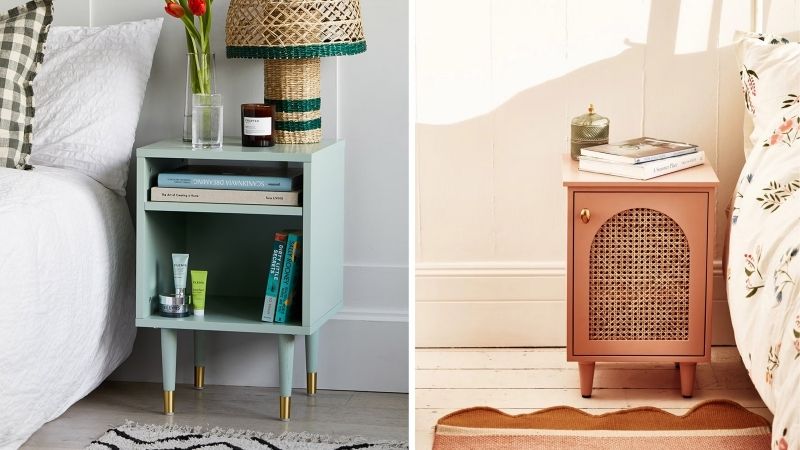
Calculate Width × Depth, Not Width Alone
Footprint, not width, tells you how much floor a nightstand takes. Multiplying width by depth, the picks here run from the Pottery Barn Winslet Mini at about 1.36 square feet to the West Elm Metalwork Mini at about 1.78, with the IKEA VIHALS at 1.49 and the HAUGA at 1.52. A narrow front can still hide a large footprint behind it.
Do the simple math before comparing. Convert each table’s width and depth to square feet by multiplying them and dividing by 144, so a 14-by-14-inch top is about 1.36 square feet and a 16-by-16 is about 1.78. Line those areas up against the gap beside your bed, since the floor the table occupies is what a tight room really feels.
Treat near-equal footprints as the same. The HAUGA at about 1.52 square feet and the VIHALS at 1.485 differ by only about 2.3 percent, so neither takes meaningfully more space, and the choice between them comes down to storage and build. Reserve the bigger-or-smaller judgment for genuine gaps, like the Metalwork against the Winslet.
Match Height to Your Mattress Setup
Height should land near the top of the mattress so the surface is easy to reach from bed. These run from the IKEA VIHALS at 22.875 inches to the Pottery Barn Winslet at 26, with the Metalwork at 24.75 and the HAUGA at 24.625, so the right one depends on how tall your bed and mattress sit together in the room.
Measure from the floor to the top of your mattress, then choose a table within a few inches of it. A low platform bed pairs with a shorter table, while a tall bed with a thick mattress suits the 26-inch Winslet. A surface far below the mattress top makes reaching a lamp or a glass an awkward downward motion each night.
Remember height is fixed, so there is no adjusting later. A table too low leaves you reaching down and one too tall can loom over the mattress, neither of which is comfortable, so the quick measurement against your actual bed build pays off. When between heights, slightly below the mattress top usually reads better than well above it.
Decide How Much Storage the Footprint Must Provide
Storage and footprint trade off, so decide how much you need in the floor you can spare. The Winslet packs three drawers into the smallest footprint here, the HAUGA mixes a drawer with open spaces, the VIHALS offers open storage on casters, and the Metalwork pairs a drawer with a shelf in the largest footprint of the four tables.
Match the storage type to your bedside habits. Drawers hide clutter in a tiny footprint, as the Winslet shows; open storage keeps items reachable but on display, like the VIHALS; a drawer-and-shelf mix does both. Decide whether you would rather tuck things away or grab them quickly, then pick the layout that fits the area you have.
More storage in less floor usually costs more. The Winslet fits three drawers into about 1.36 square feet but sits at the premium end, while the budget VIHALS trades a larger footprint and open shelving for a far lower price. Weigh how much concealed storage you truly need against the footprint and the price before deciding which wins.
Check Delivery and Assembly Constraints
A small table is easy to move in, but the build and extras still vary. The budget IKEA pieces use particleboard and arrive flat-packed for assembly, the VIHALS adds casters for mobility, and the Pottery Barn and West Elm pieces mix engineered wood with poplar or metal. Confirm what assembly and features each involves before buying one.
Match the build to how the nightstand will be used. Particleboard like the VIHALS and HAUGA is fine in a calm bedroom but chips at edges and swells if it gets wet, while poplar or a metal frame tolerates more. New engineered-wood furniture meets the EPA’s formaldehyde limits under TSCA Title VI, so any new-piece odor usually fades.
Check model-specific safety features, not assumptions. Pottery Barn provides an anti-tip kit for the Winslet Mini, but that is a condition of that model, not proof the others ship with it, so anchor a tall or drawer-heavy nightstand regardless. The casters on the VIHALS also mean it rolls, which a child’s room should account for.
Top Picks
Each pick below fills a clear role, with footprint, height, storage and build drawn from the makers’ listings, current as of October 2026. Prices move and two are marked limited or last-chance, so confirm before buying. The table pairs the footprint with the main catch for each nightstand before the fuller notes that follow below.
| Product | Best For | Key Spec | Watch Out For |
|---|---|---|---|
| Winslet Mini | Best Overall Small Footprint | ~1.36 sq ft; 3 drawers | $399 |
| VIHALS | Best Mobile Small Table | ~1.49 sq ft; casters | Marked last chance |
| HAUGA | Best Open + Closed Storage | ~1.52 sq ft | Footprint almost tied with VIHALS |
| Metalwork Mini | Best Metal Storage | 16 in square; drawer + shelf | Largest footprint here |
Winslet Mini: Best Overall Small Footprint
The Pottery Barn Winslet Mini is the overall pick for the smallest footprint with real storage. At 14 by 14 inches it occupies about 1.36 square feet, stands 26 inches tall, packs in three drawers, and is built from poplar with engineered wood, MDF and oak veneer, listing around $399 at Pottery Barn as of October 2026 in this group.
It suits a tight bedside where you want drawers to hide clutter without giving up floor, since three of them fit the smallest footprint here. The 26-inch height pairs with a standard or taller bed. Confirm the 14-by-14 footprint against your gap, and note Pottery Barn provides an anti-tip kit for this model to secure it to the wall.
The catch is price: at around $399 it is the most expensive here, so it suits a buyer who values the three-drawer storage in a minimal footprint over a budget figure. The poplar-and-veneer build is sturdier than particleboard, which partly explains the cost, so choose it when a small footprint plus hidden storage matters more than price.
IKEA VIHALS: Best Mobile Small Table
The IKEA VIHALS is the pick for a movable small table. At 14.625 inches square it occupies about 1.485 square feet, stands 22.875 inches tall, offers open storage on casters, and lists around $39.99 at IKEA as of October 2026, the cheapest option here, though it was marked as a last-chance item on the page that was checked.
It suits a bedside where you want to roll the table aside to clean or rearrange, since the casters make it mobile, and the open shelf keeps items within reach. The low price makes it easy to try. Measure the roughly 1.485-square-foot footprint against your gap, and account for the casters if a child shares the room, as it rolls.
The catches are the material and the stock. It is particleboard, so it chips at edges and swells if it gets wet, and being marked last chance means it may sell out, so confirm availability before counting on it. Keep it dry and to light duty, and the mobility and low price make it a practical, if not long-lived, small table.
IKEA HAUGA: Best Open + Closed Storage
The IKEA HAUGA is the pick for a mix of hidden and open storage. At 15.625 by 14 inches it occupies about 1.519 square feet, stands 24.625 inches tall, and pairs a drawer with two open spaces, listing around $49.99 at IKEA as of October 2026 in the budget tier for a nightstand of this compact size and build.
It suits a bedside that wants both a drawer to hide clutter and open shelving for a book or remote within reach, covering two needs in one small footprint. Measure the roughly 1.519-square-foot footprint, which is almost identical to the VIHALS, so treat the two as taking the same floor and choose on storage style and mobility instead.
The catch is construction: it is particleboard and fiberboard, so it chips at edges and swells if it gets wet, and will not take the heavy use a solid-wood piece shrugs off. Keep it in a calm bedroom and wipe spills quickly, and the drawer-plus-open-storage layout earns its place for the low price beside a bed in a quiet room.
West Elm Metalwork Mini: Best Metal Storage
The West Elm Metalwork Mini is the pick for a metal-framed small table. At 16 inches square it occupies about 1.778 square feet, stands 24.75 inches tall, and pairs an engineered-wood drawer with a shelf on a hot-rolled-steel frame, listing around $349 at West Elm as of October 2026 in the mid-to-upper tier for a nightstand.
It suits a bedside that wants an industrial look and a sturdier metal frame than particleboard, with a drawer for hidden storage and a shelf for reachable items. The steel frame tolerates knocks well. Measure the 16-inch square footprint, the largest here, against your gap, since it takes meaningfully more floor than the 14-inch tables.
The catch is footprint and price: at about 1.778 square feet it is the biggest here, so it suits a bedside with a little more room, and at around $349 it costs well above the IKEA pieces. Choose it when the metal build and look matter and you can spare the floor; for the tightest gaps, a 14-inch table saves more space.
Frequently Asked Questions
Buyers of compact nightstands ask the same practical things, mostly about how small is small, whether 14 inches is enough, and width versus depth. Each answer below leads with the direct reply, then adds the condition that changes it, so you can apply it to your exact bedside gap rather than a single idea of what small should mean.
How small is a small bedside table?
By footprint, the small ones here run from about 1.36 to 1.78 square feet, so small is a range, not a number. The Winslet Mini at roughly 1.36 is the most compact and the Metalwork at about 1.78 the largest, with the two IKEA tables between. Compare the floor area each takes rather than a single width when you judge small.
What counts as small depends on the gap beside your bed. A table of about 1.36 square feet suits a tight space between a bed and a wall, while 1.78 needs a little more room, so measure the available area first. A difference of under a square foot across these still shows clearly on the floor of a small bedroom.
Do not judge by width alone, which can mislead. A table narrow at the front can reach back far enough to take as much floor as a wider, shallower one, so the honest measure is width times depth. Convert each table’s dimensions to square feet, line them up, and the genuinely smallest footprint is clear regardless of the front width.
Is 14 inches wide enough beside a bed?
For most bedsides, yes. A 14-inch top, as on the Winslet, holds a lamp, a phone and a book, which covers typical nightstand duty, and the Winslet fits three drawers into that width. The limit shows only when you want a wide tray or several items spread out, so measure what you actually set down before deciding on the size.
It depends on the surface shape and what you place on it. A 14-inch square top gives more usable area than a round one of the same width because it has no rounded corners, so shape matters too. For a larger lamp base or a stack of books, a couple more inches of width or depth helps, at the cost of a bit more footprint.
Weigh the width against the floor you save. A 14-inch table keeps the walkway clear in a tight room, which is often worth more than a slightly bigger top, especially beside a single or platform bed. If 14 inches feels cramped, the issue is usually bedside clutter, so trim what you keep there before sizing up to a larger table.
Is width or depth more important in a tiny bedroom?
Both matter, because footprint is width times depth, but the one that limits you depends on the gap. If the space between the bed and the wall is narrow, width governs the fit; if the walkway in front is tight, depth governs how far the table protrudes. Measure both, then pick the table whose footprint respects the tighter one.
In practice, a smaller footprint overall beats optimizing one dimension. A table that is narrow but deep, or wide but shallow, can still take a lot of floor, so compare the square footage, not one measurement. The near-tie between the HAUGA and VIHALS footprints shows how two tables of different widths can occupy almost the same floor.
Let the room’s pinch point decide. Mark the table’s footprint on the floor where it will go and check both the clearance to the bed and the walkway past it, which reveals whether width or depth is the real constraint. Choosing by that pinch point, rather than a single dimension, is what keeps a tiny bedroom feeling open and usable.
Can a small nightstand still have drawers?
Yes. The Pottery Barn Winslet Mini fits three drawers into about 1.36 square feet, the smallest footprint here, proving a compact table can still hide clutter. So a small nightstand does not force you into open shelving; it is about choosing a design that packs drawers neatly into a tight footprint rather than trading them for size.
The trade-off is usually price or capacity. Fitting drawers into a small footprint tends to cost more, as the Winslet shows against the budget open-storage VIHALS, and each drawer in a tiny table holds less. So weigh how much concealed storage you need against the footprint and the price before choosing drawers over simple open shelving.
Mind the weight limits on small drawers. A compact drawer holds light items well but can bind or sag if overloaded, so keep heavy books or large objects on a stronger surface. A drawered small nightstand is ideal for hiding a few essentials neatly; just match what you store to the size and build of the drawers it provides.
Final Thoughts
Choosing a small bedside table comes down to footprint, not one dimension: calculate width times depth, match the height to your mattress, and check the build. The compact Winslet, mobile VIHALS, open-and-closed HAUGA and metal Metalwork each suit a gap and need, and the smallest footprint, not the narrowest front, saves the most room.
