
Key takeaways
- TV stands and media consoles often describe overlapping furniture in U.S. stores. For a tv stand vs console decision, the meaningful difference is usually how much enclosed storage, equipment access, and visual coverage you want, not a strict naming rule.…
TV stands and media consoles often describe overlapping furniture in U.S. stores. For a tv stand vs console decision, the meaningful difference is usually how much enclosed storage, equipment access, and visual coverage you want, not a strict naming rule. Choose a unit that safely supports your exact TV and fits the room.
As an Amazon Associate we earn from qualifying purchases.
By KK Home Furnishings Editorial Team
TV Stand vs Console: What Actually Changes?
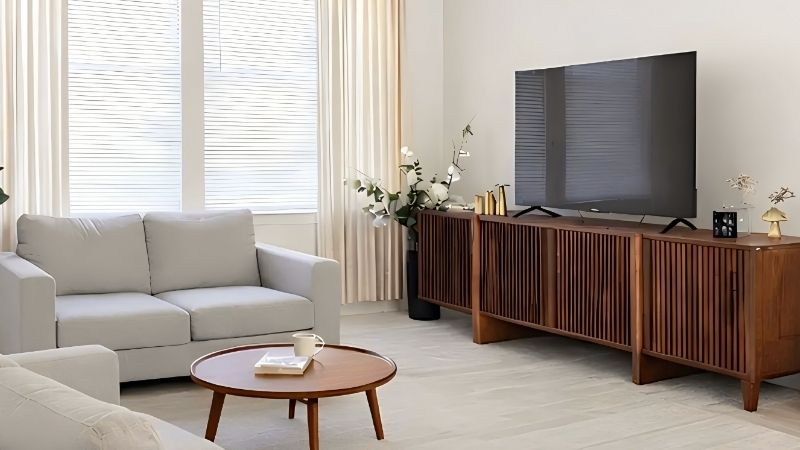
A TV stand is furniture designed to support or accompany a television. A TV console is generally a low media cabinet that combines TV placement with storage for devices and accessories. Retailers use these terms interchangeably: Best Buy includes console-style cabinets within its TV stand category, while IKEA sells stands with both open shelving and doors [Best Buy; IKEA, October 2026].
| Shopping Factor | TV Stand | TV Console | What to Check |
|---|---|---|---|
| Common meaning | Broad TV-support furniture category | Often a low media-storage cabinet | Actual design, not the product name |
| Storage | May be open, closed, or minimal | Frequently includes cabinets or drawers | Clear shelf openings and door swing |
| Equipment access | Open designs can simplify access | Doors can conceal receivers and accessories | Cables, airflow, and remote operation |
| TV placement | Freestanding or wall-adjacent designs | Freestanding and some wall-hung designs | Approved load, flat support, installation |
| Appearance | Can be visually light or substantial | Often reads as a continuous cabinet front | Wall proportions and storage needs |
| Better starting point | Simple screen support and easy access | Concealed media storage and less visible clutter | Your actual equipment and daily habits |
The table compares typical design tendencies, not mandatory specifications. A TV stand with drawers may function exactly like a console, and a product sold as a console might be entirely open. Check the maker’s photographs, assembly instructions, and support limits before using the marketing label to narrow your purchase.
TV Stand Is Often the Wider Retail Category
In everyday shopping language, a TV stand is anything designed as furniture for a television area, from a simple open bench to a cabinet with doors. The term does not promise exposed shelves, a particular material, or even that the television must rest on top. Some stands are intended to sit beneath a separately mounted screen.
That broad usage appears in current U.S. retail catalogs. IKEA describes TV stands and benches with drawers, adjustable shelving, doors, and cable management, while Best Buy groups media consoles among TV stands. This makes “TV stand” a practical search category rather than a reliable description of one specific construction [IKEA; Best Buy, October 2026].
TV Console Usually Emphasizes Media Storage
A media console typically looks like a low cabinet: it may have sliding doors, drawers, shelves, or a mix of concealed and open bays. Those features can hide game controllers, remotes, and cables while giving the room a more continuous furniture line. The key benefit is storage organization, not an inherently greater ability to hold a large television.
The console label alone cannot tell you whether a drawer will fit your accessories or whether a closed bay can accommodate a receiver. Compare internal shelf openings, usable depth with plugs attached, cable cutouts, and how doors operate when someone sits nearby. Those details are more decisive than a console’s exterior styling.
TV Weight and Installation Matter More Than the Label
Neither term certifies a load rating. A TV placed on furniture needs a complete, stable contact area for its pedestal or both feet, along with a manufacturer-published limit appropriate to that configuration. A unit intended only to sit below a wall-mounted TV may have different loading assumptions from furniture designed to carry the screen itself.
Also verify whether the specific product is freestanding, wall-hung, or required to be anchored. The U.S. Consumer Product Safety Commission recommends securing TVs and furniture against tip-over hazards; where anchoring is not possible, it advises a sturdy low base and positioning the TV well back from the edge [CPSC, 2025]. Never infer wall-mounting permission from a floating appearance.
Choose a TV Stand or Console for Your Room
Once you understand the overlapping names, select the furniture by the task it must perform. The six situations below prioritize room layout, electronics, storage habits, and stability. Each choice is conditional: a well-designed stand can outperform a poorly matched console, and the reverse is also true.
For a Small Apartment With Limited Floor Space
Start with a shallow, uncomplicated TV stand when you need to preserve walking space and have only a streaming box or compact device. Open shelves make equipment easy to reach and may create a lighter visual impression than a cabinet with large doors. That is a design advantage in some small rooms, not a reason to ignore storage entirely.
If loose accessories accumulate around the television, a compact console with one enclosed compartment may keep the same wall area tidier. Before choosing either, measure the full cabinet depth and confirm that doors or drawers will open without hitting seating. The outside dimensions alone do not reveal how far a handle or door projects in use.
For a Family Living Room That Needs Hidden Storage
A console with practical cabinets or drawers usually deserves the first look when multiple people share controllers, remotes, charging cables, and media accessories. Closed storage can keep small objects together and make cleanup faster. Inspect how drawers slide and whether commonly used items remain accessible without moving furniture or unplugging equipment.
For households with children, prioritize stability over the appearance of closed storage. Follow the unit’s anchoring instructions, avoid placing tempting objects where children might climb, and keep heavier items low. These precautions reflect CPSC guidance for preventing furniture and television tip-overs [CPSC, 2025], not a claim that any cabinet style is automatically childproof.
For Gaming Consoles, Receivers, and Frequent Cable Changes
Choose an open-back stand or a console with genuinely accessible media bays when you often swap HDMI cables, connect controllers, or replace hardware. A closed console may still work if it has generous service openings and suitable ventilation, but attractive doors do not prove that heat-producing electronics can operate safely behind them.
Measure each device including its plugs, then read its own ventilation instructions. Consider where a power strip can be accessed without strain, how cords exit the cabinet, and whether a rear panel blocks an important connector. These checks matter more than the number of shelves stated in the store title or a generic “gaming” label.
For a Wall-Mounted TV With a Clean Media Wall
A low media console often creates a continuous horizontal line beneath a mounted screen, with space to conceal power accessories and network devices. You can also use a simple TV bench for the same visual purpose. The television’s wall bracket and the furniture are two separate installations, with their own approved mounting and support instructions.
Do not assume a freestanding cabinet can be attached to a wall merely because a photo shows a floating appearance. A real wall-hung console needs hardware and wall construction that match its manufacturer’s requirements. If you rent, a freestanding unit may be easier to accommodate, but a rental does not remove any anchoring obligations specified for the furniture.
For a TV With Widely Spaced Legs
Choose by the full flat support area rather than by the words stand or console. Some televisions use legs near the far ends of the screen, so a narrow furniture top may be unsuitable even when its advertised TV-size category sounds right. Check the TV maker’s exact leg spacing, the actual usable top, and the furniture’s maximum supported TV weight.
Many console designs have raised trim, decorative sides, or segmented tops that reduce usable support. Conversely, a plain open stand may offer a longer uninterrupted surface. Neither is inherently safer. If the TV uses a center pedestal instead, assess that base’s front-to-back footprint as well as width before selecting furniture.
For a Rental or a Room You Rearrange Often
A freestanding stand with simple assembly can be convenient if you expect to relocate furniture. Fewer integrated wall cabinets may mean less planning around future room layouts. Still, check the actual product weight, packaging dimensions, and whether the piece can be safely disassembled without damaging fasteners or unsupported joints.
A console may remain the better choice when you want organized storage that moves with the television setup. Before buying, distinguish a fully freestanding model from a suspended one and review the maker’s anti-tip requirements. Portability is a useful convenience, but it never overrides the stability instructions for that exact unit.
Frequently Asked Questions
Furniture names get even more confusing when a seller uses “console,” “media unit,” and “entertainment center” on the same page. These answers address four related buying questions that are not settled by comparing a stand’s open shelves with a console’s cabinets.
Is a Console Table the Same as a TV Console?
No, not necessarily. A console table may be designed for an entryway, behind a sofa, or for decorative objects rather than for a television. Its narrow top and light construction may not suit a TV pedestal, even if both products contain the word console in the title.
Use an entryway-style table as TV furniture only when the manufacturer explicitly approves the required load and the television’s support footprint fits securely. Also follow any anchoring and placement directions. Furniture vocabulary cannot substitute for the maker’s stated use and support limits.
Does Every TV Console Include Cable Holes?
No. Some models have rear cable cutouts or removable panels; others prioritize drawers and enclosed storage with limited access. A sales photograph may hide the entire back. Look for a rear view or assembly diagram that shows where power and signal leads can pass without being pinched.
If a console lacks the opening your setup needs, do not automatically drill into it. A new hole can weaken a component, interfere with fittings, or violate instructions. Ask the maker about permitted modifications, or choose a different cabinet that already accommodates your equipment.
Will Cabinet Doors Block My Remote Control?
They can, depending on the remote and the door material. Infrared controls may require a suitable path to the receiver, while some equipment uses radio-based communication that operates differently. A solid opaque door should not be assumed to work with every remote simply because it is labeled for media storage.
Check whether your equipment supports an external infrared receiver, a compatible repeater, or control over a network. Mesh and glass can change signal behavior, but no material alone guarantees compatibility across devices. Plan this before buying an enclosed console for equipment operated from across the room.
When Is an Entertainment Center Better Than a Console?
Consider a larger entertainment center when you need substantial storage around, rather than only below, the television. IKEA’s U.S. entertainment-center category includes TV storage combinations with surrounding cabinets or shelving, illustrating that broader wall-oriented role [IKEA, October 2026].
Before choosing a wall-scale arrangement, confirm the room dimensions, all module connections, and any required anchors. Surrounding shelves must not obstruct the television’s ventilation or access to connections. A compact console is often simpler when the goal is merely to conceal a few devices beneath the display.
Final Thoughts
The best answer to tv stand vs console is to shop the features instead of the name. Start with a TV stand if you need simple support and equipment access; favor a console if enclosed storage is a priority. Either way, verify the exact TV footprint, rated load, cable access, and installation instructions before ordering.
