
Key takeaways
- A floating TV stand is a media cabinet designed to hang on a wall, leaving the floor clear. When asking what is a floating tv stand, the crucial distinction is the support method, not just the minimalist appearance. Some consoles…
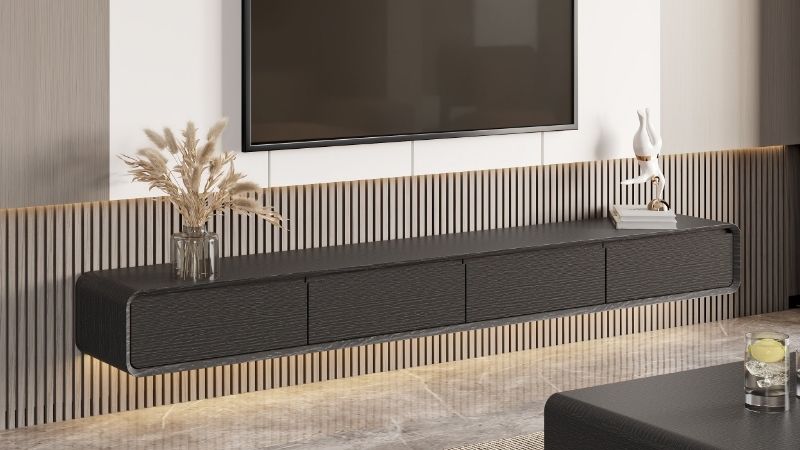
A floating TV stand is a media cabinet designed to hang on a wall, leaving the floor clear. When asking what is a floating tv stand, the crucial distinction is the support method, not just the minimalist appearance. Some consoles only look suspended, while others can be used either on the floor or on the wall if their instructions allow.
As an Amazon Associate we earn from qualifying purchases.
By KK Home Furnishings Editorial Team
What Makes a TV Stand Truly Floating
A genuinely floating unit is supported by a mounting arrangement approved for that particular cabinet and wall, rather than by legs that transfer its weight to the floor. It can hold entertainment equipment and organize cables, but its permitted contents and television placement are matters of product specifications, not style labels. The table identifies the distinctions to check first.
| Design | Floor Contact | Typical Use | Check Before Use |
|---|---|---|---|
| True wall-mounted media cabinet | None during normal use | Storage beneath a separately mounted TV | Exact wall-hanging approval and mounted load conditions |
| Convertible TV bench | Floor or wall, in approved configurations | Media storage; sometimes a TV on its top | Correct model, wall fixing and TV top weight rating |
| Floor-standing floating-look console | Legs, plinth or recessed base | Minimalist appearance without a wall-hung cabinet | Floor stability and maker-required anti-tip anchoring |
| Ordinary TV console | Feet, legs or a base | Support a TV and associated components | TV footprint, top weight limit and tip prevention |
| Wall shelf for electronics | None if approved for mounting | Light equipment or decor within its design load | Whether it is actually intended to support TV equipment |
| Wall-mounted TV with separate console | Depends on console choice | Independent TV display and media storage | Separate approvals for TV mount and console |
One real-world distinction appears within IKEA BESTÅ. The 47 1/4-inch-wide TV unit, article 705.660.33, can stand on the floor or be wall mounted under IKEA instructions, whereas the taller 70 7/8-inch-wide unit, article 805.660.37, expressly must not be hung [IKEA US, product pages, accessed October 2026]. Similar styling does not make these two units interchangeable.
A Floating TV Stand Is Furniture, Not the Television Mount
The word “floating” normally describes the cabinet, not the television. A screen may hang above that cabinet on a completely separate TV mount, or in a permitted configuration sit directly on a console. A wall-mounted cabinet does not automatically include the hardware or approval needed to hold a television from its front, rear or upper surface.
Check the listing for terms such as “wall-mounted media console,” “floating TV cabinet,” or “wall-hung TV bench,” then inspect the actual assembly documentation. Marketing photos often show a television over a low cabinet, but the photo alone cannot establish whether the screen rests on the unit or is independently fixed to the wall.
Floating and Floating-Look Consoles Are Not Identical
A floating-look console uses styling to suggest open space underneath. Recessed feet, a dark base or very short legs can visually separate a cabinet from the flooring, yet the furniture still relies on that base. This style often offers the clean profile of floating furniture without requiring a load-bearing wall-mounted cabinet installation.
The practical distinction affects maintenance and mobility. A floor-standing console can usually be repositioned after its contents are removed, subject to cable and anti-tip restraints. A true wall-hung cabinet occupies fixed attachment points, so changes to the room can involve professional removal, wall repair and a new approved mounting location.
A Floating Stand Can Be Open, Closed or Modular
Floating media furniture is not one fixed shape. Open units provide visible shelves and easy access to remotes or devices; door-front units conceal equipment and other household items. Push-open drawers can keep a shallow appearance, but drawer travel, ventilation and cable openings must still work with the actual hardware stored inside.
Some systems combine separate wall-mounted cabinets. IKEA EKET, for example, uses dedicated EKET suspension rails and identifies wall material as a factor affecting allowable load [IKEA US, EKET 591.890.33, accessed October 2026]. That confirms how modular hanging storage can be built; it does not certify an EKET cabinet as a TV-supporting media console.
Choose a Floating TV Stand for Your Situation
A floating design makes the most sense when its use matches your wall, television arrangement and storage habits. The following six situations separate genuine reasons to choose a suspended cabinet from cases where a stable floor-standing unit is more practical. Each choice still depends on the individual product manual, not on an assumed universal load rating.
For a Living Room With an Independently Wall-Mounted TV
Choose a purpose-built wall-mounted media cabinet when the screen already has a separate approved mounting system and you want a visually lighter storage line below it. Keeping the furniture and television independently supported can clarify their different duties, provided the attachments and installed items remain within the manufacturers’ rules.
Look for accessible cable openings and enough usable compartment depth for your actual equipment. A cabinet that appears generous from the front may have a shallow internal space once door hinges and cable bends are accounted for. Measure a receiver or console with its connected plugs attached rather than relying only on the product’s outside dimensions.
A long, narrow cabinet may be attractive beneath a large screen, but visual alignment is not the same as structural permission. The cabinet’s wall-hung capacity can differ from a published top-panel TV weight limit. IKEA specifically says the permitted load for a wall-hung BESTÅ television bench depends on the wall material [IKEA US, 705.660.33, accessed October 2026].
For a Television That Must Sit Directly on the Cabinet
Choose a bench whose manufacturer explicitly permits the intended top-mounted television, then confirm the screen’s footprint and full weight. The word “floating” does not establish either permission. Some wall-hung media cabinets are intended mainly for set-top boxes, a soundbar or decorative storage rather than a large television resting on their upper panel.
An example of why the configuration matters is BESTÅ article 705.660.33. IKEA publishes a 35 lb maximum television weight for its top panel, while separately cautioning that the wall-hung unit’s maximum load depends on the wall [IKEA US, accessed October 2026]. The top-panel figure alone is not approval for a particular installed wall assembly.
If your television has widely spaced feet or a heavy base, a floor-standing TV bench may be easier to match to the actual support requirements. Never substitute a narrow display shelf simply because it visually lines up with the screen. CPSC recommends placing televisions only on furniture intended to support them and securing them appropriately [CPSC, Anchor It!, accessed October 2026].
For a Small Room That Needs Visible Floor Space
A genuinely wall-hung cabinet leaves its underside clear of furniture legs. That can make it easier to reach the floor for ordinary cleaning and can reduce the appearance of clutter beneath the screen. It does not create more total room area or eliminate the amount of wall surface and storage volume that the cabinet occupies.
Select storage around real objects rather than choosing the thinnest cabinet available. Game consoles, routers and streaming equipment need room for their original cables, ventilation and access to controls. A unit can be mounted neatly yet become inconvenient if you must pull it apart each time a plug comes loose or a device needs service.
The benefits are strongest where the cabinet replaces a bulky piece of floor furniture without sacrificing needed storage. A shallow unit is not necessarily better for every device. Before buying, map the wall outlets, cable routes and door opening positions, since extension cords and tightly packed electronics can spoil the otherwise clean layout.
For a Rental or a Room With Uncertain Wall Construction
Choose floor-standing furniture first when you do not have permission for structural wall fixing or cannot identify a suitable load-bearing substrate. Adhesive strips, ordinary picture hooks and unknown drywall anchors are not automatically appropriate alternatives for suspending a filled media cabinet. If the wall conditions are unclear, request qualified advice.
A convertible design can offer flexibility, but only when the exact model supports both modes. IKEA describes the 47 1/4-inch BESTÅ TV unit as usable on the floor or wall, and even requires its floor-standing version to be fixed to the wall with the included fittings [IKEA US, 705.660.33, accessed October 2026]. “Floor-standing” does not mean every TV unit can be left unsecured.
Where drilling is limited, consider a stable console with appropriately restrained furniture and television rather than imitating a floating effect by propping a wall-hung cabinet on improvised blocks. Property rules are separate from product safety rules: permission to drill never substitutes for the cabinet maker’s mounting instructions.
For a Family Room With Children or Pets
Prefer a setup that reduces reachable loose objects and is secured under the maker’s directions. A wall-hung cabinet can move drawers and devices away from the floor, but it is not automatically childproof. Accessible cables, opening fronts and attractive objects on the upper surface can still tempt climbing, pulling or grabbing.
The U.S. Consumer Product Safety Commission warns that unsecured televisions and furniture can tip and injure children. It advises following the manufacturer’s instructions, using furniture intended for televisions and securing screens that are not wall mounted [CPSC, Anchor It!, accessed October 2026]. A suspended design needs its own reliable mounting system as well.
Choose closed compartments only when they do not trap heat-producing components or block needed remote-control signals. Check how doors open near walkways and whether devices remain accessible to adults without making cables available to children. Remove tempting objects from the top of the cabinet rather than treating elevated storage as a complete safety barrier.
For a Gaming Setup, Soundbar or Media Equipment Collection
A floating TV stand can organize hardware beneath a wall-mounted screen, but equipment compatibility often determines the best configuration. Consoles with rear exhausts, large receivers and multiple network devices can need more depth and air movement than a streamlined cabinet provides. Use the equipment manufacturer’s clearance requirements rather than an assumed gap.
Start with the actual components: note their width, depth, connected cable projection and which ports must stay reachable. Open compartments generally simplify access, while doors reduce visible clutter. Neither option guarantees ventilation; a closed cabinet may need a different layout if its manufacturer does not allow heat-producing equipment inside.
Soundbars may be positioned on furniture or attached to compatible mounts, depending on their own instructions. A cabinet marketed as floating does not necessarily include soundbar brackets or cable pass-throughs. Check whether the planned arrangement blocks a television sensor, the soundbar’s upward-firing drivers, cabinet doors or nearby power outlets.
Frequently Asked Questions
These questions address product labels and ownership details that are often missing from marketing images. They focus on special cases rather than repeating the definition or the room-by-room choices above. Where an item has several permitted configurations, its exact model number and assembly documents determine what you can safely do.
Can You Put a Floating TV Stand on the Floor?
Yes, but only if the specific model is also designed for floor-standing use. IKEA BESTÅ article 705.660.33 is an example that allows either floor or wall placement; its floor-standing instructions still call for wall fixing [IKEA US, accessed October 2026]. Other hanging cabinets have no approved legs, base or floor-use configuration.
Do not assume an open-sided wall cabinet will stand safely just because its lower panel appears flat. The underside may be intended to hang above the floor, not to bear concentrated loads. If the manual authorizes wall mounting only, choose a different approved floor-standing console instead of adding improvised feet or supports.
Does a Floating TV Stand Include a Television Wall Mount?
Usually not as a guaranteed part of the category. A wall-hung media cabinet and a VESA television mounting bracket are different systems with different purposes. Some product bundles may include separate mounting accessories, but a floating-cabinet listing should not be read as proof that a TV bracket, anchors or mounting service is included.
Review the retailer’s “what is included” section and the manufacturer’s parts list. If the screen will hang on a separate mount, verify that bracket against the exact television and wall. If the screen will rest on the cabinet, check the bench’s published TV support conditions instead of assuming that a separate wall mount is unnecessary.
Is a Floating TV Stand the Same as a Floating Shelf?
No. Both can be attached to a wall, but a floating shelf is a broad storage category, while a floating TV stand is intended to organize media equipment and may have specialized cable openings, doors or device compartments. The furniture label does not establish a uniform weight rating, and a basic decor shelf may not be designed for a television.
A cabinet suitable for media gear needs enough usable depth, the right access points and manufacturer-approved use for those devices. If a shelf listing does not state that it supports your intended TV or components, do not infer this from the shelf’s width or its advertised “heavy-duty” appearance. A media cabinet can also be unsuitable for a top-mounted TV.
Can a Floating TV Stand Be Removed and Reused After a Move?
Sometimes, if the cabinet and its approved fittings remain undamaged and the maker permits reinstallation. Removing it does not guarantee that its original wall screws or anchors can be reused in another wall. The next installation depends on the new wall construction, the available instructions and the condition of all cabinet connection points.
Keep the assembly sheet, product label and all removable components together during the move. Inspect the cabinet and replace hardware only as directed by the maker. If a hanger is bent, a fixing hole is damaged or the original system is unavailable, do not mount the cabinet again until the correct components and a suitable wall have been confirmed.
Final Thoughts
The simplest answer to what is a floating tv stand is a media cabinet designed for wall suspension, not merely a console with a light-looking base. Choose by permitted use, equipment fit and the manufacturer’s installation conditions. A convertible floor-standing model is a useful alternative when true floating furniture is impractical.
