Key takeaways
- Bedroom: 45–50% with sleep mode engaged. Compressor noise in a small bedroom is unavoidable at full speed, so a quiet unit like the ToLife 1000 Sq Ft or the 95OZ Dehumidifier for Home earns its place overnight.
- Bathroom and adjoining closet: 45%, run for an hour after showers. This is where small-space mold usually starts.
- Basement or under-stair storage: 50%, continuous. The KNKA Energy Star 4500 Sq.Ft handles this scale without cycling constantly.
- Living area with plants and textiles: 50% keeps fabric fresh without stressing houseplants.
What's inside
In a compact home, moisture behaves differently than it does in a sprawling floor plan. When square footage is tight, furniture sits closer to walls, closets share air with bathrooms, and a single load of laundry drying on a rack can push the humidity in a studio apartment up by ten points in an hour. That’s why the number you dial into your dehumidifier matters more in small spaces than almost anywhere else: there’s less air volume to buffer a spike, and less distance between damp air and the upholstered sofa, wooden dresser, or stacked storage bins you’ve carefully arranged.
This guide covers the humidity percentage worth targeting in 2026, how that target shifts with the season and the room, and the settings people commonly get wrong — running a unit at maximum extraction, for example, which wastes electricity and dries out wood furniture. You’ll also see how tank size, drainage, and fan modes affect what setting is even practical for your layout, plus a few models suited to different footprints.
As an Amazon Associate we earn from qualifying purchases.


The Target Number: 45 to 50 Percent
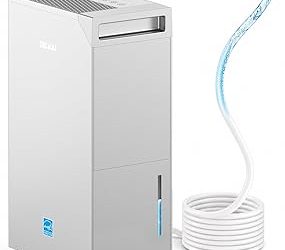
Set your dehumidifier to 45–50% relative humidity and leave it there. Below 45%, you start pulling moisture out of hardwood, veneers, and glued joints, which invites shrinkage and split panels — a real concern if your small space relies on solid-wood pieces or built-in shelving. Above 55%, dust mites thrive and mold spores find purchase on the back of that bookcase pressed against an exterior wall. Fifty percent is the sweet spot most conservators and building scientists converge on, and units with an intelligent humidistat like the 5500 Sq.Ft Energy Star Most Efficient Dehumidifier hold that setpoint automatically rather than making you babysit a dial.
Adjust By Season, Not By Feel
Your ideal setting drifts through the year. In summer, 50% is comfortable and achievable. In winter, when exterior walls and single-pane windows drop below the dew point, you may need to run closer to 40% to stop condensation from beading on glass and soaking window sills. A useful rule: if you see water on your windows in the morning, lower the setting by five points until it stops. Models with automatic defrost, like the Waykar 34 Pints, keep working in cooler rooms where cheaper compressors ice over and stall.
Match The Setting To The Room’s Job
- Bedroom: 45–50% with sleep mode engaged. Compressor noise in a small bedroom is unavoidable at full speed, so a quiet unit like the ToLife 1000 Sq Ft or the 95OZ Dehumidifier for Home earns its place overnight.
- Bathroom and adjoining closet: 45%, run for an hour after showers. This is where small-space mold usually starts.
- Basement or under-stair storage: 50%, continuous. The KNKA Energy Star 4500 Sq.Ft handles this scale without cycling constantly.
- Living area with plants and textiles: 50% keeps fabric fresh without stressing houseplants.
Why Continuous Mode Isn’t Always Better
Continuous mode ignores your setpoint and runs until the tank fills or the hose drains. It’s the right choice during a genuine moisture event — after a leak, a flood, or during a humid stretch when a small unit can’t keep up. It is the wrong default for daily use, because it will happily overshoot into the 30s and leave your furniture parched. Use continuous for recovery, then return to a humidistat setting for maintenance. A model with a drain hose, such as the 4500 Sq. Ft Quilt Compressor Dehumidifier, makes continuous operation practical without a tank to empty.
Fan Speed, Placement, And Airflow
The setting on the display only works if air actually reaches the sensor. In a tight room, tucking a unit behind an armchair or inside a closet creates a pocket of dry air around the intake while the rest of the space stays damp. Leave at least 8–12 inches of clearance on all sides and place the unit centrally if possible. High fan speed gets you to the setpoint faster; low fan speed is quieter and slightly more efficient once you’re there.
Tips
- Buy a separate hygrometer and place it across the room from the dehumidifier. Built-in sensors read the air nearest the machine and often show a lower number than the room’s true average.
- Pull furniture two inches off exterior walls. It’s a free upgrade to airflow and one of the most effective mold-prevention moves in a small home.
- Rinse the filter monthly. A clogged filter makes the unit work harder to hit the same setting, raising both noise and running cost.
- If your unit fills its tank more than twice a day at 50%, you have a source problem — a leak, poor bathroom venting, or unsealed foundation — not a settings problem.
Frequently Asked Questions
Is 30% ever the right setting?
Rarely, and not for long. Thirty percent is drying-out territory after water damage. Sustained, it cracks furniture, warps instruments, and irritates skin and airways.
Should I run it at night?
Yes, if humidity warrants it. Sleep mode dims the display and drops fan speed, which makes it viable in a bedroom without disrupting rest.
Does a higher pint rating mean a lower setting is possible?
It means the unit reaches your setting faster and holds it more steadily in a large or damp space. The target percentage itself doesn’t change.
Do I need a drain hose in a small apartment?
Only if you can position the unit near a floor drain, sink, or tub. Otherwise a large tank with auto shutoff is more practical.
Conclusion
Set it to 50% in summer, drop toward 40% in winter if condensation appears, and resist the urge to run continuous mode as a permanent setting — your furniture and your electricity bill will both be better for it. Choose a unit sized generously for your space with a reliable humidistat, place it with real clearance around the intake, and the right setting becomes something you configure once and largely forget.