Key takeaways
- Parked footprint versus working footprint: Measure both. A folding jobsite saw might occupy nine square feet while cutting but only two against a wall. A cabinet saw never shrinks, and you also need four feet of clearance on the infeed and outfeed sides, which means the real space demand is closer to fifty square feet.
- Rip capacity you’ll genuinely use: Thirty inches handles almost all furniture work, including ripping a 60-inch panel in half. Fifty inches exists for people breaking down full sheets solo without a track saw. Paying for reach you can’t physically maneuver around is the most common small-shop mistake.
- Power supply reality: A 230V single-phase cabinet saw requires a dedicated circuit an electrician has to install. If you’re renting, or your panel is full, a 15-amp saw on a standard household outlet is not a compromise, it’s the only option.
- Dust extraction from day one: Enclosed cabinet bases capture most debris at a 4-inch port. Open-frame portables throw fine dust into the room, which matters enormously if your shop shares air with a bedroom or kitchen. Budget for a shop vac and a hose adapter.
- Fence accuracy over headline horsepower: Furniture joinery lives and dies on a fence that stays parallel and repeats a setting. Rack-and-pinion and precision-machined fences are worth more to your dovetails than an extra 500 RPM.
What's inside
Ask ten woodworkers who makes the best table saw and you’ll get ten answers, most of them shaped by the shop they work in rather than the saw itself. That’s the real complication for anyone furnishing a home with handmade pieces: a cabinet saw that lives happily in a two-car garage becomes a permanent obstacle in a 400-square-foot apartment, and a lightweight benchtop model that tucks under a workbench will fight you the moment you try to rip a full sheet of plywood for a bookcase carcass.
This guide looks at table saws through the lens of the space you actually have. We cover six machines spanning the range from a palm-sized precision saw for inlay and small joinery up to a 3 HP industrial cabinet saw with a 50-inch rip fence, and we’re specific about the footprint, the storage behavior, and the dust situation for each. Below you’ll find the models, a short list of things worth checking before you commit, and honest notes on which saw belongs in which room.
As an Amazon Associate we earn from qualifying purchases.




How to Choose a/an Who Makes The Best Table Saw (2026)
- Parked footprint versus working footprint: Measure both. A folding jobsite saw might occupy nine square feet while cutting but only two against a wall. A cabinet saw never shrinks, and you also need four feet of clearance on the infeed and outfeed sides, which means the real space demand is closer to fifty square feet.
- Rip capacity you’ll genuinely use: Thirty inches handles almost all furniture work, including ripping a 60-inch panel in half. Fifty inches exists for people breaking down full sheets solo without a track saw. Paying for reach you can’t physically maneuver around is the most common small-shop mistake.
- Power supply reality: A 230V single-phase cabinet saw requires a dedicated circuit an electrician has to install. If you’re renting, or your panel is full, a 15-amp saw on a standard household outlet is not a compromise, it’s the only option.
- Dust extraction from day one: Enclosed cabinet bases capture most debris at a 4-inch port. Open-frame portables throw fine dust into the room, which matters enormously if your shop shares air with a bedroom or kitchen. Budget for a shop vac and a hose adapter.
- Fence accuracy over headline horsepower: Furniture joinery lives and dies on a fence that stays parallel and repeats a setting. Rack-and-pinion and precision-machined fences are worth more to your dovetails than an extra 500 RPM.
The Best Who Makes The Best Table Saw (2026)s Reviewed
DEWALT DWE7491RS 10-Inch
The rolling stand is the whole argument here: it folds and wheels into a closet or against a wall, then deploys to a stable working height in seconds. With 32-1/2 inches of rip capacity and a rack-and-pinion fence that holds its setting reliably, this is the saw that lets someone build real casework without dedicating a room to it.
SKIL TS6307-00 15 Amp Jobsite Saw
SKIL’s folding stand collapses flatter than most, and the saw itself is genuinely light enough to carry up stairs alone. Cut quality is solid for framing, trim, and shelving, and the price leaves room in the budget for a decent blade upgrade, which is where this saw improves most.
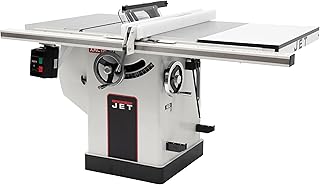
JET JTAS-10XL30-DX 30-Inch Rip Cabinet Saw
Once you have a dedicated garage or basement bay and a 230V circuit, this is the class shift you feel immediately: a heavy cast-iron table that damps vibration, 3 HP that never bogs in thick hardwood, and an XACTA fence with the repeatability serious furniture work demands. The 30-inch rip keeps the overall footprint sane.
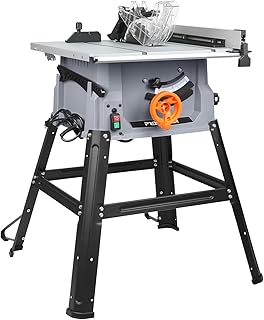
Prostormer 10-Inch Benchtop Saw with Stand
A capable entry point for decking, trim, and DIY projects, with 45-degree bevel capacity and 5000 RPM in a package you can lift onto a bench and store vertically. Expect to true up the fence and swap the stock blade, but the value for occasional weekend work is hard to argue with.
JET JTAS-10XL50-1DX 50-Inch Rip Cabinet Saw
The 50-inch version of JET’s Deluxe XACTA is for the shop that regularly breaks down full sheet goods without a helper, and it needs the aisle space to prove it. Same excellent 3 HP drivetrain and fence system, just with substantially more table to walk around.
Frequently Asked Questions
Can I run a table saw in an apartment?
A benchtop or the Mini Table Saw can work for small joinery if you cut on a mat, extract dust aggressively, and respect quiet hours. Full-size saws are impractical because of noise transmission and airborne dust.
Is 3 HP overkill for furniture?
Not if you resaw or rip thick hardwood regularly. For plywood and softwood projects, a 15-amp portable saw is entirely adequate.
What does the Mini Table Saw actually handle?
With a half-inch cut depth and seven speed settings, it’s built for thin stock: PCB, acrylic, model parts, and small inlay work. It won’t replace a full-size saw.
Should I upgrade the blade immediately?
Yes on budget saws. A quality 40-tooth combination blade improves cut quality more than any other single change you can make.
Final Thoughts
For most home furniture builders working in tight quarters, the DEWALT DWE7491RS is the clear recommendation: it stores small, cuts accurately, and grows with your skills. If you have the space and a 230V circuit, the JET JTAS-10XL30-DX is a genuine lifetime machine, while the SKIL TS6307-00 remains the smartest pick for anyone starting out with limited room and budget.