
Key takeaways
- A 5 piece sectional is a sectional sofa sold as a five-component arrangement, not a promise of seating for five people. The right one depends on the actual module list, assembled footprint, usable seats, and whether its pieces can be…
A 5 piece sectional is a sectional sofa sold as a five-component arrangement, not a promise of seating for five people. The right one depends on the actual module list, assembled footprint, usable seats, and whether its pieces can be rearranged. Start with the room plan and the manufacturer’s configuration diagram, not the piece count alone.
As an Amazon Associate we earn from qualifying purchases.
By KK Home Furnishings Editorial Team
What a Five-Piece Sectional Really Includes
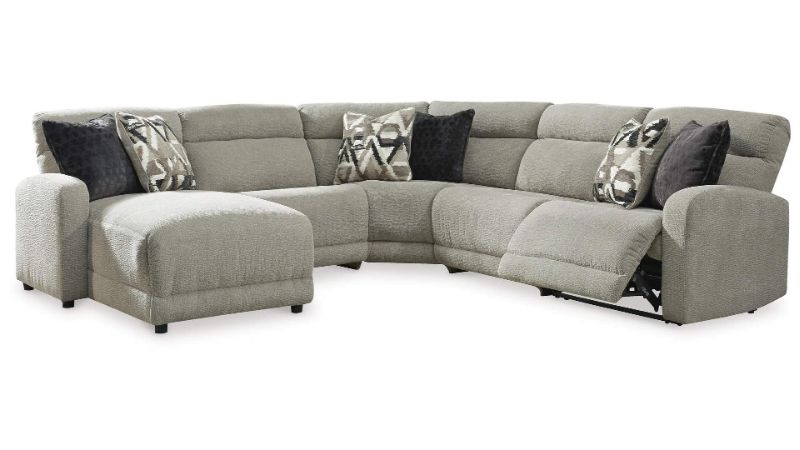
A five-piece label describes the manufacturer’s bundle, but there is no universal recipe for those five pieces. One configuration may contain a corner and armless seats; another may use a chaise or ottoman. This guide is based on published manufacturer dimensions and configuration documents reviewed in October 2026, not hands-on furniture testing.
Count the Seating Modules, Not the Cushions
Ask the seller for an itemized component list showing each corner unit, armless chair, armed end, chaise, and ottoman. A removable back cushion is not automatically a separate sectional module. Likewise, a brand may sell five seat units and additional sides as one configuration, so the numbers printed on a builder are not interchangeable with another company’s five-piece label.
Lovesac is a useful illustration of the counting problem: its configuration guide distinguishes seat units from side units, including arrangements described as five seats plus five sides. Burrow, by contrast, sells named Range and Field five-piece arrangements. Neither labeling scheme proves how many adults can sit comfortably until the actual seating layout is shown.
Use the Assembled Footprint and Seat Dimensions
Start with an overhead drawing of the complete sofa, including the longest side and the projection into the room. Product depth can mean a single module or an entire sectional return; those measurements are not interchangeable. Compare the footprint with the walking route around the furniture, then check actual seat depth and height to judge whether the sit will feel upright or relaxed.
The manufacturer lists Burrow’s Range five-piece sectional at 91.5 inches along each outside run and 28 inches high, with a 21-inch sit depth and 16-inch seat height for that listed configuration. Its Field five-piece sectional is also listed at 91.5 by 91.5 inches, but 33 inches high. These examples show why equal piece counts and matching outer dimensions still do not guarantee the same back profile.
Look Beyond the Pieces to Connection and Maintenance
A sectional that can be reconfigured must have a practical way to keep its parts together. Burrow describes steel latches and a modular connection system for Range; Lovesac describes clamps and positioning hardware for its seat-and-side system. Before ordering, identify whether rearrangement requires tools and whether individual replacement connectors can be obtained later.
Also distinguish removable covers from machine-washable covers. Lovesac advertises washable covers for its compatible Sactionals components, but care instructions still depend on the specific fabric and cover. Stain-resistant upholstery is a manufacturer-described feature, not a guarantee against spills. Check cushion replacement options, fabric care labels, and which parts a warranty actually covers before judging long-term upkeep.
Use this comparison to choose a starting layout. The arrangements are design categories, not promises that every maker can assemble each one from exactly five modules.
| Layout | Best Use | Measure First | Trade-Off |
|---|---|---|---|
| Corner L-shape | Conversational seating and an open room center | Both wall runs and the corner return | Corner position may limit rearrangement |
| Chaise sectional | Stretching out while retaining standard seats | Chaise projection and facing direction | One long lounge takes floor space |
| U-shaped arrangement | Groups facing a central table or screen | Outer width and both projecting ends | Access can become tight in smaller rooms |
| Open-ended lounger | Flexible end seat and an airy silhouette | Open end and nearby traffic path | Less arm support at the exposed end |
| Pit-style grouping | Casual shared lounging | Total depth and reach to a table | Poorer upright seating for some users |
| Ottoman-inclusive set | A movable footrest or occasional extra perch | Ottoman position and moving clearance | An ottoman is not a full back-supported seat |
Choosing a Five-Piece Layout for Your Room
A useful buying decision begins with the intended activity: conversation, TV viewing, daily family use, or a frequently changing floor plan. The same five components can create very different traffic patterns depending on arms, corners, and the orientation of the chaise. Compare each arrangement with your room rather than with a staged photograph.
In a Small Apartment: Favor an Open Side and Clear Walkway
For a compact living room, a low-profile L-shape or open-ended arrangement can leave one side visually and physically accessible. The goal is not to find the smallest piece count; it is to avoid a return that blocks the door, balcony, or path to the kitchen. Draw the sofa at its full installed size, not as a row of separate shipping boxes.
A sectional measuring 91.5 inches on both outside runs, as Burrow publishes for its Range five-piece example, still occupies a substantial corner. Verify the exact variant before using that figure: a different arm or ottoman arrangement can change the footprint. Check the delivery path just once, including the narrowest doorway and stair landing, and keep the final placement clear of traffic routes.
In an Open-Plan Living Room: Define the Seating Zone
A five-piece L can separate the lounging area from dining space without using a wall as a backstop. Put the longer run where it can face the primary activity, then make sure the shorter return does not turn into a barrier between zones. In a large room, the sectional can anchor a rug, but the rug should support the arrangement rather than dictate a poor traffic route.
The Room & Board Omni configuration sheet illustrates how different a five-piece footprint can become: its published five-piece modular example is 111 by 111 inches, larger than Burrow’s listed Range configuration. That sheet documents a design, not live inventory. Use such dimensions to understand scale, then rely on the exact current product diagram before committing.
With Children or Pets: Prioritize Replaceable Surfaces
Households with frequent spills or pet hair benefit more from serviceable upholstery than from a marketing phrase like family-friendly. Request the exact fabric care code and ask whether cushion or frame covers detach individually. If a cover can be washed, confirm its prescribed cycle, drying method, and whether shrinking or dye transfer is excluded from the warranty.
Also consider how a loose ottoman changes use. It can be moved out of the way for play, but it can drift if the system lacks secure connections. A firm corner seat may be useful for reading, while very deep lounge modules can make reaching a table less convenient. These are use-case trade-offs, not claims that a particular fabric or seat has been independently durability-tested.
For Movie Nights: Separate Lounge Depth From Seat Count
A deep sectional invites reclining, but the best lounging position may occupy space that would otherwise support another upright sitter. A chaise, ottoman, or pit-style extension can be worth more than an extra conventional seat if two people usually stretch out. For regular guests, however, a stable backrest and distinct seating positions matter more than the number of cushion seams.
Use the manufacturer’s seated depth instead of judging from room photographs. Burrow publishes a 21-inch sit depth for the referenced Range and Field configurations; that is a product-specific figure, not a general standard for all five-piece sectionals. Compare seat height, back support, and cushion fill as well. A lower silhouette can look streamlined yet feel harder to get out of for some household members.
If You Move Often: Check Whether the System Truly Reconfigures
A genuinely modular sectional has separate load-bearing modules and a documented method for reconnecting them. Detachable shipping sections alone may not permit changing a left-hand chaise into a right-hand one. Ask for a diagram that shows every approved configuration using the exact pieces in the bundle, including any special corner, arm, or side components.
Lovesac illustrates the advantage of separately selected seats and sides, while Burrow describes interchangeable Range modules and compatible add-ons. Those features are not automatically cross-compatible across collections, generations, or brands. Before treating future expansion as a benefit, check whether the manufacturer still sells the matching connectors, covers, and additional seats in your chosen series.
For Guests and Everyday Conversation: Count Usable Positions
A five-piece sectional may appear expansive but seat fewer people comfortably if a corner overlaps two cushions or the chaise is used for reclining. Look for uninterrupted, back-supported seating positions and arm placement. If five adults regularly gather, inspect a labeled seating diagram and ask for actual cushion widths; do not translate the number of modules directly into the number of usable seats.
An ottoman may provide occasional seating, but it does not offer the same back support as a standard chair module. For conversation, check whether people can face one another without twisting around a very long row. If the sectional is mainly for two adults and occasional company, a larger chaise layout may be more useful than a rigid arrangement designed to maximize simultaneous upright seating.
Frequently Asked Questions
Does a Five-Piece Sectional Seat Five People?
Not necessarily. Five pieces describe the seller’s components, while seating capacity depends on usable cushions, corner geometry, and the way an ottoman or chaise is counted. A manufacturer may also label seats and sides separately, making a simple piece count unreliable across brands.
For regular group use, request a top-view layout with each back-supported sitting position identified. If the listing gives only a marketing seating number, compare it with cushion widths and the arrangement you actually plan to assemble.
Can You Reverse the Chaise on Any Five-Piece Sectional?
No. Some modular sets permit moving modules between sides, while others rely on a dedicated left-facing or right-facing chaise. A reversible label should be supported by a diagram for the exact configuration and connectors included.
Facing terminology can vary in casual listings. Use the manufacturer’s own diagram and confirm which side the chaise occupies when you are standing in front of the sofa looking at it. Do not infer reversibility from removable cushions alone.
Is a Five-Piece Sectional Always Bigger Than a Three-Piece One?
No. Module count is not a size category. Broad seats can make a three-piece set wider than a five-piece set built from narrower modules, and a chaise or corner can increase depth without adding a conventional place to sit.
Compare overall width, overall depth, and any return or protruding ottoman in the exact assembled position. Check seat dimensions separately, because outside size includes arms, backs, and corners that are not all usable seating.
Should You Choose Loose Modules or Permanently Fixed Sections?
Choose reconfigurable modules when you expect the layout to change or need easier component-by-component replacement. A more fixed sectional can make sense when the room and preferred orientation are unlikely to change and you do not need expansion.
The practical test is the connection method. Ask how the pieces lock together, whether gaps develop when people move across seats, and whether covers or connectors can be reordered. Treat advertised modularity as a set of supported operations rather than an automatic guarantee of unlimited layouts.
Final Thoughts
Choose a 5 piece sectional by the configuration it can actually form, not by the number on the label. Compare the exact component list with your room plan, confirm usable seating and connection hardware, and examine fabric-care and replacement options. The best layout is the one that preserves the way your household moves and relaxes.
