
Key takeaways
- A low silhouette visually balances a screen roughly 75 inches wide.
- Closed drawers hide accessories without surrounding the display with tall furniture.
- A floor-standing layout avoids depending on a wall mount for the TV.
An oversized screen looks more balanced when the furniture serves the room rather than simply matching the diagonal measurement. These 85 inch tv stand ideas cover six different layouts, from a long credenza to a wall-mounted display, with practical checks for TV feet, cabinet load limits, and storage.
As an Amazon Associate we earn from qualifying purchases.
By KK Home Furnishings Editorial Team
Practical 85 Inch TV Stand Ideas for Everyday Rooms
A 2025 Sony 85-inch BRAVIA 5 is about 74.6 inches wide, even though its advertised diagonal is 85 inches. The furniture or wall installation must also suit the actual screen weight, foot depth, and any required anti-tip restraints. Compare these six arrangements by room use first; the example sizes below are references, not universal rules.
| Idea | Space or Size Needed | Cost Tier | Effort and Time |
|---|---|---|---|
| Extra-wide low credenza | Long usable top; TV feet and verified load must fit | Moderate to premium | Assembly and careful TV placement |
| Wall-mounted TV with floating cabinet | Suitable structural wall; cabinet mounts independently | Moderate to premium | Bracket installation often needs a professional |
| Open-shelf AV console | Full TV foot depth plus equipment ventilation | Budget to premium | Assembly and repeated cable organization |
| Modular storage wall | Wide wall with clear door swing and anchored modules | Moderate to premium | Multi-unit assembly and wall anchoring |
| Wood-accent focal wall | Panel area broader than display; access to outlets | Moderate to premium | Surface preparation and structural coordination |
| Off-center open-plan layout | Main seating sightline and clear circulation paths | Budget to moderate | Layout measuring and securing furniture |
An Extra-Wide Low Credenza for a Centered TV
Best For: Homeowners with a broad wall, a verified load-rated cabinet, and enough depth for the actual television feet.
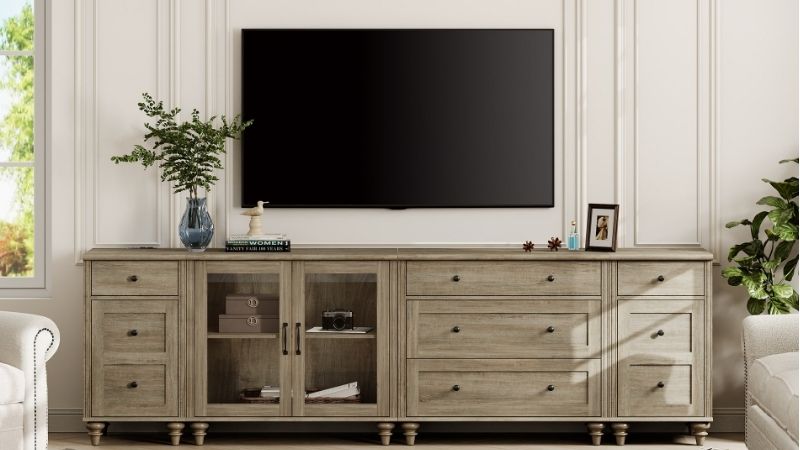
A long, low credenza gives an 85-inch screen visual room to breathe without surrounding it with additional cabinetry. Choose this arrangement when the television is the main focal point and you want closed storage for remotes, games, and smaller accessories. The trade-off is a longer furniture footprint along the wall.
Screen diagonal and furniture width are not interchangeable. Sony lists its 2025 85-inch BRAVIA 5 K-85XR50 at 74.63 inches wide and 108.2 pounds with the stand; LG lists the 86QNED80URA at 75.8 inches wide, 60.3 inches between stand supports, and 122.4 pounds with the stand. These are model examples, not universal limits.
Before buying a credenza, compare its rated top load with the actual TV weight, then measure the span and front-to-back footprint of the attached feet. Put every foot fully on the intended surface, leave room for cords, and anchor the television and furniture according to their respective manuals. A wide cabinet alone is not proof of safe support.
Pros:
- A low silhouette visually balances a screen roughly 75 inches wide.
- Closed drawers hide accessories without surrounding the display with tall furniture.
- A floor-standing layout avoids depending on a wall mount for the TV.
Cons:
- A long cabinet can crowd a doorway or narrow circulation route.
- An attractive top may still lack the rated load for a heavy screen.
Who Should Skip It: Skip this idea if you cannot confirm the cabinet load rating or the complete footprint of both TV feet.
A Wall-Mounted Screen Above a Floating Media Cabinet
Best For: Minimalist rooms where suitable wall structure and approved mounting hardware can carry the television independently of furniture.
Mounting the television separately frees the cabinet from supporting its weight, so the piece beneath can focus on storage and proportion. This approach is especially effective when a heavy-looking cabinet would overpower the room. A shallow floating unit also makes the floor visible, but its own wall-mounting limits still matter.
The Sony K-85XR50 specifies a 400 x 400 mm VESA hole pattern; an LG 86QNED80URA specifies 600 x 400 mm. Neither number identifies a suitable bracket on its own: verify supported screen weight, the exact television model, and the wall construction. Installation instructions determine the required fasteners and mounting positions.
The floating cabinet must have its own wall-rated installation and an unobstructed cable path. Keep an outlet accessible and allow any receivers inside the cabinet the clearance required by their manuals. If the wall contains uncertain framing or vulnerable masonry, use a qualified installer rather than assuming a generic toggle anchor is sufficient.
Pros:
- The TV load transfers to an approved wall mount instead of the console.
- Visible floor area helps a relatively small room feel less congested.
- A separate cabinet allows independent placement of storage and screen height.
Cons:
- Wall type and hidden services can make professional installation necessary.
- Floating cabinets cannot be assumed to have the same loads as floor units.
Who Should Skip It: Skip this layout when wall construction is unsuitable or you cannot obtain a compatible TV-specific mounting solution.
A Freestanding Open-Shelf Console for Gaming and AV Gear
Best For: Gaming rooms with consoles, receivers, and speakers that need reachable wiring and product-specific ventilation space.
Open shelving is a deliberate functional choice, not a cheaper imitation of a closed credenza. It suits households that swap HDMI cables, use multiple consoles, or need front access to a receiver. The open compartments make equipment easier to reach, while dust and visible wiring become the main styling compromises.
Measure the actual receiver, console, and center-channel speaker before selecting shelf openings, including clearance for connectors behind the devices. A display such as the Sony BRAVIA 5 can use feet with an approximately 18.75-inch front-to-back stand depth, so a shallow media rack cannot be judged by its width alone. Confirm the full support surface and weight rating.
Route power and signal cables through separate, accessible openings where practical, without bundling them over sharp metal edges. Equipment vents need the space specified by each device maker; a decorative fabric basket must not block them. Dust the shelves routinely and favor adjustable feet if the floor is uneven, provided the furniture instructions permit them.
Pros:
- Open bays let equipment be serviced without removing cabinet doors.
- Shelves can be chosen around measured receiver height and cable clearance.
- Accessible rear space makes changing consoles and HDMI equipment less disruptive.
Cons:
- Exposed cables require more deliberate routing to maintain a tidy appearance.
- Open shelves reveal dust and equipment clutter more readily than cabinets.
Who Should Skip It: Skip an open rack if you need childproof closed storage or cannot accommodate each device’s required ventilation clearance.
Statement and Space-Saving Designs for Large TVs
The next three layouts solve different design problems: a media wall creates household storage, a wood backdrop gives the screen a calmer visual frame, and an asymmetrical setup works around doors or windows. None requires inventing a one-size-fits-all cabinet dimension. Prioritize safe support and practical access over a showroom-perfect photograph.
A Modular Media Wall with Cabinets Alongside the Screen
Best For: Large living rooms that need concealed household storage alongside a television rather than only below it.
A modular storage wall frames a large screen without requiring a single enormous TV stand. Place taller closed cabinets to either side and keep the space directly around the screen relatively clear. This adds room for board games, books, or seasonal items, but the composition becomes busy if every cabinet front competes for attention.
IKEA publishes a BESTÅ configuration measuring 94.5 inches wide, yet its listed maximum TV weight is only 35 pounds for that specific combination. Its published width cannot establish support for an 85-inch television weighing much more. Treat the modular pieces as storage and wall-mount the screen independently unless every relevant support rating is confirmed.
Plan doors so they open without hitting nearby lamps or a sofa arm, and measure the wall outlets before specifying panel backs. Tall modules and the base need the anchoring prescribed for their configuration. The U.S. CPSC Anchor It! program recommends securing tip-prone furniture to the wall, regardless of the room’s design style or price tier.
Pros:
- Side cabinets create more concealed storage than a single low bench.
- Separate modules can be reorganized around doors, windows, and power outlets.
- A visually open center keeps the oversized display from feeling boxed in.
Cons:
- Some very wide modular units have unexpectedly low stated TV loads.
- Extra cabinet fronts and tall modules increase installation and anchoring complexity.
Who Should Skip It: Skip a storage wall in a narrow room where cabinet depth would obstruct paths or dominate the viewing area.
A Warm Wood-Accent Wall and Understated Media Bench
Best For: Neutral modern interiors needing a warmer focal point without turning the TV cabinet into another visual statement.
A timber-toned accent panel or a carefully finished slat feature can make a black television look less abrupt against a pale wall. The low bench becomes a quiet base for a screen that is already visually dominant. This is a decorative option rather than an acoustic upgrade: slats alone do not establish a measurable sound improvement.
Use the television maker’s published cabinet dimensions to lay out the panel edge and reveal. For example, Sony’s 85-inch K-85XR50 is 74.63 inches wide without the stand, so a 72-inch decorative field would be narrower than the screen itself. The surrounding panel can be broader; that is a design preference, not a mounting standard.
Choose finishes that can be cleaned without trapping grime in deep grooves, especially near cooking spaces or busy family areas. A panel must not hide ventilation gaps, electrical boxes, or inspection access. If you use a wall mount, install it into the approved structural support rather than treating lightweight decorative slats as load-bearing material.
Pros:
- A broad wood backdrop softens the contrast of a large dark display.
- Simple lower furniture leaves the screen and wall material as the focus.
- Replaceable finish panels can refresh the room without changing the TV.
Cons:
- Decorative cladding may conceal wiring faults or service access if poorly planned.
- Detailed grooves demand more frequent cleaning than a plain painted wall.
Who Should Skip It: Skip elaborate wall cladding if the installation would block electrical access or tempt you to mount into nonstructural material.
An Off-Center Console Layout for Open-Plan Rooms
Best For: Open-plan homes where the screen faces the main seats but a doorway or window prevents perfect symmetry.
An off-center arrangement can feel intentional when a large display must share the wall with a window, doorway, or reading chair. Keep the television aligned to the primary seating area and balance the opposite side with one modest object or a floor lamp. Trying to fill both sides symmetrically often crowds the circulation zone.
Start with a paper or taped outline of your own display rather than assuming every 85-inch model spans the same width. The 2025 Sony example measures 74.63 inches, while an LG 86-inch model measures 75.8 inches. Leave room to move past the furniture and fully open doors; the correct clearance depends on your actual room, not a universal staging number.
For a room that changes layout frequently, choose a floor console that can be repositioned without separating fixed wall cabinets. But do not treat movable as unsecured: a TV resting on furniture still needs the manufacturer’s anti-tip measures. Avoid placing heavy speakers where people brush past them, and keep cables out of walkways and under-seat paths.
Pros:
- The focal point can follow the main sofa rather than the wall center.
- One compact balancing object preserves circulation space beside a doorway.
- A movable console allows future changes without rebuilding a media wall.
Cons:
- An uneven layout looks accidental if furniture edges ignore seating sightlines.
- Floor-level cables are harder to disguise near active paths and doorways.
Who Should Skip It: Skip this layout if the off-center position forces viewers into uncomfortable angles or blocks a frequently used path.
Frequently Asked Questions
Use these checks before buying furniture or beginning installation. A marketed screen size tells you the diagonal, but it does not identify the TV stand footprint, weight, mounting-hole arrangement, or the capabilities of the cabinet beneath it.
How wide should a TV stand be for an 85-inch TV?
A stand should support the exact TV feet and meet its published load rating; there is no single cabinet width that makes every 85-inch set safe. A long credenza often looks better when it extends beyond the screen, but the real compatibility checks are foot spacing, front-to-back depth, and weight capacity.
For scale, Sony lists its 85-inch BRAVIA 5 at 74.63 inches overall width. Some TVs have wide-set legs, while others have a central or adjustable stand. Check the measurements for your specific model and measure the furniture’s clear, usable top rather than its outside decorative edges.
Can a 70-inch TV stand work under an 85-inch screen?
It can work visually below a wall-mounted television because the cabinet is not bearing the TV. It should not be used for tabletop support unless every foot fits fully and the top is rated for the actual set. Do not assume a product’s screen-size marketing label replaces its load specification.
For perspective, IKEA’s 70 7/8-inch BESTÅ TV unit lists a maximum TV weight of 66 pounds, while Sony’s example 85-inch BRAVIA 5 weighs 108.2 pounds with its stand. Those exact products are not a compatible tabletop pairing. Ratings differ by model and configuration, so review current documents.
Is a floating TV cabinet sturdy enough for an 85-inch TV?
The cabinet can sit beneath an 85-inch TV when the screen is mounted on its own properly specified wall bracket. A floating cabinet does not automatically support a TV above it, and the cabinet’s wall-mounted load rating may be lower than its floor-standing rating depending on the model and wall.
IKEA explicitly states that the maximum load for a wall-hung BESTÅ bench depends on the wall material. Verify anchors, supports, and permitted loads for that cabinet, and separately verify TV mount compatibility and wall structure. An installer should check uncertain framing or unusual masonry.
What is a renter-friendly way to style a large TV?
A simple freestanding credenza, a removable rug, and a lamp or two can form a finished-looking setup without permanent decorative paneling. Focus spending on stable, correctly sized furniture before adding wall finishes. The TV’s feet still need enough depth, and the surface still needs the required load rating.
A rental is not exempt from tip-over safety. CPSC’s Anchor It! guidance emphasizes fastening furniture and televisions appropriately; discuss approved anchoring locations and future patching with the property owner. If drilling is not permitted, do not substitute an improvised unsecured arrangement.
Final Thoughts
The strongest 85 inch tv stand ideas make the screen feel deliberate while meeting real mounting and storage constraints. Choose a long, verified-load credenza for a tabletop TV, a separately supported wall mount for a lighter look, or modular storage for busy rooms. Measure your model, secure the furniture, and keep access practical.
