Key takeaways
- Avoid a reversed sectional order. Compare facing and sitting labels, sketch the room, and verify the exact module codes before checkout.
What's inside
Confirm a sectional’s orientation from the seller’s diagram and exact component codes before ordering. In a left-arm-facing description, left normally refers to your left while you stand facing the seat. A manufacturer using left-arm-sitting describes a different viewpoint. The word left by itself is incomplete.
You do not need to memorize every retailer’s shorthand. You need one room sketch, one declared viewpoint and a list of the components that will arrive. This process is especially useful when the chaise needs to stay clear of an entrance.

Separate the arm label from the whole arrangement
A left-arm-facing sofa component tells you where that component’s arm is when viewed from the front. It does not necessarily name the side of the chaise in the completed sectional. A sectional may combine an armed sofa, an armed chaise, armless seats and a corner unit. Read the component list rather than assigning the entire arrangement from one label.
Ashley’s sectional descriptions explicitly define left and right arms from the viewpoint of someone facing the piece. They also identify the included components. That definition is useful within those listings; check the actual configuration you have selected rather than the first photograph shown.
By contrast, the La-Z-Boy Leighton configuration sheet labels components left-arm-sitting and right-arm-sitting, with separate module codes. This older manufacturer document demonstrates a terminology difference; it is not a statement that the collection is currently available. Never silently substitute facing for sitting on an order.
Make the room decide the chaise location
Draw the room from above. Add the wall behind the sofa, doorway, door swing, main walking route and objects that cannot move. Then draw the sofa and extend the chaise on the side that leaves the intended route usable. Mark a point in front of the sofa labeled “viewer facing seats.”
Add a physical landmark to the sketch: “chaise beside window” or “chaise away from hall entrance.” This is less ambiguous during a conversation than repeating left. The landmark also helps another household member check the drawing without adopting the wrong viewpoint.
Measure the full assembled footprint separately. Correct orientation does not prove sufficient space. Keep both decisions on the plan: where the long section goes, and how far it extends.
Use an order-verification table
| Item | Record before checkout | What should agree |
|---|---|---|
| Room landmark | Chaise beside window, away from entrance, or another fixed location | Your measured room drawing |
| Viewing convention | Facing, sitting, or seller-defined diagram | Written product definition |
| Configuration code | Complete selected arrangement identifier | Cart and quote |
| Module codes | Each sofa, chaise, corner and armless component | Manufacturer configuration drawing |
| Reversibility | Exactly which parts can change sides | Assembly instructions |
| Final confirmation | Dated diagram or written response | Order acknowledgment |
If a retailer provides no component codes, ask for an identifiable configuration drawing linked to the order. The aim is evidence you can compare with the delivered items, not a longer conversation containing the same unclear word.
Worked example: protecting the doorway
Illustrative room: you stand facing the proposed sofa. The window is on your left and the hall entrance is on your right. Your plan puts the chaise beside the window to keep the entrance side open.
- Mark the chaise on the left of the front-view sketch and label the nearby window.
- Read the retailer’s orientation definition.
- If the selected chaise is described as left-arm-facing, compare its actual drawing with your sketch; do not stop at the words.
- If the supplier uses sitting terminology, check its diagram from that viewpoint instead.
- Verify every adjoining module and save the completed arrangement with the order.
The final confirmation should say which component sits beside the window and list its code. If a salesperson sends a mirrored image, flag the disagreement before payment or production. A drawing that contradicts the requested layout is not resolved by a reassuring product title.
Reversible cushions do not establish a reversible sectional
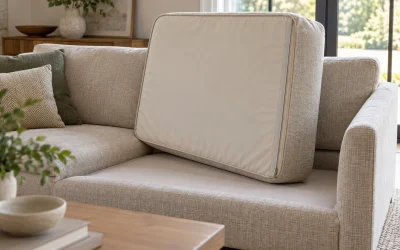
A listing may describe reversible seat cushions, movable ottomans or modular seats. These are different features. A cushion that flips for wear does not prove that an armed chaise can move to the opposite end. Ask which pieces move, how they connect and whether additional modules are needed.
For a sofa-and-ottoman chaise design, check how the long cushion and ottoman are repositioned in the assembly instructions. For separate modules, use the permitted configuration drawing. Do not assume that turning a component around creates the mirror image while preserving its intended connections.
Close the loop on the order
Before checkout, compare the selected swatch, configuration name, diagram and codes on one screen or printed page. Save that version. If the cart changes when you select another color or size, check the orientation again.
At delivery, compare the labels and layout with the saved order before discarding packaging or proceeding with assembly. Report a discrepancy using the component code and marked diagram. Those two details explain the problem more clearly than “the left side is wrong.”