Key takeaways
- Separate carton, assembled and approved delivery dimensions to check access, assembly space and final furniture fit before placing an order.
What's inside
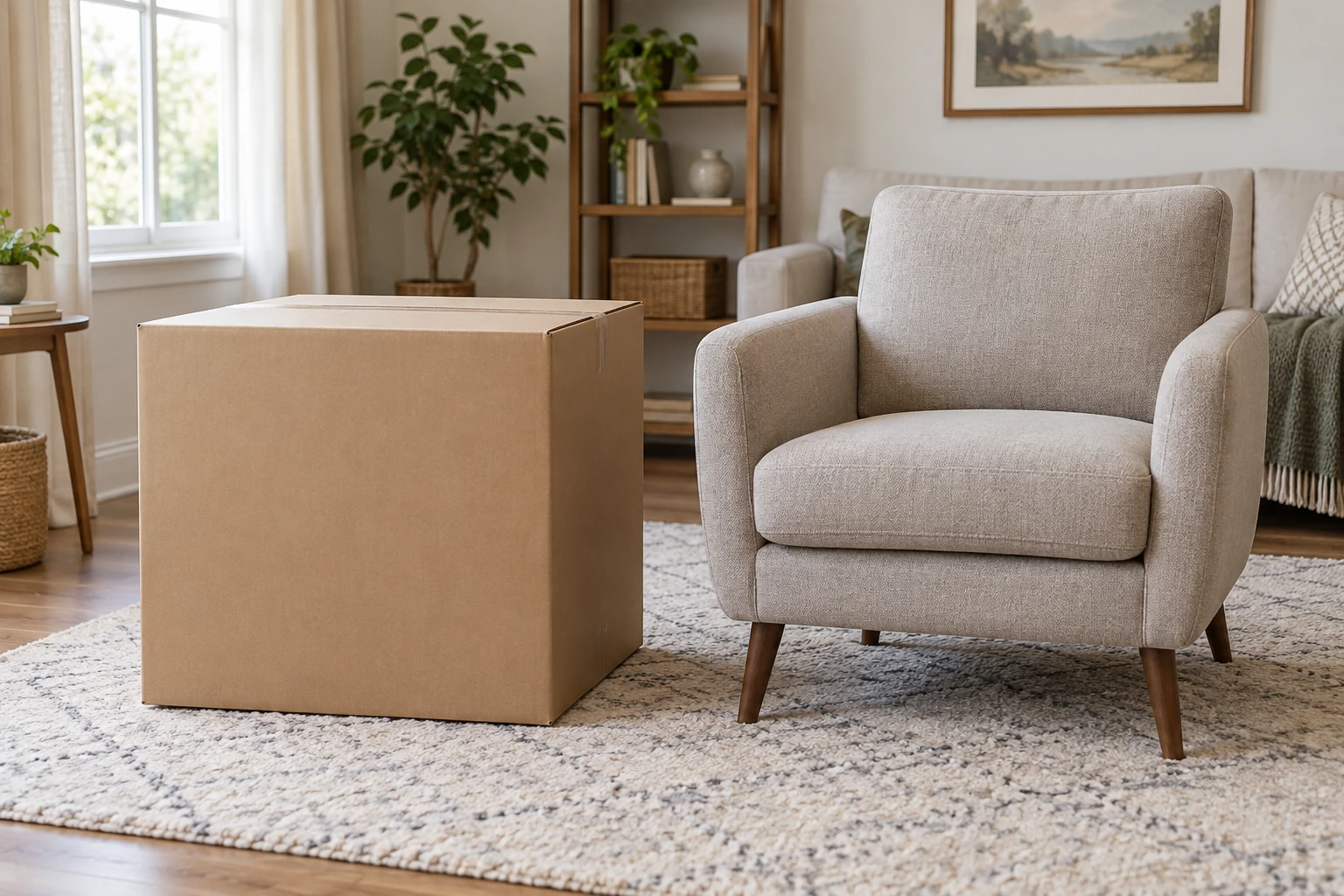
Furniture carton dimensions describe what arrives; assembled dimensions describe what you will use. You need both. A compact flat package can become a much larger cabinet, while a sofa’s protective packaging may be larger than the sofa itself. Do not use one set of measurements to answer every delivery and room-fit question.
Keep three dimension records
Create separate entries for the assembled furniture, every delivery package, and any approved delivery configuration. The third record matters when a retailer delivers a sofa with its feet removed or brings modular pieces separately. Never assume the delivery team can dismantle a frame simply because a smaller component would fit.
Use the seller’s labels carefully. Product width, seat width, shipping length, and package depth can refer to different directions. Copy the dimension names alongside the numbers, identify the unit, and add a small sketch. A bare note saying “84 by 36” is difficult to interpret when you later compare it with a doorway.
A real example of different measurements
The IKEA ÅLHULT bench 606.030.93 is listed at 40.5 by 14.125 by 17.75 inches assembled. Its single package is listed as 42.25 inches long, 15.5 inches wide, and 3.25 inches high. The box is longer than the bench but much flatter. Neither record replaces the other.
That example illustrates the distinction, not how every bench is packaged. Check the exact variant, because a different size or upholstery option may change package count and dimensions. Treat a missing carton dimension as information to request, not an invitation to estimate it from product photographs.
| Record | What to capture | Decision it supports |
|---|---|---|
| Assembled item | Overall width, depth and height | Final position in the room |
| Each package | Number, dimensions and weight | Access and handling plan |
| Approved reduced form | Confirmed removable parts and resulting size | Retailer-approved delivery route |
| Access route | Openings, turns and height restrictions | Whether the planned delivery is feasible |
| Assembly area | Clear floor area and working access | Where construction can take place |
| Service scope | Drop point, unpacking and assembly responsibilities | Who handles each stage |
Check every package, not just the largest volume
For a multi-box order, list each carton separately. The longest carton may be difficult on a stair landing, while a shorter but wider carton may fail at a doorway. Total shipping volume does not tell you which part of the route is restrictive.
Package weight is a separate handling issue. A thin box can still be heavy or awkward. Ask the delivery provider how the item will be handled and where it will be left. Do not plan to lift a package alone merely because its dimensions pass your initial route check.
Room & Board’s delivery measuring guide includes doorways, hallways, stairs, landings, and elevators, with fixed obstructions included in measurements. Apply that route-based approach while using the actual package or approved furniture configuration supplied by your own retailer.
Worked example: delivery succeeds, assembly location fails
Consider a hypothetical cabinet delivered in two flat packages. Both packages can enter a small room in the provider’s confirmed handling configuration. The finished cabinet is 72 inches tall and 24 inches deep, and its instructions require assembling it flat before raising it.
If it were a simple rigid rectangle pivoting through that depth-height plane, its diagonal would be about 75.9 inches: the square root of 72 squared plus 24 squared. A 74-inch obstruction above the assembly area would fail that simplified raising check, despite clearing the final 72-inch height.
This is an illustrative geometry check, not permission to improvise an assembly method. Real instructions, feet, trim, handling space, and the permitted pivot direction matter. The remedy is to verify an appropriate assembly location and method before purchase, not to tilt heavy furniture experimentally under a low ceiling.
Confirm when packaging is removed
A room-of-choice service, doorstep shipment, and full assembly service can involve different transport forms. Ask whether the provider moves the product boxed, unpacks it before entering, or assembles it in the final room. Obtain confirmation for your order rather than relying on a general description from another retailer.
Unpacking outside a narrow doorway is not automatically a solution. It may expose surfaces to damage, leave packing materials in a shared area, or fall outside the purchased service. Likewise, asking a team to carry separate unprotected panels is a change to the plan that needs their agreement.
Make the final room check separately
Mark the assembled footprint in the room, then account for moving drawers, opening doors, reclining mechanisms, and access around the furniture. For sofas, overall depth also differs from the space your body uses; our overall versus usable sofa depth guide addresses that separate comfort question.
Before ordering, your worksheet should answer four things: what arrives, how it gets inside, where it is assembled, and how it operates once placed. If any answer depends on an unconfirmed dimension or service, resolve that specific gap before treating the furniture as a fit.