Key takeaways
- Measure wall to opposite wall: Subtract the cabinet depth. A 42-inch wide hallway with a 14-inch deep shoe storage cabinet leaves 28 inches – too tight. That same cabinet in a 48-inch hallway leaves 34 inches – passable but tight. For hallways under 44 inches wide, stay at 13-14 inches deep maximum.
- Account for door swing: Entry doors that swing inward need 30-36 inches of clearance. Place the cabinet on the hinge side of the door, not the handle side, and leave at least 4 inches between the cabinet side and the door trim so the handle does not hit.
- Allow air gap: Do not push a closed cabinet flush against the wall if it has a solid back. Leave 1 to 2 inches behind it or choose a model with a recessed back panel and vent holes.
- Check height with sightlines: In a small entry, keep the cabinet height at 36 to 48 inches if you want to place keys, mail, or decor on top without blocking a mirror or window. Taller 55-60 inch cabinets work better on a blank wall and store 18-24 pairs but can make a 10×10 ft foyer feel crowded.
The best shoe storage cabinet for most entryways and small spaces is a shallow closed cabinet that is 13 to 15 inches deep, holds 12 to 18 pairs with adjustable shelves, and has ventilation gaps or louvers – choose a closed cabinet if you need a tidy look and odor control in a narrow hallway, and an open cabinet if you need grab-and-go access for 4 to 6 daily pairs.
Closed vs. Open Shoe Storage Cabinets: Head-to-Head
The core trade-off is visibility versus concealment. Open shoe storage cabinets and cubby benches store fewer pairs per inch of wall space but make it faster to get out the door. Closed shoe storage cabinets hide clutter, protect shoes from dust and sunlight, and look like regular entryway furniture, but they need proper ventilation to prevent odor and moisture buildup.
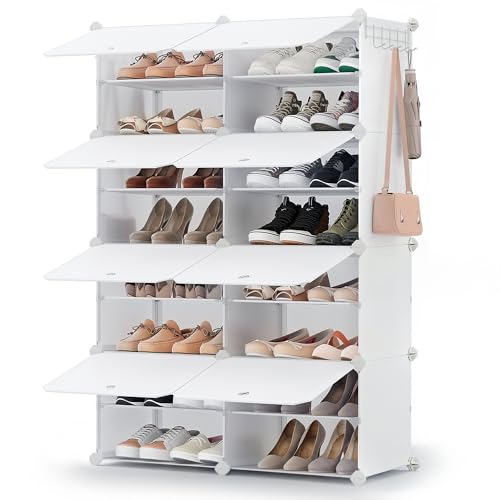
SONGMICS Shoe Rack, 8-Tier with Doors, 32-Pair Storage Cabinet
Included for 'Best Shoe Storage Cabinets for Entryways and Small Spaces' because the listing specifies 8-Tier with Doors and 32-Pair Storage Cabinet, details this guide uses to compare options.
View on Amazon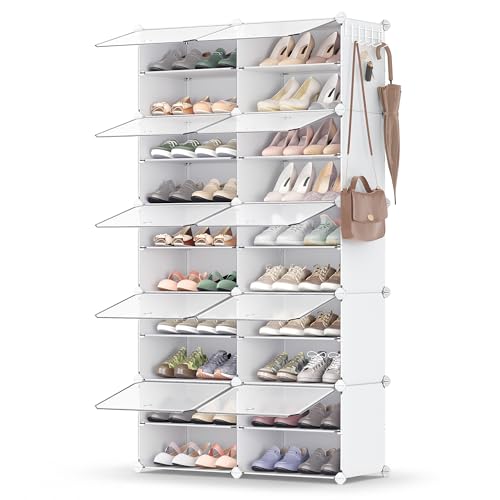
SONGMICS Shoe Rack, 10-Tier with Doors, 40-Pair Storage Cabinet
Included for 'Best Shoe Storage Cabinets for Entryways and Small Spaces' because the listing specifies 10-Tier with Doors and 40-Pair Storage Cabinet, details this guide uses to compare options.
View on Amazon
SONGMICS Home Shoe Storage Bench, Snapsemble Superfast Assembly
Included for 'Best Shoe Storage Cabinets for Entryways and Small Spaces' because the listing specifies Snapsemble Superfast Assembly, details this guide uses to compare options.
View on Amazon
SONGMICS Shoe Rack, 12-Tier with Doors, 48-Pair Storage Cabinet
Included for 'Best Shoe Storage Cabinets for Entryways and Small Spaces' because the listing specifies 12-Tier with Doors and 48-Pair Storage Cabinet, details this guide uses to compare options.
View on Amazon| Feature | Closed Cabinet (Doors / Tilt-Out) | Open Cabinet (Cubby / Slanted Shelves) |
|---|---|---|
| Typical Depth | 13-15 inches (shallow), 15-18 inches (standard) | 12-14 inches (shoe cubbies), 14-16 inches (with bench) |
| Pairs Stored per 30-inch Wide Unit | 9-12 pairs (3 tiers, tilted), 12-18 pairs (3-4 flat shelves, size 7-9) | 6-8 pairs (2 tiers), 8-10 pairs (3 tiers with slanted shelves) |
| Ventilation | Requires rear gaps, louvered doors, or 0.5-0.75 inch door clearance; needs 1-2 inches off wall for airflow | Naturally ventilated; dries wet shoes 30-40% faster |
| Best For Hallway Width | Works in 36-42 inch wide hallways when depth stays under 15 inches | Works in 42+ inch hallways or open entry corners where protrusion is less critical |
| Dust and Sun Protection | Excellent – keeps leather and suede from fading | Poor – shoes collect dust, colors fade near sunny doors |
| Child and Pet Friendliness | Doors keep pairs from scattering, optional soft-close hinges | Low to the ground, easier for kids to use independently |
| General Market Range | Usually $180-$450 for engineered wood, $400-$750 for solid wood | Usually $120-$350 for cubby benches, $150-$400 for open tower racks |
When to Choose Closed
Choose a closed shoe storage cabinet if your entryway is the first thing guests see, if you store dress shoes, leather boots, or suede sneakers, or if shoes tend to develop odor in your household. Look for models with either louvered panels, drilled ventilation rows, or a 0.5-inch gap under each door. Solid back panels without any airflow will trap humidity, especially in winter when wet boots are stored.
When to Choose Open
Choose an open shoe storage cabinet if speed matters more than concealment, such as for a family that cycles through sneakers, school shoes, and sandals daily. Open slanted shelves also fit taller items like ankle boots without removing a shelf. If you prefer an open look but want less clutter, consider a hybrid: a bench with two open cubbies at the bottom and a closed cabinet above.
How to Measure for a Narrow Hallway or Small Entry
Most entry hallways lose functionality when furniture leaves less than 36 inches of clear walkway. That is the minimum for one person to pass comfortably with a bag or stroller, and it is also the standard interior door clearance required by building codes.
- Measure wall to opposite wall: Subtract the cabinet depth. A 42-inch wide hallway with a 14-inch deep shoe storage cabinet leaves 28 inches – too tight. That same cabinet in a 48-inch hallway leaves 34 inches – passable but tight. For hallways under 44 inches wide, stay at 13-14 inches deep maximum.
- Account for door swing: Entry doors that swing inward need 30-36 inches of clearance. Place the cabinet on the hinge side of the door, not the handle side, and leave at least 4 inches between the cabinet side and the door trim so the handle does not hit.
- Allow air gap: Do not push a closed cabinet flush against the wall if it has a solid back. Leave 1 to 2 inches behind it or choose a model with a recessed back panel and vent holes.
- Check height with sightlines: In a small entry, keep the cabinet height at 36 to 48 inches if you want to place keys, mail, or decor on top without blocking a mirror or window. Taller 55-60 inch cabinets work better on a blank wall and store 18-24 pairs but can make a 10×10 ft foyer feel crowded.
Capacity Planning by Household Size
Shoe counts add up faster than expected because each person typically needs 3 to 5 pairs in rotation near the door. Use this to size your cabinet instead of relying on a generic pair count from a product listing, which is often based on small flats.
- 1-2 people in a studio or apartment: 8-12 pairs total. A single 28-32 inch wide, 3-tier shallow cabinet is enough. Reserve one shelf with 7-8 inches of vertical clearance for boots by removing an interior shelf if it is adjustable.
- 3-4 people (couples or small family): 16-24 pairs total. Look for a 36-48 inch wide cabinet with 3 to 4 shelves, or pair two 24-inch units flanking the door. Men’s size 11-12 sneakers need 11.5 to 12 inches of shelf depth laid flat; tilted shelves can save 2-3 inches of depth.
- 5+ people or boot-heavy household: 24-36 pairs. Consider a 60-inch wide low cabinet at 24-28 inches high that doubles as a bench, plus a slim 10-12 inch deep tilt-out cabinet for overflow. Tilt-out designs with 2 or 3 compartments store 6-9 pairs each but need 20-24 inches of floor clearance when open, so they are not ideal directly behind a door.
For boots, measure shaft height. Ankle boots need 10-12 inches, mid-calf needs 14-16 inches, and tall boots need 17-19 inches. Cabinets with one adjustable shelf that moves to 16+ inches on one side solve this without forcing you to fold boot shafts.
Material and Construction Trade-Offs
A shoe storage cabinet lives by the front door, so it takes kicks, moisture, and weight from people sitting to put on shoes. Construction matters more here than in a bedroom dresser.
| Material | Durability and Weight Limit | Moisture and Ventilation | Best For |
|---|---|---|---|
| Solid Wood (pine, rubberwood, oak) | Strongest, usually 150-250 lbs top weight if bench-height; resists warping longest | Handles humidity well, can be refinished; still needs vents for closed designs | Long-term entryway furniture, homes that want to repaint or refinish |
| Engineered Wood (MDF / particleboard with veneer or melamine) | Moderate, usually 80-150 lbs top weight; edges can swell if unsealed | Less tolerant of wet boots; look for sealed edges and metal shelf supports | Budget and mid-range cabinets where style outweighs heavy daily sitting |
| Metal Frame + Wood Shelves | Very strong frame, often 200+ lbs; shelves may be thinner wood or metal mesh | Mesh shelves ventilate best; open-frame designs air-dry fastest | Modern entries, damp climates, renters who need lightweight durability |
| Bamboo / Rattan Hybrid | Light to moderate, usually 100-180 lbs; flexible but can crack if screws over-tightened | Naturally ventilated if rattan or cane panels are used | Small spaces needing airflow without looking industrial |
Foam seat cushions on bench-style cabinets are usually 1.5 to 2 inches of medium-density foam. Low-density foam compresses within 6-12 months under daily adult use. If you plan to sit to lace boots, choose a hard wood top or a cushion with high-density foam and a removable, washable cover.
Decision Matrix: Pick by Your Situation
Match your entryway constraints to the cabinet type that causes the fewest compromises.
| Your Situation | Recommended Shoe Storage Cabinet | Why |
|---|---|---|
| Narrow hallway 36-42 inches wide, 1-2 people | Slim closed cabinet, 13-14 inch depth, 28-32 inch width, 40-48 inch height | Preserves 28+ inches of walkway while hiding 9-12 pairs; shallow depth avoids blocking traffic |
| Rental apartment, cannot wall-anchor | Low open bench, 14 inch depth, 36-42 inch width, under 30 inch height | Low center of gravity prevents tipping without anchors; freestanding and moves easily |
| Family with kids and pets | Closed cabinet with soft-close doors + one open cubby row at floor level | Top hides adult shoes and odor, bottom cubbies let kids grab shoes without opening doors |
| Many boots and large shoe sizes | 48-60 inch wide cabinet with at least one 16-18 inch tall compartment or slanted open shelves | Standard 5-6 inch shelf spacing crushes boots; tall compartment prevents shaft creasing |
| Back or knee pain, need to sit | Bench-height closed cabinet, seat height 17-19 inches, 150+ lbs weight limit | Standard chair seat height allows sitting to put on shoes; confirms it is tested as a bench, not just storage |
| Sunny or dusty entry | Fully closed cabinet with solid doors and interior vents | Prevents UV fading on leather and keeps dust off suede and knit uppers |
Assembly, Moving, and What Wears First
Shoe storage cabinets are deceptively heavy to move. A 36-inch engineered wood cabinet usually ships in one box at 45-65 lbs and requires 30-60 minutes for two people to assemble. Solid wood models of the same size often ship at 60-85 lbs. Measure your doorway and stairwell before delivery – the box is typically 4-6 inches larger than the cabinet in each direction and may not turn a tight 28-inch apartment doorway.
For stability, any cabinet taller than 36 inches should be wall-anchored if children or pets can climb, especially tilt-out models where weight shifts forward when compartments are open. Renters who cannot drill should stay under 30 inches high or choose a low bench style that does not need anchoring.
What wears first is predictable: soft-close hinges loosen with daily slamming, particleboard shelf pins strip if shelves are overloaded beyond 25-30 lbs per shelf, and the bottom edge swells if wet shoes drip directly onto unsealed engineered wood. Prevent this by adding adhesive felt pads under the cabinet to lift it 0.25 inches off the floor, placing a removable drip tray or mat inside the bottom compartment, and tightening all cam locks again two weeks after assembly when wood settles.
Clearance around the cabinet also affects longevity. Leave at least 2 inches on each side for air circulation and to prevent scuffs from bags and vacuums. If the cabinet has doors that open outward, ensure 18-20 inches of floor space in front so doors open to 90 degrees without hitting a wall or radiator.
A well-chosen shoe storage cabinet should not just fit pairs – it should fit your entryway’s width, your household’s boot height, and your tolerance for daily tidying. In a truly compact space, a 13-inch deep closed cabinet with adjustable shelves and hidden ventilation will hold more while keeping the hallway walkable. In a larger foyer where speed matters, an open bench with cubbies will get everyone out the door faster and keep shoes dry.