Key takeaways
- Drawer glides: Metal ball-bearing glides with a 3/4 to full extension are far more durable than wood-on-wood or plastic center glides. They prevent sticking and support heavier loads.
- Drawer bottoms: Look for at least 0.2-inch plywood or 0.4-inch MDF bottoms that are grooved into the drawer sides, not just stapled underneath.
- Joinery: Dovetail or dowel joints outlast stapled butt joints, especially for bottom drawers that hold jeans and sweaters.
- Back panel: A solid or well-screwed back panel prevents racking. Thin cardboard backs held with staples are a failure point during moves.
What's inside
- Standard Measurements for a 6 Drawer Chest of Drawers
- Double-Column vs Single-Column Layout: Which Stores More?
- Material and Construction Trade-Offs for Family Use
- Decision Matrix: Which 6 Drawer Dresser Fits Your Situation?
- Assembly, Moving and What Wears Out First
- How to Choose for Maximum Storage Without Overcrowding Your Room
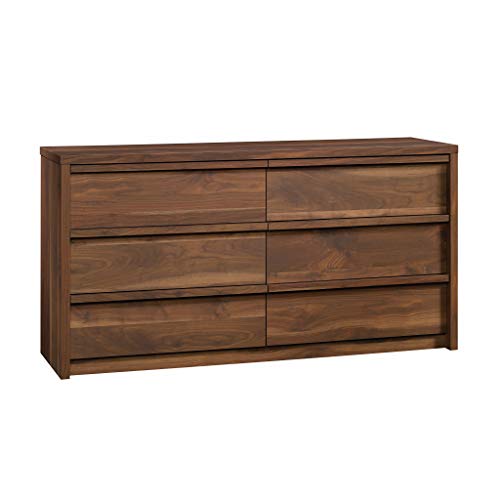
A 6 drawer chest of drawers is the best wide dresser for maximum storage when you need to store clothing for one to two people without adding a second dresser, typically offering 50 to 60 inches of width and 12 to 16 cubic feet of usable drawer volume in a single footprint.
- Standard Measurements for a 6 Drawer Chest of Drawers
- Double-Column vs Single-Column Layout: Which Stores More?
- Material and Construction Trade-Offs for Family Use
- Decision Matrix: Which 6 Drawer Dresser Fits Your Situation?
- Assembly, Moving and What Wears Out First
- How to Choose for Maximum Storage Without Overcrowding Your Room
Unlike tall 5-drawer chests or narrow 3-drawer units, a 6-drawer wide dresser spreads storage horizontally, which makes it more stable, easier to organize by category, and better suited as a bedroom anchor piece that can also hold a TV or mirror. Choosing the right one comes down to layout, actual dimensions, and material durability — not just drawer count.

Orgobysol 6 Drawer Double Dresser for Bedroom, Modern Simply Chest of Drawers, Wood Storage Dresser with Anti-Tipping for Living Room Hallway Entryway, Nursy Black (15.3" D x 47.2" W x 32.3" H)
Included for '6 Drawer Chest of Drawers: Best Wide Dressers for Maximum Storage' because the listing specifies Modern Simply Chest of Drawers and Nursy Black (15.3" D x 47.2" W x 32.3" H), details this guide uses to compare options.
View on Amazon
Orgobysol 6 Drawer Double Dresser for Bedroom, Modern Simply Chest of Drawers, Wood Storage Dresser with Anti-Tipping for Living Room Hallway Entryway, Nursy White (15.3" D x 47.2" W x 32.3" H)
Included for '6 Drawer Chest of Drawers: Best Wide Dressers for Maximum Storage' because the listing specifies Modern Simply Chest of Drawers and Nursy White (15.3" D x 47.2" W x 32.3" H), details this guide uses to compare options.
View on Amazon
FOTOSOK Black Dresser for Bedroom, Modern 6 Drawer Double Dresser
Included for '6 Drawer Chest of Drawers: Best Wide Dressers for Maximum Storage' because the listing specifies Modern 6 Drawer Double Dresser, details this guide uses to compare options.
View on AmazonStandard Measurements for a 6 Drawer Chest of Drawers
Most 6 drawer wide dressers sold in 2026 fall into a predictable size range, but small variations affect how they fit and function in your room.
| Measurement | Standard Range | What It Means for Fit |
|---|---|---|
| Overall Width | 50 – 64 inches | Fits along a 10 ft wall with 28-35 inches of clearance on each side for nightstands or doors |
| Overall Height | 30 – 36 inches | Standard counter height; works under a window sill and keeps top surface reachable |
| Overall Depth | 16 – 20 inches | 18 inches is ideal for folded clothes without wasting floor space |
| Drawer Interior Depth | 14 – 18 inches | Deep enough for folded jeans and sweaters without double-stacking |
| Drawer Interior Height | 5 – 8 inches | Top drawers are often 5-6 inches for accessories, bottom drawers 7-8 inches for bulk items |
| Weight Capacity (per drawer) | 25 – 45 lbs | Engineered wood is usually 25-30 lbs; solid wood with metal glides is 35-45 lbs |
For room planning, allow at least 36 inches of clear space in front of the dresser so drawers can fully extend (most need 16-18 inches of pull-out plus room to stand) and 2-3 inches behind if your baseboards are thick. In a 10×12 ft bedroom, a 60-inch wide dresser will occupy half of the 10 ft wall, leaving room for a queen bed on the adjacent wall without blocking closet doors.
Measure your doorway and hallway before buying. Boxed 6-drawer dressers often ship at 62 x 20 x 32 inches and 90-140 lbs, and assembled units will not fit through a doorway narrower than 29 inches without angling. If you have a tight apartment entry or stairwell under 36 inches wide, look for models that ship in two boxes or require assembly.
Double-Column vs Single-Column Layout: Which Stores More?
The drawer arrangement determines how usable the storage actually is.
Double-Column (3×2) – The Most Common Wide Dresser
This layout has two columns of three drawers side-by-side. Each drawer is typically 24-28 inches wide and 16-18 inches deep. It is the best for shared use because each person can take one side, and for organization by category (tops left, bottoms right, etc.). It also distributes weight evenly and resists tipping better than tall chests. Nearly all 50-64 inch wide models use this configuration.
Single-Column (6 High) – Tall and Narrow
A true single-column 6 drawer chest stacks six drawers vertically in a 30-38 inch wide frame. It saves floor width but reaches 48-54 inches high, which makes the top drawers hard to reach and requires wall anchoring for safety. Total drawer volume is similar, but the narrow drawers (28-34 inches wide) are less efficient for bulky items like comforters. Choose this only if wall width is severely limited.
Hybrid Layouts (2 Small on Top, 4 Large Below)
Some wide dressers place two half-width drawers on top for socks, underwear and accessories, with four full-width or double-width drawers below for folded clothes. This gives better sorting without needing drawer dividers but reduces the width of the top storage. It is a good compromise for families who need both small-item organization and bulk storage.
Material and Construction Trade-Offs for Family Use
For families needing bulk clothing storage, durability matters more than finish. Weight, humidity, and daily opening cycles will expose weak construction quickly.
| Material / Build | Durability & Weight Limit | Pros | Cons | Best For |
|---|---|---|---|---|
| Solid Wood (pine, rubberwood, poplar) | High – 35-45 lbs per drawer, 10-15+ year life | Strong joints, can be refinished, holds screws well | Heavier (120-180 lbs assembled), usually $600-$1200, can expand in humidity | Long-term family use, kids’ rooms |
| Engineered Wood (MDF/particleboard with veneer/laminate) | Medium – 25-30 lbs per drawer, 3-7 year life | Affordable (usually $250-$550), lighter, consistent finish | Sags under heavy loads, chips at edges, cannot be easily repaired if stripped | Renters, guest rooms, tight budgets |
| Solid Wood Frame + Engineered Drawer Boxes | Medium-High – 30-35 lbs per drawer | Balances strength and price, usually $400-$750 | Drawer bottoms may be thin plywood | Most buyers wanting value and durability |
| Metal Frame + Wood Drawers | High – 40+ lbs per drawer | Very stable, modern look, excellent glide support | Industrial style not for every decor, can be noisy | Maximum load, frequent moving |
Check these construction details regardless of material:
- Drawer glides: Metal ball-bearing glides with a 3/4 to full extension are far more durable than wood-on-wood or plastic center glides. They prevent sticking and support heavier loads.
- Drawer bottoms: Look for at least 0.2-inch plywood or 0.4-inch MDF bottoms that are grooved into the drawer sides, not just stapled underneath.
- Joinery: Dovetail or dowel joints outlast stapled butt joints, especially for bottom drawers that hold jeans and sweaters.
- Back panel: A solid or well-screwed back panel prevents racking. Thin cardboard backs held with staples are a failure point during moves.
Decision Matrix: Which 6 Drawer Dresser Fits Your Situation?
| Your Situation | Recommended Width & Depth | Best Layout & Material |
|---|---|---|
| Small apartment or 10×12 ft bedroom | 50-54 inches wide, 16-18 inches deep | Double-column engineered wood or hybrid wood frame; keep depth under 18 inches to save floor space |
| Family with kids and pets | 54-60 inches wide, 18-20 inches deep | Solid wood or metal frame double-column with ball-bearing glides and anti-tip kit; rounded edges and durable laminate top |
| Renters who move often | 50-56 inches wide, split-box assembly | Engineered wood with cam-lock assembly; avoid fully assembled solid wood (heavy and hard to move through doorways) |
| Shared couple needing bulk storage | 60-64 inches wide, 18-20 inches deep | Double-column 6-drawer with equal-width drawers so each person gets 3 full drawers |
| Need dresser to double as TV stand | 58-64 inches wide, 30-33 inches high | Wide double-column solid wood; ensures top can support 50-80 lbs and width fits 55-65 inch TV |
Assembly, Moving and What Wears Out First
A 6 drawer chest is one of the heaviest bedroom pieces to assemble and live with. Plan accordingly.
Assembly reality: Most flat-pack 6-drawer dressers take 60-120 minutes with two people, require a Phillips screwdriver and included Allen keys, and involve 30-50 cam locks and wood dowels. The heaviest single box is often 95-130 lbs. Do not assemble alone — aligning the top panel while securing the sides needs two sets of hands.
Moving reality: Empty the drawers before moving; even 15 lbs per drawer adds 90 lbs of shifting weight that will break glides and stress joints. Remove drawers and carry the frame and drawers separately. Wrap the top with a blanket — the top surface is the first to scratch.
What fails first:
- Drawer glides loosen from particleboard sides after 1-2 years of heavy loads. Tighten screws every 6 months and avoid overfilling above the drawer rim.
- Drawer bottoms sag if overloaded with denim or books. Reinforce with a center support rail if not included.
- Top finish wears from daily items, perfume, and water rings. Use a tray for toiletries and felt pads under decor.
- Anti-tip straps must be anchored into a wall stud, not just drywall. This is essential for any dresser over 30 inches high, especially in homes with children.
For maximum usable life, line drawers with breathable liner, keep loads under 30 lbs per drawer for engineered wood, and leave 1 inch of space at the top of each drawer so clothes do not snag on the frame above.
How to Choose for Maximum Storage Without Overcrowding Your Room
Start with your wall. If you have at least 62 inches of uninterrupted wall width, a 58-60 inch double-column dresser gives the best volume-to-footprint ratio. If you have only 52 inches, drop to a 50-inch model rather than blocking a vent, outlet, or door swing.
Next, match depth to your folding style. If you file-fold and want visibility, 16-18 inch deep drawers prevent items from getting lost in the back. If you stack bulky sweaters, 19-20 inch depth is better but will protrude further into the room.
Finally, prioritize glide quality and drawer-box construction over exterior finish. A simple solid-wood-frame dresser with full-extension metal glides will store more reliably for five years than a stylish veneer piece with cheap center glides that stick under weight. For families in 2026, that durability difference is what turns a 6 drawer chest of drawers into true bulk storage rather than just another piece of furniture.