Key takeaways
- Interior width and depth at the top opening, not at the floor. Many chest freezers taper slightly or have a rounded floor corner.
- Usable depth beside the compressor step. Almost every chest freezer has a raised step on one end that covers the compressor. That step usually sits 8 to 12 inches high and 9 to 14 inches long, so bins on that end must be shorter.
- Height from floor to the bottom of the lid gasket, then subtract 1 inch for air circulation and so the lid seals without pushing on food.
The best stackable bins for a chest freezer are open-top or handled rectangular baskets sized so two or three of them fill the width of the cabinet exactly, with a total stack height that stops 1 to 2 inches below the lid gasket. Get that fit right and a chest freezer stops being a dig-to-the-bottom pit and becomes a set of drawers you can lift out in order.
Measure the Freezer Before You Shop
Chest freezers are sold by cubic feet, but bins are sold by inches, and the two rarely line up. Take three interior measurements with the freezer empty or nearly empty:
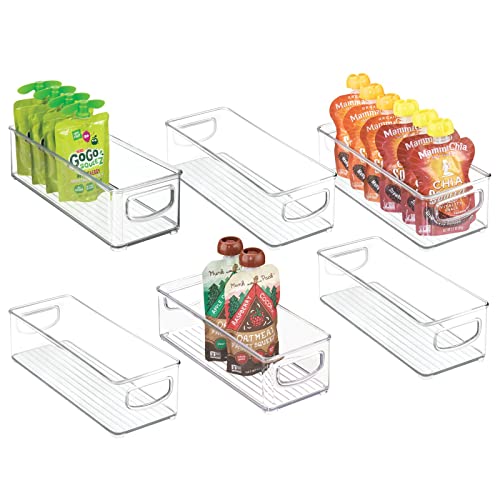
mDesign Plastic Stackable Small Organizing Bin Kitchen Pantry Cabinet, Refrigerator, Freezer Food Organization Storage Bins with Handles, Drawer Container Organizer, Ligne Collection, 6 Pack - Clear
Included for 'Stackable Bins for a Chest Freezer: Sizing, Layering and Lifting Weight' because the listing specifies Refrigerator and Freezer Food Organization Storage Bins with Handles, details this guide uses to compare options.
View on Amazon
mDesign Plastic Long Stackable Storage Organizer Container, Organization Bin w/Handles for Kitchen, Pantry, Fridge, Freezer, Cabinet, Perfect to Hold Breast Milk - Ligne Collection - Clear
Included for 'Stackable Bins for a Chest Freezer: Sizing, Layering and Lifting Weight' because the listing specifies Organization Bin w/Handles for Kitchen and Pantry, details this guide uses to compare options.
View on Amazon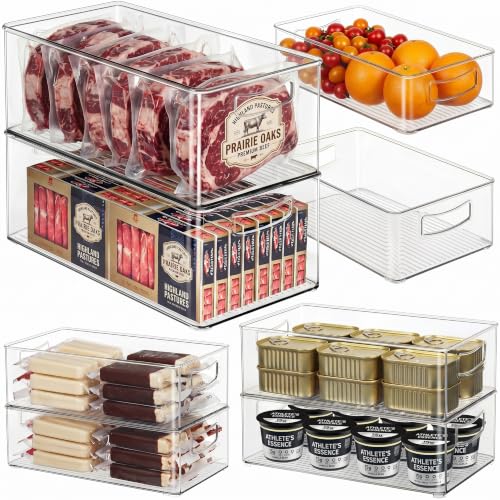
Hudgan 8 Pack Freezer Organizer Bins,Stackable,Clear Bins for Fridge,Pantry
Included for 'Stackable Bins for a Chest Freezer: Sizing, Layering and Lifting Weight' because the listing specifies Stackable and Clear Bins for Fridge, details this guide uses to compare options.
View on Amazon
Freezer Organizer Bins, 4 Pack Big Baskets for 5/ 7 Cu.FT Deep Freezer
Included for 'Stackable Bins for a Chest Freezer: Sizing, Layering and Lifting Weight' because the listing specifies 4 Pack Big Baskets for 5/ 7 Cu.FT Deep Freezer, details this guide uses to compare options.
View on Amazon- Interior width and depth at the top opening, not at the floor. Many chest freezers taper slightly or have a rounded floor corner.
- Usable depth beside the compressor step. Almost every chest freezer has a raised step on one end that covers the compressor. That step usually sits 8 to 12 inches high and 9 to 14 inches long, so bins on that end must be shorter.
- Height from floor to the bottom of the lid gasket, then subtract 1 inch for air circulation and so the lid seals without pushing on food.
Most chest freezers also come with one or two wire hanging baskets that ride on a ledge at the top. Decide whether you will keep them. If you do, your stack needs to stop below the basket floor, which costs you roughly 6 to 9 inches of stacking height.
Typical Interior Sizes and What Fits
Interior dimensions vary by brand, but the ranges below cover most common models and give a starting point for planning bins.
| Freezer size | Typical interior (W x D, inches) | Usable height (main well) | Bin layout that usually fits |
|---|---|---|---|
| 3.5 cu ft | 18-20 x 14-16 | 16-18 in | 2 bins side by side, 2 high (8 in tall bins) |
| 5 cu ft | 24-28 x 16-18 | 17-20 in | 2-3 bins across, 2 high |
| 7 cu ft | 32-35 x 17-19 | 19-22 in | 3 bins across, 2-3 high |
| 9-10 cu ft | 38-44 x 18-20 | 21-24 in | 4 bins across, 3 high |
| 14-15 cu ft | 52-58 x 19-21 | 23-26 in | 2 rows of 3, 3 high |
Leave about half an inch of side play per bin. A bin that exactly matches the opening will freeze in place once a little frost builds up on the walls.
Bin Types Compared
“Stackable” means different things depending on the design, and the difference matters when one bin holds 15 pounds of frozen meat.
| Bin type | Stacks how | Cold performance | Best use | Weak point |
|---|---|---|---|---|
| Open-top plastic basket with handles | Rests on rim of bin below | Good; slots let air move | Everyday sorting by food type | Thin plastic can crack below 0°F if dropped |
| Lidded clear bin | Lid carries next bin | Slower airflow, contents freeze slower | Loose items, bags of vegetables | Lids frost shut; corners trap moisture |
| Coated wire basket | Nests or sits on rim | Best airflow | Heavy roasts, irregular shapes | Small items fall through; coating chips |
| Collapsible fabric or silicone crate | Usually not load-bearing | Fair | Top layer only | Sags when full; cannot hold weight above |
| Reusable grocery-style crate | Interlocking rims | Good | Bulk buyers, hunters | Bulky; often too tall for small units |
For freezer use, look for polypropylene or polyethylene bins, which stay somewhat flexible in the cold. Acrylic and polystyrene, often used for display-clear pantry bins, become brittle at freezer temperatures and are the ones that shatter when knocked against the wall.
Planning the Layout: Bottom Layer First
Treat the freezer as a filing system that you open from the top. The order you stack is the order you will unpack every time you need something deep.
- Bottom layer: long-term and bulk. Whole turkeys, quarter-beef cuts, summer produce you will not touch until winter. These get used least often.
- Middle layer: weekly proteins. Chicken, ground beef, fish, sorted one category per bin.
- Top layer or hanging baskets: daily items. Bread, ice packs, frozen fruit for smoothies, leftovers in flat containers.
- Compressor step: short bins of 6 to 8 inches for butter, nuts, flour and small packages.
Color-coding works well in a chest freezer because you are reading bins from above. One color per food category, or a contrasting label on the handle, means you can find the right bin without lifting the ones on top.
Weight and Handling Realities
A 12 x 16 x 8 inch bin packed with frozen meat weighs roughly 15 to 25 pounds. Lifting that from the bottom of a 26-inch-deep chest freezer is an awkward, bent-over reach. A few practical rules:
- Keep bins under about 20 pounds if anyone in the house has a sore back. Smaller bins mean more lifts but lighter ones.
- Choose handles you can grip with gloves on. Molded cutout handles are easier than thin wire loops when your fingers are cold.
- Check that a bin’s rim actually supports the weight above. Many tapered bins are designed to nest when empty and stack only when rotated 180 degrees, which is easy to forget.
- Do not stack heavier than the bin below can carry. Two full bins on a thin basket can bow the bottom bin enough to wedge it against the wall.
Labeling and Inventory That Survive the Cold
Paper labels fall off once condensation hits them. Better options are waterproof vinyl labels, a permanent marker on the bin itself, or a clip-on tag on the handle that you can rewrite. Many people tape a simple inventory sheet inside the lid or keep a list on the fridge, crossing items off as they come out. A dated layer system (oldest food in the front bin of each row) cuts waste more than any particular bin brand.
Picks by Situation
| Your situation | What to buy | Why |
|---|---|---|
| Small 3.5-5 cu ft freezer in an apartment or garage | Two to four handled open-top bins, 7-8 in tall | Easy to lift; matches the shallow well |
| Large freezer for bulk meat or hunting season | Heavy-gauge interlocking crates or coated wire baskets | Carry real weight without bowing |
| Lots of loose bags of vegetables and fruit | Lidded clear bins in the top layer | Bags stop sliding into gaps |
| Freezer shared by several people | Color-coded bins, one per person or category | No one digs through everything |
| Limited budget | Basic plastic dishpan-style tubs plus labels | Usually $3-$8 each, still lift out cleanly |
Purpose-built freezer organizer sets typically run $25 to $60 for three to six pieces. General storage bins that happen to fit cost less, often $4 to $12 each, and work just as well if the plastic is freezer-safe.
Common Mistakes
- Filling every inch. A chest freezer needs some space around the walls for cold air to move. Packed edge to edge with tight bins, the center of each bin freezes slower.
- Ignoring the drain plug. Many chest freezers have a defrost drain at the bottom front. Bins sitting over it should be easy to pull when you defrost.
- Buying tall bins. One 16-inch bin is harder to use than two 8-inch bins. Shorter bins give you more layers and lighter lifts.
- Forgetting the lid. If the lid does not close flat, the gasket leaks, frost builds fast, and bins freeze together.
Quick FAQ
Can I use regular storage bins in a chest freezer?
Yes, if they are made from polypropylene or polyethylene, usually marked with recycling code 5 or 2 on the bottom. Avoid clear rigid styrene or acrylic bins, which crack easily below freezing.
Are freezer bins worth it compared with reusable shopping bags?
Bags are cheap and flexible, but they slump and do not carry weight above them. Bins create defined layers, so for a freezer more than half full, rigid bins are the more practical choice.
How many bins does a 7 cubic foot freezer need?
Usually six to eight: three across in two layers in the main well, plus one or two short bins on the compressor step.