Key takeaways
- Hooks instead of hangers. Coats on hooks need only 10 to 14 inches of depth, though they bulk up as you layer them.
- End-on (pull-out) hanging rails. A rail that runs front to back lets hangers face the door, so a 14 to 16 inch cabinet can hold a short row of coats.
- Angled hangers. Hangers that sit at an angle on a rail fit in about 16 to 18 inches, but long coats crease.
A hallway wardrobe for coats and shoes works only if it is deep enough for hangers, about 20 to 24 inches inside, or if it switches to hooks and a shallower 12 to 16 inch cabinet with tilt-out shoe compartments. Most hallways are 36 to 48 inches wide, so the real question is how much depth you can give up and still keep a clear walking path of at least 32 to 36 inches.
Start With Hallway Width, Not the Wardrobe
Building guidelines in the US commonly call for hallways of at least 36 inches, and a comfortable walking path for one person carrying bags is around 32 inches clear. Subtract the cabinet depth plus its open door swing from your hallway width to see what is left.

VASAGLE Coat Rack, Hall Tree with Shoe Storage Bench, 3-in-1, Steel Frame
Included for 'Hallway Wardrobe for Coats and Shoes: Depths That Fit Narrow Halls' because the listing specifies Hall Tree with Shoe Storage Bench and 3-in-1, details this guide uses to compare options.
View on Amazon
VASAGLE Hall Tree with Bench and Shoe Storage, 2 Fabric Drawers, 10 Hooks
Included for 'Hallway Wardrobe for Coats and Shoes: Depths That Fit Narrow Halls' because the listing specifies 2 Fabric Drawers and 10 Hooks, details this guide uses to compare options.
View on Amazon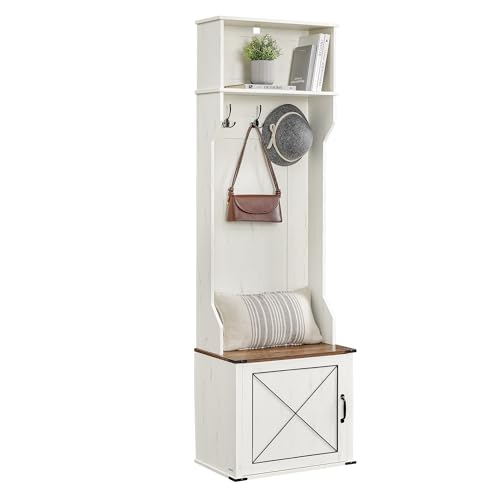
VASAGLE Hall Tree with Bench and Shoe Storage, 3 Tri-Hooks, Hinged Door
Included for 'Hallway Wardrobe for Coats and Shoes: Depths That Fit Narrow Halls' because the listing specifies 3 Tri-Hooks and Hinged Door, details this guide uses to compare options.
View on Amazon
VASAGLE Coat Rack, Hall Tree with Shoe Bench, 4-in-1, 9 Removable Hooks
Included for 'Hallway Wardrobe for Coats and Shoes: Depths That Fit Narrow Halls' because the listing specifies Hall Tree with Shoe Bench and 4-in-1, details this guide uses to compare options.
View on Amazon| Hallway width | Max cabinet depth (keeping 32 in clear) | Realistic storage style |
|---|---|---|
| 36 in | 4 in | Wall hooks and a wall-mounted shoe ledge only |
| 42 in | 10 in | Slim tilt-out shoe cabinet with hooks above |
| 48 in | 16 in | Shallow wardrobe with hooks or end-on hanging rod, shoe cabinet below |
| 54 in | 22 in | Standard hanging wardrobe if doors are sliding |
| 60 in or entry nook | 24 in+ | Full-depth wardrobe with hinged doors, bench optional |
Hinged doors add a hidden cost: a 20-inch-wide door needs 20 inches of open space in front of the cabinet. In a narrow hall, sliding doors, bi-fold doors or open shelving with a curtain often work better.
Hanging Depth vs Hook Depth
A coat on a standard hanger is about 19 to 22 inches wide shoulder to shoulder. Puffer jackets and winter parkas push that to 22 to 24 inches. That is why full wardrobes are usually 22 to 24 inches deep inside. If your hallway cannot spare that, you have three options:
- Hooks instead of hangers. Coats on hooks need only 10 to 14 inches of depth, though they bulk up as you layer them.
- End-on (pull-out) hanging rails. A rail that runs front to back lets hangers face the door, so a 14 to 16 inch cabinet can hold a short row of coats.
- Angled hangers. Hangers that sit at an angle on a rail fit in about 16 to 18 inches, but long coats crease.
Shoe Storage Built Into a Hallway Wardrobe
Shoes are where most hallway wardrobes underperform. Plan for these sizes:
| Shoe storage format | Depth needed | Pairs per 24 in width | Good for |
|---|---|---|---|
| Tilt-out (flip-down) compartments | 7-10 in | 4-6 per tier | Sneakers, flats; not boots |
| Flat shelves, shoes side by side | 12-14 in | 3-4 per shelf | Everyday adult shoes |
| Angled slanted shelves | 11-13 in | 3-4 per shelf | Display and quick grab |
| Open boot bay | 12-14 in, 16-20 in tall | 2-3 pairs of tall boots | Winter and rain boots |
| Bench cubbies | 14-18 in | 2-3 per cubby | Kids, family drop zone |
A household of four typically wears 8 to 12 pairs a week. Count those, not your entire collection; the rest belongs in bedroom closets.
Common Hallway Wardrobe Layouts
Tall unit with half hanging, half shoes
About 24 to 36 inches wide and 70 to 80 inches tall, with a coat rail on one side and shoe shelves on the other. Works in wide halls or entry nooks. Fits a couple or small family.
Shallow cabinet plus wall hooks
A tilt-out shoe cabinet about 9 inches deep and 30 to 40 inches tall, with a hook rail mounted above at about 60 to 66 inches for adults and 40 to 48 inches for children. The cheapest and most space-efficient setup for a standard 42-inch hallway.
Hall tree with closed lower storage
Open coat hooks, a bench at 17 to 19 inches high for sitting to put on shoes, and cubbies or a cabinet underneath. Good if you want somewhere to sit and do not mind coats being visible.
Built-in or modular wardrobe system
Modular frame-and-door systems, for example IKEA’s PAX wardrobe frames, come in 13.75-inch (35 cm) and roughly 22.875-inch (58 cm) depths, and the shallower frame is often chosen for hallways. Built-ins cost more but can use the full ceiling height for out-of-season storage.
Materials and Durability in a High-Traffic Spot
Hallway furniture takes knocks from bags, strollers and wet boots. What wears first is usually the bottom edge and the lower shelf where wet shoes sit.
| Material | Moisture resistance | Dent resistance | Typical price, tall unit |
|---|---|---|---|
| Laminated particleboard | Poor at raw edges; swells if wet | Fair | $150-$400 |
| Painted MDF | Fair if sealed | Fair; chips show | $250-$600 |
| Solid wood (pine, oak) | Good when finished | Pine dents, oak resists | $500-$1,500 |
| Powder-coated metal | Very good | Very good | $150-$500 |
Put a washable boot tray on the bottom shelf whatever the material. Particleboard shelves that hold wet shoes daily tend to swell at the front edge within a year or two.
Assembly and Safety Realities
- Anchor tall units to the wall. Anything over about 30 inches tall can tip, and a hallway wardrobe gets pulled on daily. Use the anti-tip kit and screw into a stud.
- Check flat-pack box weight. A 70-inch particleboard wardrobe often ships in one or two boxes of 80 to 140 pounds. Plan for two people.
- Allow headroom to stand it up. Assemble it on the floor, then tilt it upright; a 79-inch-tall unit needs a ceiling height above its diagonal measurement, roughly 81 to 83 inches, to swing up without scraping.
- Mind baseboards. A baseboard can push a cabinet 0.5 to 0.75 inches off the wall. Many units have a notch at the back; otherwise, plan to shim.
Quick Picks by Household
- Single person or couple, narrow hall: tilt-out shoe cabinet plus a hook rail.
- Family with kids: hall tree with bench, low hooks and a cubby per child.
- Cold climate with bulky coats and boots: full-depth wardrobe in an entry nook, with an open boot bay.
- Renters: freestanding units only; choose lighter pieces you can move, and use a small anti-tip strap that leaves one screw hole.