Key takeaways
- Box weight: pole stands usually ship at 8–15 lb; hall trees with benches at 40–80 lb, often in one long box around 70 in. Plan for two people to carry it upstairs.
- Assembly time: 20–30 minutes for a pole stand, 60–90 minutes for a hall tree.
- Anchoring: anything over about 60 in tall should be strapped to a wall stud. Hanging all coats on one side of a pole stand is the most common tip-over cause.
- Re-tighten: check bolts after the first two weeks and each season. Threaded pole sections loosen with daily use.
- Floor protection: felt pads under the feet prevent scratches on hardwood; on tile, rubber pads stop sliding.
A shoe rack with a coat hanger, often sold as a hall tree or entryway coat-and-shoe stand, is the most space-efficient way to store shoes, jackets and bags in one footprint, and the right one depends on whether you need a freestanding unit, a wall-anchored hall tree with a bench, or a slim stand that fits behind a door. The non-negotiables are a wide, heavy base or a wall anchor, hooks set at heights everyone in the house can reach, and enough shoe shelf depth for your largest pairs.
The Three Main Types
Freestanding coat stand with shoe shelves
A vertical pole or narrow frame with hooks at the top and two or three shoe tiers at the bottom. The footprint is small, usually 15–20 in square, but stability depends on the shoes. Load the shelves and the base acts as ballast; leave them empty and hang three winter coats on one side, and it can tip.

VASAGLE Coat Rack, Hall Tree with Shoe Storage Bench, 3-in-1, Steel Frame
Included for 'Shoe Rack With Coat Hanger: Hall Tree vs Coat Stand, Hook Heights and Stability' because the listing specifies Hall Tree with Shoe Storage Bench and 3-in-1, details this guide uses to compare options.
View on Amazon
VASAGLE Hall Tree with Bench and Shoe Storage, 7 Double Hooks
Included for 'Shoe Rack With Coat Hanger: Hall Tree vs Coat Stand, Hook Heights and Stability' because the listing specifies 7 Double Hooks, details this guide uses to compare options.
View on Amazon
VASAGLE Coat Rack, Hall Tree with Shoe Bench, 4-in-1, 9 Removable Hooks
Included for 'Shoe Rack With Coat Hanger: Hall Tree vs Coat Stand, Hook Heights and Stability' because the listing specifies Hall Tree with Shoe Bench and 4-in-1, details this guide uses to compare options.
View on Amazon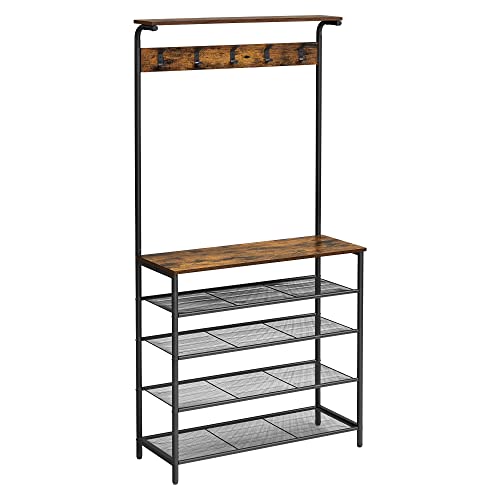
VASAGLE Hall Tree with Shoe Bench, 5-Tier Shoe Rack, 5 Dual Hooks
Included for 'Shoe Rack With Coat Hanger: Hall Tree vs Coat Stand, Hook Heights and Stability' because the listing specifies 5-Tier Shoe Rack and 5 Dual Hooks, details this guide uses to compare options.
View on AmazonHall tree with bench
A wide frame, typically 24–40 in, with a backboard or open frame holding a row of hooks, a seat at about 18 in high, and one or two shoe shelves below. Often there’s a top shelf for hats or baskets. These are the most complete solution for families but need the most floor space.
Ladder or A-frame style
Two side rails leaning against the wall with hooks along a crossbar and shoe rungs below. Light and inexpensive, but they rely on wall friction and should be fixed with a small bracket in homes with kids or pets.
Sizing: The Measurements That Matter
| Dimension | Typical range | What to aim for |
|---|---|---|
| Overall height | 65–75 in | Below any ceiling light or ceiling slope, with 6 in to spare |
| Upper hook height | 60–70 in | About 66 in for adults; long coats need hems clear of the shoe tier |
| Lower hook height (kids) | 36–48 in | A second row at 40–44 in for school bags and children’s jackets |
| Bench seat height | 17–19 in | 18 in, dining chair height |
| Shoe shelf depth | 11–15 in | 12–13 in for adult sneakers; 14 in+ for boots stored flat |
| Shoe tier spacing | 6–12 in | At least 7 in for sneakers, 14–18 in for ankle boots |
| Hook spacing | 4–8 in | 6 in or more so winter coats don’t bunch |
A key check that product photos hide: hanging length. An adult parka is roughly 30–36 in long; hung from a hook at 66 in, its hem ends around 30–36 in from the floor. If the top shoe tier or bench sits at 18–20 in, you’re fine. On short coat stands with hooks at 60 in, long coats drape over the top shoe shelf and get dirty.
How Much Does It Hold?
Each hook realistically holds one heavy coat or two light jackets. A 32 in wide hall tree with 6 hooks and two 32 in shoe shelves usually stores 6–10 coats and 6–8 pairs of adult shoes. A freestanding pole stand with 8 hooks and a 3-tier round base often holds 6–9 pairs but only 4–6 coats before the balance suffers.
Weight ratings vary widely. Budget metal stands often state 30–50 lb total on the hooks; sturdier hall trees with a solid wood or thick engineered wood backboard state 100 lb or more across the hooks and 200–300 lb on the bench. If a product doesn’t publish a hook rating, assume it’s on the low end.
Materials and Construction Trade-Offs
| Construction | Stability | Typical lifespan | Price range | Main weakness |
|---|---|---|---|---|
| Thin tubular metal pole | Low without anchoring | 3–5 years | $25–$60 | Screw-together sections loosen and wobble |
| Metal frame with particleboard shelves | Medium | 4–7 years | $60–$150 | Shelf edges swell from wet shoes |
| Engineered wood hall tree | Medium to high once anchored | 5–8 years | $100–$250 | Hook screws strip out of particleboard |
| Solid wood hall tree | High | 10+ years | $200–$600 | Heavy to move, 60–100 lb |
| Bamboo stand | Medium | 5–8 years | $40–$120 | Thin rails can split at screw points |
Look at how the hooks are attached. Hooks screwed through a backboard into a wooden rail hold far better than hooks screwed straight into the face of particleboard. Double hooks, with an upper prong for hats and a lower one for bags, add flexibility without extra width.
Which Type Fits Your Entry
| Situation | Best type | Why |
|---|---|---|
| Narrow hallway, under 44 in wide | Slim freestanding stand or ladder rack under 12 in deep | Keeps a 32–36 in walking path |
| Family with kids | Hall tree with bench and two hook heights | Kids can hang their own bags; seat for boots |
| Corner by the door | Round-base pole stand | Fits a 20 in square corner |
| Renter, no drilling | Wide-base hall tree with low center of gravity | Stable without wall anchors if shoes stay loaded |
| Mudroom with wet gear | Metal frame with slatted or wire shoe shelves | Water drains through; add a boot tray |
| Behind a door | Wall-mounted hook rail plus separate low shoe rack | Separate pieces avoid door swing conflict |
Assembly and Safety
- Box weight: pole stands usually ship at 8–15 lb; hall trees with benches at 40–80 lb, often in one long box around 70 in. Plan for two people to carry it upstairs.
- Assembly time: 20–30 minutes for a pole stand, 60–90 minutes for a hall tree.
- Anchoring: anything over about 60 in tall should be strapped to a wall stud. Hanging all coats on one side of a pole stand is the most common tip-over cause.
- Re-tighten: check bolts after the first two weeks and each season. Threaded pole sections loosen with daily use.
- Floor protection: felt pads under the feet prevent scratches on hardwood; on tile, rubber pads stop sliding.
FAQ
Is a hall tree better than separate hooks and a shoe rack?
A hall tree saves floor space and looks unified. Separate wall hooks and a low rack are more flexible, carry more weight because hooks go into studs, and fit awkward layouts like behind a door.
How do I keep a coat stand from tipping?
Balance coats on all sides, keep heavy bags on the lowest hooks, load the shoe tiers, and add a wall strap if you can. A wider base, at least 16–18 in across, makes a big difference.