Key takeaways
- Wall-mounted: needs two studs (usually 16 inches apart) or rated drywall anchors; best for renters only if the lease allows screw holes; safest for homes with toddlers.
- Freestanding: no drilling for the main body, easy to move, but must still be anchored with an anti-tip strap. A loaded tilt-out cabinet is top-heavy when two drawers are open at once, and this is the single biggest safety issue with the category.
A slim shoe cabinet for a hallway should be no deeper than 9 to 10 inches if your hallway is under 40 inches wide, and in that depth range a tilt-out (flip-drawer) design is the only style that stores adult shoes without forcing them sideways. Anything deeper than about 12 inches starts to block the walking path, swing into door arcs, and turn into a hip-level obstacle in the dark. The rest of this guide covers how to size one for your specific corridor, how many pairs each depth actually holds, and the anchoring and assembly details that matter more than the finish.
Start With the Hallway, Not the Cabinet
Most residential hallways in the US are 36 to 42 inches wide. Building codes generally require at least 36 inches of clear width for a hallway, and accessibility guidance favors keeping a 32 to 36 inch walking path clear even after furniture goes in. That gives you a simple formula: hallway width minus 32 to 36 inches equals the maximum cabinet depth you can live with comfortably.
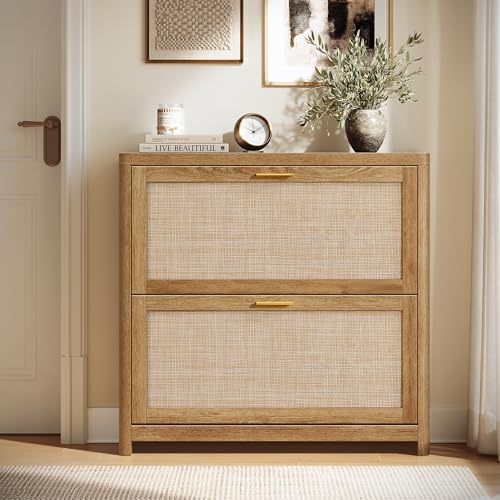
VASAGLE Boho Shoe Storage Cabinet, Slim, Rattan-Look Flip Drawers
Included for 'Slim Shoe Cabinet for a Hallway: Depths, Pair Counts and Clearance Rules' because the listing specifies Slim and Rattan-Look Flip Drawers, details this guide uses to compare options.
View on Amazon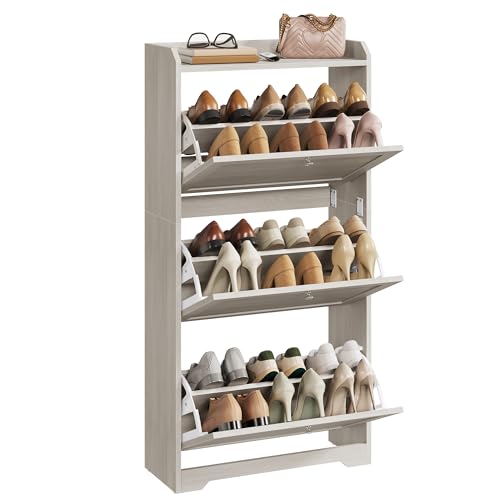
VASAGLE Shoe Storage Cabinet with 3 Flip Drawers, Slim, Holds 12‑20 Pairs
Included for 'Slim Shoe Cabinet for a Hallway: Depths, Pair Counts and Clearance Rules' because the listing specifies Slim and Holds 12‑20 Pairs, details this guide uses to compare options.
View on Amazon
VASAGLE Narrow Shoe Storage Cabinet Organizer with 2 Flip Drawers
Included for 'Slim Shoe Cabinet for a Hallway: Depths, Pair Counts and Clearance Rules' as a relevant option in this category; details come from the product listing.
View on Amazon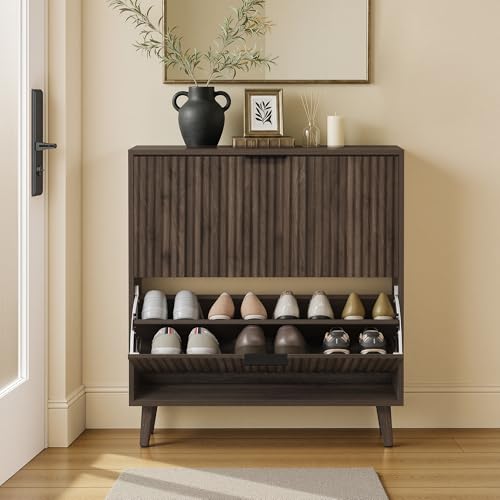
VASAGLE MAXE Collection - Shoe Storage Cabinet with 2 Flip Drawers, Freestanding Narrow Shoe Rack Organizer for Entryway, Fluted Doors, Fits 12-16 Pairs, Mid Century Modern, Walnut Brown UHSC202KF02S
Included for 'Slim Shoe Cabinet for a Hallway: Depths, Pair Counts and Clearance Rules' because the listing specifies Shoe Storage Cabinet with 2 Flip Drawers and Freestanding Narrow Shoe Rack Organizer for Entryway, details this guide uses to compare options.
View on Amazon| Hallway width | Max comfortable cabinet depth | Clear path left | Best cabinet style |
|---|---|---|---|
| 36 in | Wall-mounted only, 6–7 in | 29–30 in | Wall-hung tilt-out or shallow ledge |
| 40 in | 7–9 in | 31–33 in | Ultra-slim tilt-out, 2–3 drawers |
| 44 in | 9–11 in | 33–35 in | Standard slim tilt-out or 2-tier flip |
| 48 in+ | 11–14 in | 34–37 in | Shelf cabinet with doors or bench-height cabinet |
Measure at the narrowest point, not the middle. Radiators, door casings, light switches and baseboard heaters all steal space. Also measure the door swing of any room that opens onto the hallway: a cabinet placed within the arc of a door forces the door to stop short or scrape the cabinet top.
How Tilt-Out Cabinets Fit Shoes in 7 to 10 Inches
A tilt-out cabinet stores shoes standing nearly upright, heel down and toe up, in a hinged bin that pivots forward. Because the shoe sits at a steep angle, its length runs mostly vertically, so the cabinet only needs to be as deep as the shoe is tall at the angle it leans. That is why a 9-inch-deep cabinet can hold a men’s size 12 sneaker that is 12.5 inches long.
The limits are just as predictable. Tall boots, chunky hiking boots and high-top sneakers taller than about 6 inches at the ankle usually will not close inside a slim bin. Heels over 3 inches can catch on the bin lip. Plan on keeping boots in a separate tray or closet and using the cabinet for everyday low shoes, which is what slim cabinets do well.
Pair capacity by depth and width
| Cabinet depth | Width | Drawers | Typical capacity (adult low shoes) | Typical height |
|---|---|---|---|---|
| 6.5–7.5 in | 24 in | 2 | 6–8 pairs | 32–36 in |
| 8.5–9.5 in | 24 in | 2 | 8–10 pairs | 32–36 in |
| 8.5–9.5 in | 31–32 in | 3 | 14–18 pairs | 44–48 in |
| 9.5–10.5 in | 35–36 in | 3 | 18–24 pairs | 46–50 in |
| 12–14 in (shelf style) | 30 in | 4 shelves | 12–16 pairs | 36–42 in |
Capacity drops by roughly a third if you store mostly men’s sizes 11 and up, and rises a little for children’s shoes. A useful rule: each 24 inches of drawer width holds about three to four adult pairs per drawer.
Wall-Mounted vs Freestanding
In hallways under 40 inches, wall-mounting usually wins. Lifting the cabinet 6 to 10 inches off the floor shows more floor, which makes a corridor read wider, and it makes vacuuming and mopping easier. It also removes any risk of the cabinet tipping, since it is fixed to the wall.
- Wall-mounted: needs two studs (usually 16 inches apart) or rated drywall anchors; best for renters only if the lease allows screw holes; safest for homes with toddlers.
- Freestanding: no drilling for the main body, easy to move, but must still be anchored with an anti-tip strap. A loaded tilt-out cabinet is top-heavy when two drawers are open at once, and this is the single biggest safety issue with the category.
Every freestanding tilt-out cabinet should come with a wall strap or bracket. Use it. Open drawers shift the center of gravity forward several inches, and a narrow base has very little resistance to that.
Materials and What Wears First
| Material | Typical price range (2–3 drawer) | Strength | What fails first |
|---|---|---|---|
| Particleboard with melamine | $60–$150 | Adequate for 8–15 pairs | Hinge screws loosening from the panel; chipped edges near the floor |
| MDF with paint or lacquer | $120–$300 | Good; holds screws better | Paint wear at drawer pulls; swelling if wet boots sit inside |
| Solid wood or plywood | $250–$600+ | Excellent; repairable | Finish scuffs; seasonal sticking in humid climates |
| Metal (powder-coated steel) | $120–$350 | Very good; thin profile | Dents and scratches on the fronts; can feel cold and look utilitarian |
The weak point on any tilt-out cabinet is the pivot. Cheaper units use a simple plastic or metal pin and a small stop block; better ones use a metal hinge or a mechanism with a soft limit so drawers do not slam open. If you can, look for fronts that are at least 5/8 inch thick and pivot hardware fixed with machine screws or bolts rather than short wood screws into particleboard.
Assembly and Moving Realities
Most flat-pack slim cabinets ship in a single box weighing 35 to 70 pounds and take 60 to 120 minutes to build. The tilt-drawer mechanisms are the fiddly part: if a bin sits crooked once installed, the cause is almost always a hinge set slightly off its pre-drilled marks. Assemble the cabinet near where it will live, because a fully built 48-inch unit is awkward to carry down a narrow hallway and around corners.
If you move often, avoid gluing the back panel and keep the hardware bag. Particleboard cabinets survive one or two disassemblies; after that, cam-lock holes tend to strip.
Which Slim Cabinet Fits Your Situation
| Situation | Recommended setup |
|---|---|
| Apartment hallway under 40 in | 7–8 in deep wall-mounted tilt-out, 24 in wide |
| Family of four, 44 in hallway | Two 24 in units side by side or one 36 in three-drawer unit at 9–10 in deep |
| Renters who cannot drill | Freestanding with adhesive-free anti-tip option or a small screw-in strap patched at move-out |
| Lots of boots | Slim tilt-out for sneakers plus a separate boot tray or shelf cabinet 12+ in deep elsewhere |
| Wet or snowy climate | Metal cabinet or wipeable melamine; let shoes dry on a tray before storing |
Small Details That Make a Big Difference
- Top surface height: 32 to 36 inches works as a drop zone for keys and mail; above 44 inches it becomes a display shelf rather than a work surface.
- Ventilation: look for slots or gaps at the back of the bins. Closed bins trap moisture and odor.
- Handles: recessed or flush pulls avoid snagging bags and sleeves in tight corridors.
- Toe kick: a slightly recessed base lets you stand closer when opening the top drawer.
- Lighting: a dark cabinet in a dim hallway disappears; a light finish or a sensor light above helps prevent bumps.
FAQ
How deep is a slim shoe cabinet usually?
Most sit between 7 and 10 inches deep. Ultra-slim models go down to about 6.5 inches, and standard shelf cabinets are 12 to 15 inches deep.
Will high heels fit in a tilt-out cabinet?
Flats and heels up to about 3 inches fit in most. Stilettos and platform heels may catch on the bin edge or tip out; store them on a shelf.
Can I put a slim shoe cabinet behind a door?
Only if the door opens fully with at least 1 to 2 inches to spare and the drawers can still open past the door edge. Otherwise put it on the hinge-free wall.