Key takeaways
- Hinge side wall: the strip of wall the door folds back against. Usually only 4–6 inches of depth is usable here, enough for wall hooks or a slim tilt-out cabinet if the door has a doorstop.
- Latch side wall: often the best spot for shoe storage, since the door swings away from it.
- Walkway width: keep at least 36 inches clear between storage and the opposite wall so two people can pass and you can bring in groceries. In tight halls, 30 inches is a workable minimum.
- Floor surface: hardwood and laminate need protection from water and grit; tile is forgiving.
The best front door shoe storage combines two zones: a waterproof landing spot for wet or muddy shoes right inside the door, and closed or tidy storage a few feet away for dry everyday pairs — all placed outside the door’s swing arc so nothing blocks the entrance. Which ideas fit your home depends on how much floor you have beside the door, how many people come and go, and whether your climate brings rain, snow or mud.
First, Map the Space Around Your Front Door
A standard exterior front door is 36 inches wide and swings inward, sweeping a quarter circle about 36 inches deep. Anything placed inside that arc gets hit every time the door opens. Before choosing storage, check:

3-Tier Stackable 1" Slat Steel Frame Shoe Rack, 27.25"W x 12.75"D, Espresso
Included for 'Front Door Shoe Storage Ideas: Wet-Shoe Zones, Door Swing Clearance and Family Capacity' because the listing specifies 27.25"W x 12.75"D and Espresso, details this guide uses to compare options.
View on Amazon
HOOBRO Shoe Rack for Entryway, 5-Tier Shoe Organizer with Adjustable Mesh Shelves, 16-20 Pairs of Shoes, Spacious Floor Mount, Metal, Industrial, Shoe Shelf for Closet, Rustic Brown BF12XJ01
Included for 'Front Door Shoe Storage Ideas: Wet-Shoe Zones, Door Swing Clearance and Family Capacity' because the listing specifies 5-Tier Shoe Organizer with Adjustable Mesh Shelves and 16-20 Pairs of Shoes, details this guide uses to compare options.
View on Amazon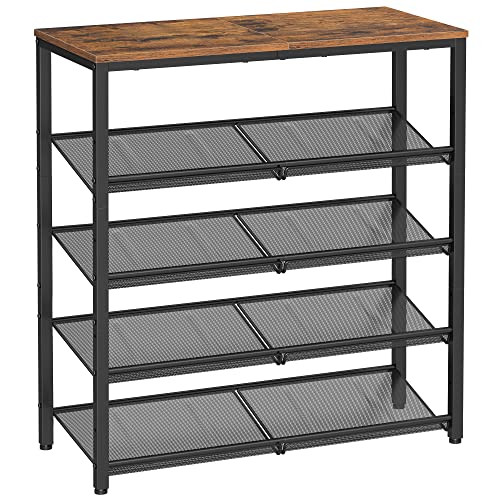
VASAGLE 5-Tier Shoe Rack, Adjustable, Freestanding
Included for 'Front Door Shoe Storage Ideas: Wet-Shoe Zones, Door Swing Clearance and Family Capacity' because the listing specifies Adjustable and Freestanding, details this guide uses to compare options.
View on Amazon- Hinge side wall: the strip of wall the door folds back against. Usually only 4–6 inches of depth is usable here, enough for wall hooks or a slim tilt-out cabinet if the door has a doorstop.
- Latch side wall: often the best spot for shoe storage, since the door swings away from it.
- Walkway width: keep at least 36 inches clear between storage and the opposite wall so two people can pass and you can bring in groceries. In tight halls, 30 inches is a workable minimum.
- Floor surface: hardwood and laminate need protection from water and grit; tile is forgiving.
How Much Storage Does Your Household Need?
Plan for the pairs that live at the door, not the whole collection. A common rule is two pairs per adult and one to two per child at the entry, with seasonal boots added in winter.
| Household | Everyday pairs at the door | Winter boots | Shelf length needed (adult pair ~ 7–8 in wide) |
|---|---|---|---|
| 1–2 adults | 3–4 | 2 | 24–36 in on one or two tiers |
| 2 adults + 1 child | 5–6 | 3 | 36–48 in |
| Family of 4 | 7–8 | 4 | 48–60 in or a 3-tier rack |
| Family of 5–6 | 10–12 | 5–6 | Cubbies or a 4–5 tier tower plus a boot tray |
Children’s shoes take about 5–6 inches of width; adult boots take 8–10 inches of width and 14–20 inches of height for tall styles.
Ideas for Wet, Muddy and Snowy Shoes
Boot tray as the first stop
A rubber or plastic boot tray with raised edges catches melting snow and mud. A common size is about 30 x 15 inches, holding three to four adult pairs. Rubber trays stay flexible in cold air and grip the floor; rigid plastic trays are cheaper but can crack with age.
Tray plus river stones
A tray filled with a layer of smooth stones keeps soles elevated above meltwater so shoes drain and dry faster. The stones can be rinsed outside.
Slatted bench over a tray
A bench with an open slatted lower shelf set over a boot tray gives you seating to pull boots on and lets water drip through. Bench seats are typically 17–19 inches high, the same as a dining chair.
Shoe bin for front door clutter
A wide, low bin — 6–8 inches tall — is the quickest landing spot for kids who kick shoes off. Choose a washable plastic or rubber bin for muddy shoes, or a lined woven bin for dry pairs. One 24 x 14 inch bin holds roughly five to six kids’ pairs tossed in.
Ideas for Dry Everyday Shoes
Slim tilt-out shoe cabinet
Tilt-out cabinets are often only 7–10 inches deep and store shoes at an angle, which suits narrow halls where a regular 12–14 inch deep rack would crowd the walkway. A two-compartment unit holds about 8 to 12 pairs. Anchor it to the wall; tilt-out doors shift the weight forward when opened.
Open tiered rack
A two- or three-tier open rack 12–14 inches deep is cheap and lets shoes air out. Bamboo and metal racks are the common choices. Expect around 3 pairs per tier on a 26–28 inch rack.
Cubbies under a coat area
Coat and shoe storage combined is efficient: hooks at 60–66 inches for adults and 36–48 inches for children, with a cubby bench below. Cubbies are usually about 12 x 12 inches, holding one pair of adult sneakers or two pairs of kids’ shoes each.
Over the door storage
Over the door shoe organizers work on a coat closet door next to the entry, not usually on the front door itself, because exterior doors are often thicker (1 3/4 in) and weather-stripped tightly, so hooks can stop the door sealing. A closet-door pocket organizer holds 12 to 24 pairs of flats or kids’ shoes.
Comparing the Main Options
| Option | Depth from wall | Typical capacity | Handles wet shoes? | Typical price |
|---|---|---|---|---|
| Boot tray | 15 in | 3–4 pairs | Yes | $15–$40 |
| Shoe bin | 12–14 in | 4–6 pairs loose | If washable | $15–$40 |
| Tilt-out cabinet | 7–10 in | 8–12 pairs | No | $80–$250 |
| Open 3-tier rack | 12–14 in | 9 pairs | Bottom tier only, with a tray | $20–$60 |
| Cubby bench | 13–16 in | 6–12 pairs | Only with liners | $100–$300 |
| Wall-mounted shoe shelves | 4–7 in | 2–3 pairs per shelf | No | $30–$90 |
Front Door Shoe Storage for Small Spaces
- No entry hall at all: a boot tray plus a wall-mounted shoe shelf above it uses about 15 inches of floor depth in total.
- Door opens straight into the living room: use a low bench or console on the latch side to define an “entry” and hide shoes in baskets beneath it.
- Apartment with a shared corridor: keep storage inside. A tall, narrow cabinet (about 20 in wide) stores 15+ pairs vertically.
- Stairs near the door: a basket on the bottom step is a trip hazard; use wall shelves on the stair wall instead, mounted at least 6 inches clear of the handrail.
Practical Habits That Make Any Setup Work
- Set a per-person limit — two pairs at the door — and move the rest to bedroom closets weekly.
- Rotate boots in spring: wash, dry fully and store them in a closet or under the bed.
- Put a washable mat outside and an absorbent mat inside; together they remove most grit before it reaches the floor.
- Give each child their own bin or cubby with a label so shoes land in the same place every time.
- Leave a small gap behind racks and cabinets so damp shoes can air out and odors do not build up.